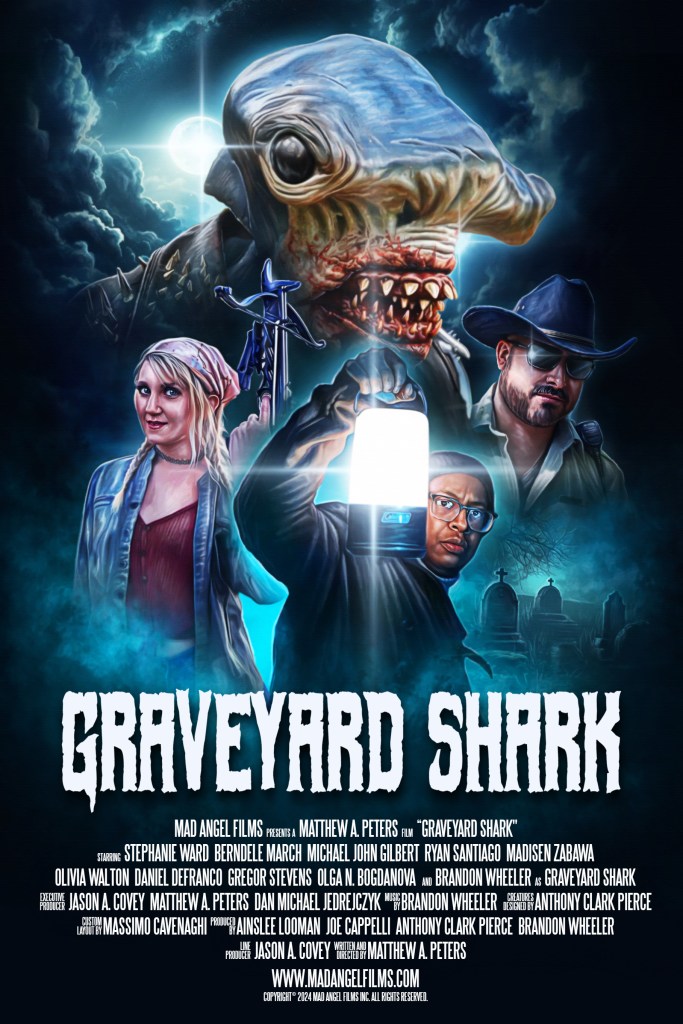
Starring Stephanie Ward, Michael John Gilbert, Berndele March, Ryan Santiago, Madisen Zabawa, Olivia Walton and Olga N. Bogdanova. Written and directed by Matthew A. Peters. Produced by Joe Cappelli, Avery Guerra, Ainslee Looman, Anthony Clark Pierce, Brandon Wheeler, Sifundo Nene and Brandon Wheeler. Mad Angel Films
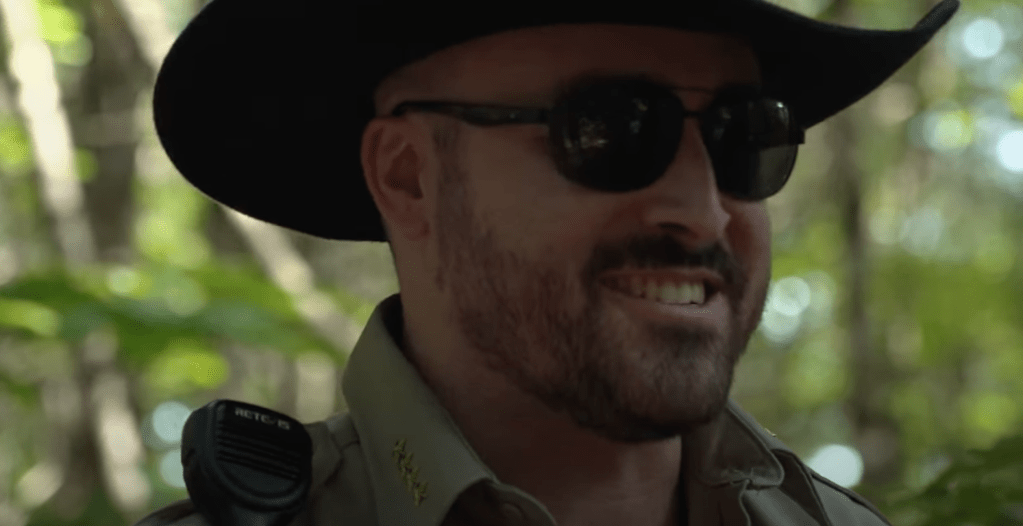
A toothy humanoid creature known as the Graveyard Shark is said to be responsible for the disappearances of various people in the backwater town of Willsboro Point. Abby Wescott (Ward), a wannabe cryptid hunter, is called in to uncover the bloody truth behind these events. Accompanied by her assistant Greg (Gilbert), Abby eventually teams-up with local oddball Captain Seyburn (March) and members of a Graveyard Shark survivors counselling group. Even though the local shades-wearing sheriff (Santiago) says that the Graveyard Shark is just some local folklore nonsense, the critter proves to be all too real when it bloodily attacks a busty, tattooed female deputy whilst she’s enjoying a sex session with her colleague near the latest crime scene! Abby and her allies finally face-off against the creature (one of the counselling group women actually gets it on with the brute!), and the identity of the person who has been secretly helping the blue-skinned beast is revealed…
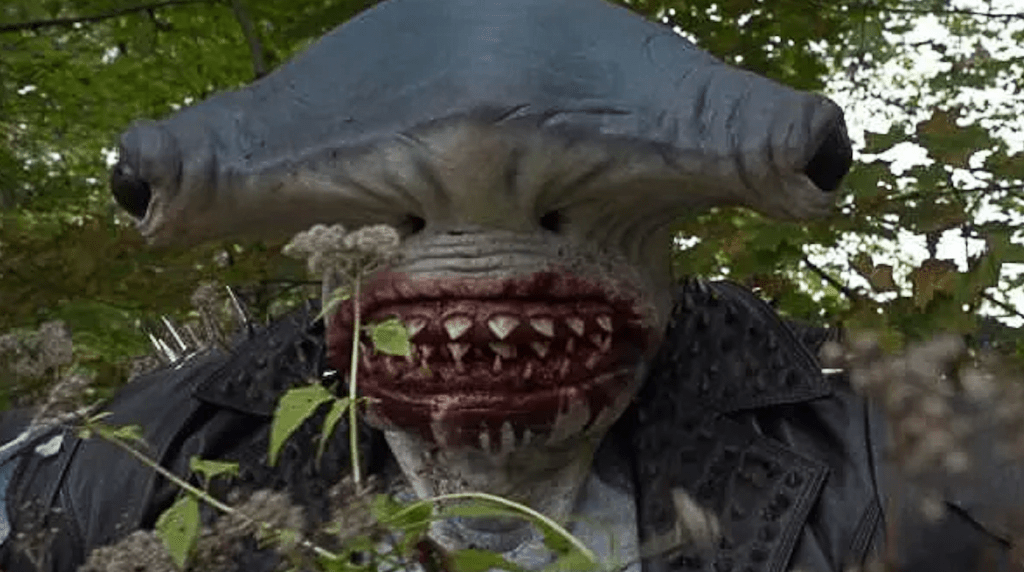
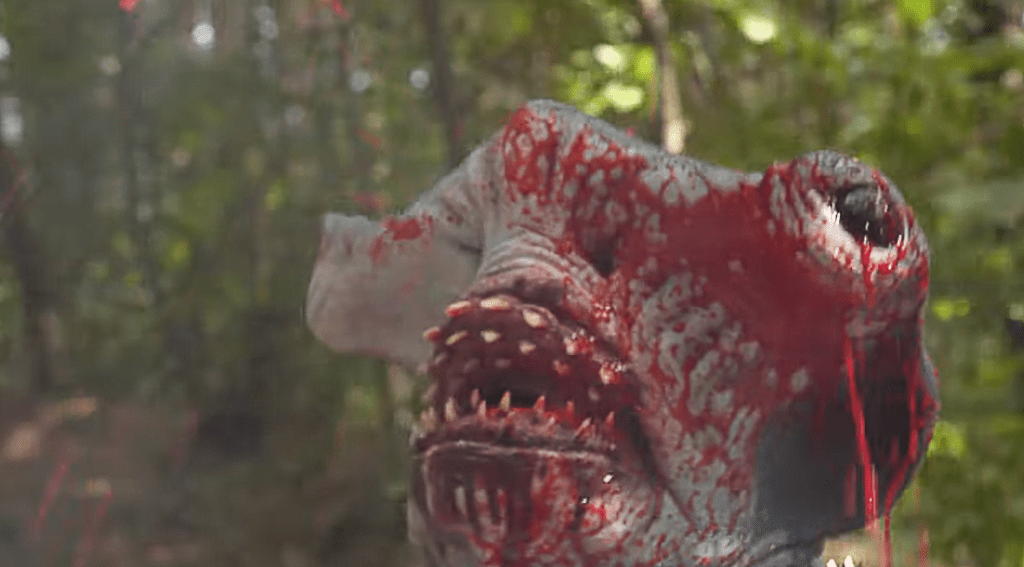
Graveyard Shark stalks through the foliage
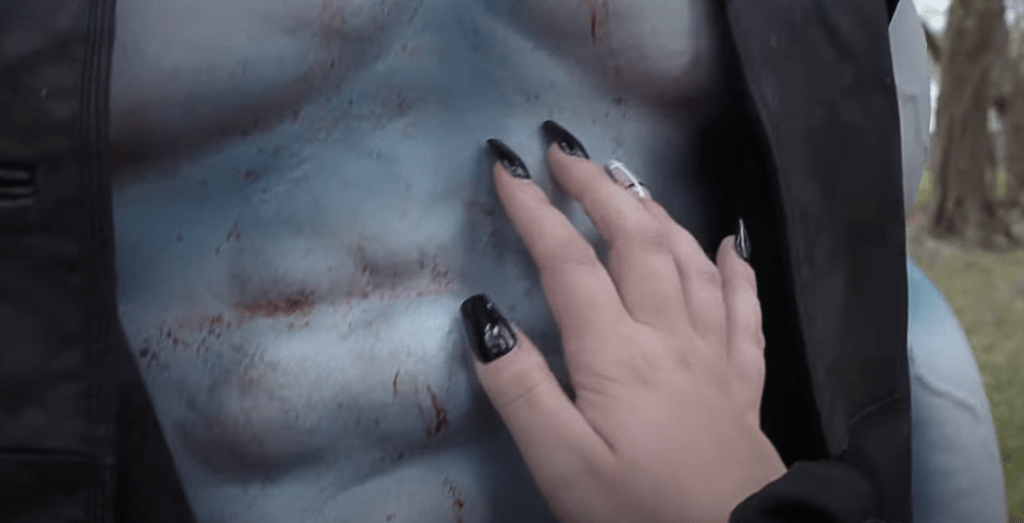
One of the characters strokes Graveyard Shark’s abs…
GRAVEYARD SHARK is a movie that most definitely doesn’t take itself seriously. The folks behind this knew (I hope) what their limitations were, so they proceeded to deliver a film full of dumb humour, copious amounts of spraying blood, stupid dialogue, boobs and a big beast.
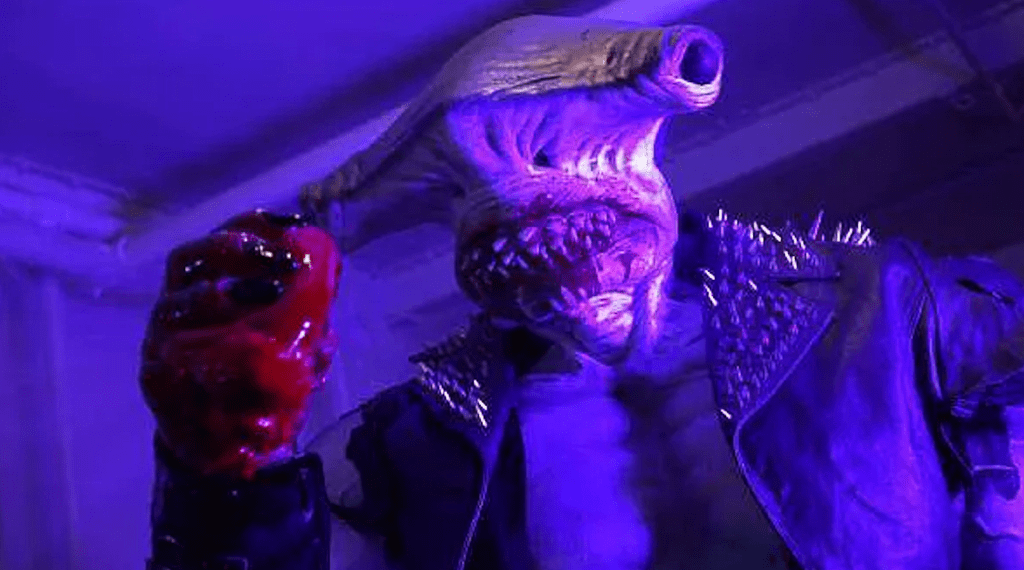
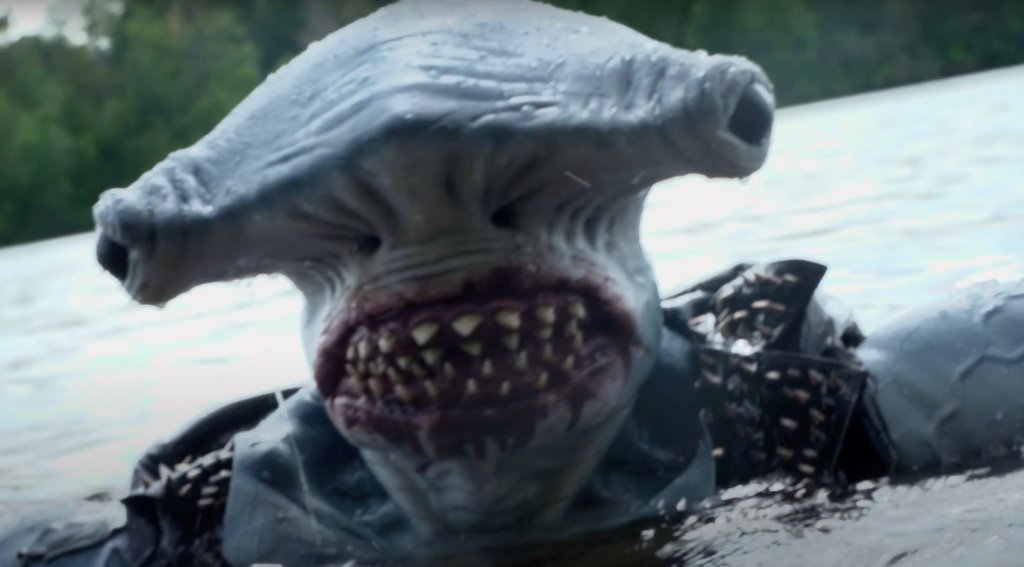
The hammer-headed mutant rips out a human heart!
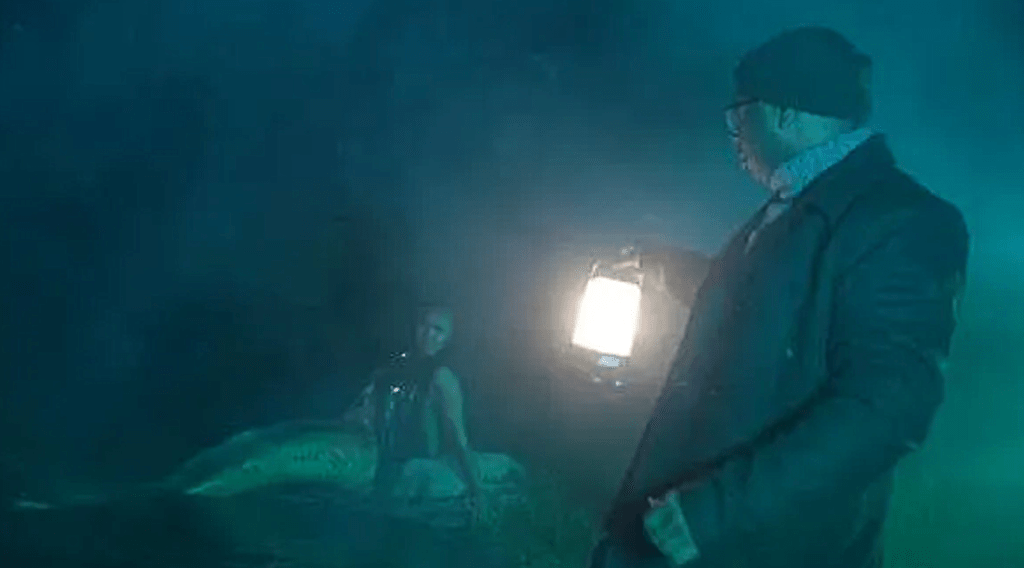
The film’s lighting and cinematography is on par with the general acting quality, which is to say that it’s all strictly amateur hour level. And yet… the filmmakers are obviously having fun, and this adds to the viewing experience. So, when we get the creature’s origin story, we can be sure that it will be a really stupid, stupid, stupid (but fun) origin story! You see, this muscled monster is the result of a union between eccentric loner Captain Seyburn… and a mermaid of colour that Seyburn encountered in a swamp! The whole backstory is explained to Abby as she sits with Seyburn in a diner. Seyburn describes, with the help of flashbacks, how he met a ‘fine-ass mermaid’ and they had comical intercourse which seemed to consist of Seyburn just grinding his groin against the underside of the mermaid’s tail. As Seyburn climaxes in his flashback, the film cuts to a shot of him in the diner, pouring melted butter all over a cooked lobster. Subtle this ain’t!
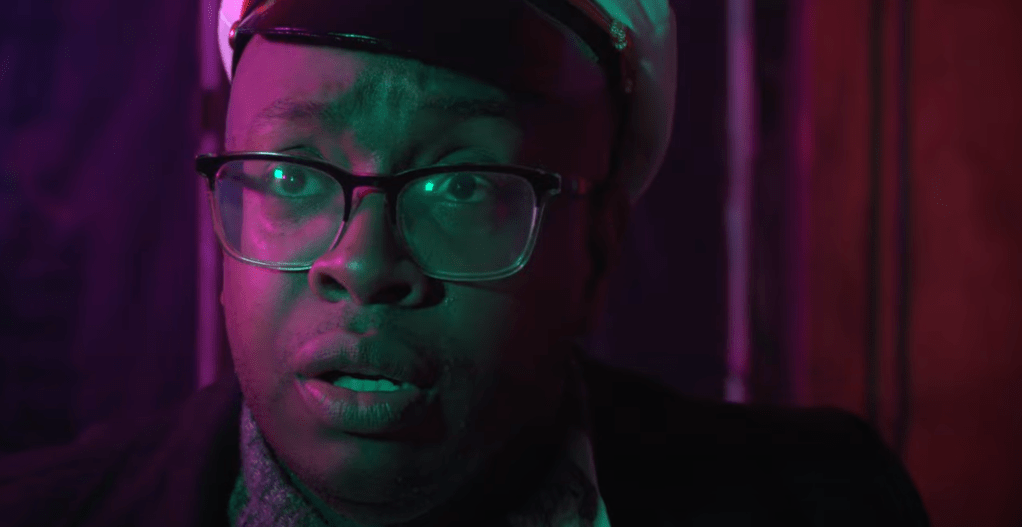
Captain Seyburn (Berndele March) talks with Abby…
…and he divulges what happened when he met a mermaid in a swamp
Abby learns from Captain Seyburn that the mermaid had returned with a love child, asking him for money to raise their lil’ shark-headed nipper, but Seyburn killed the siren with a shovel instead, burying her and the baby in the cemetery. But, somehow, the tiny mutant shark had clung to life and now it dwells in the graveyard…
Don’t trust this dude
This film really is a dumbass nonsense-fest, with such silly scenes as a dream sequence in which Abby gets high and romps in bed with a bigfoot, who is actually Greg in a costume. But I felt compelled to keep watching anyway, in large part because the movie’s titular monster is brought to the screen via the old school method of using a monster suit!
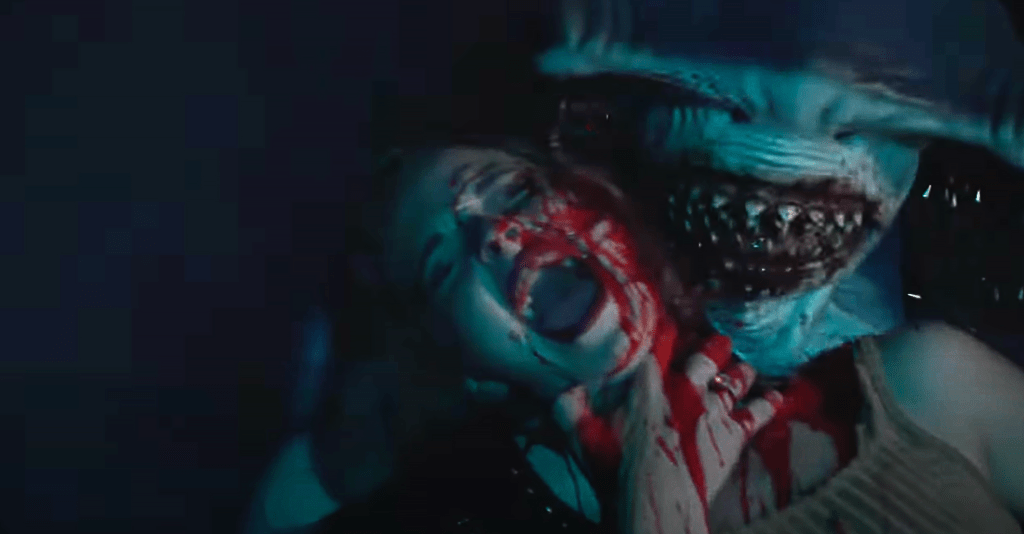
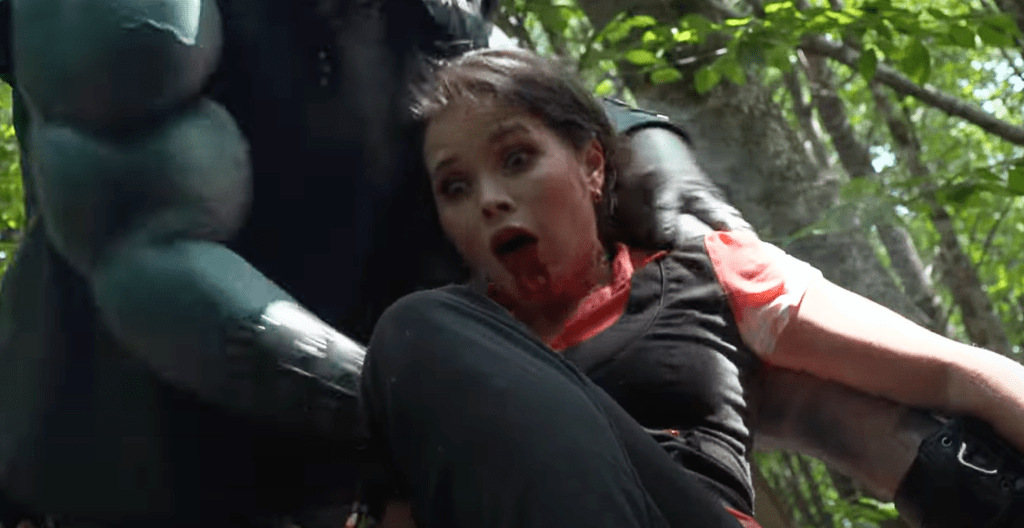
Graveyard Shark claims a victim!
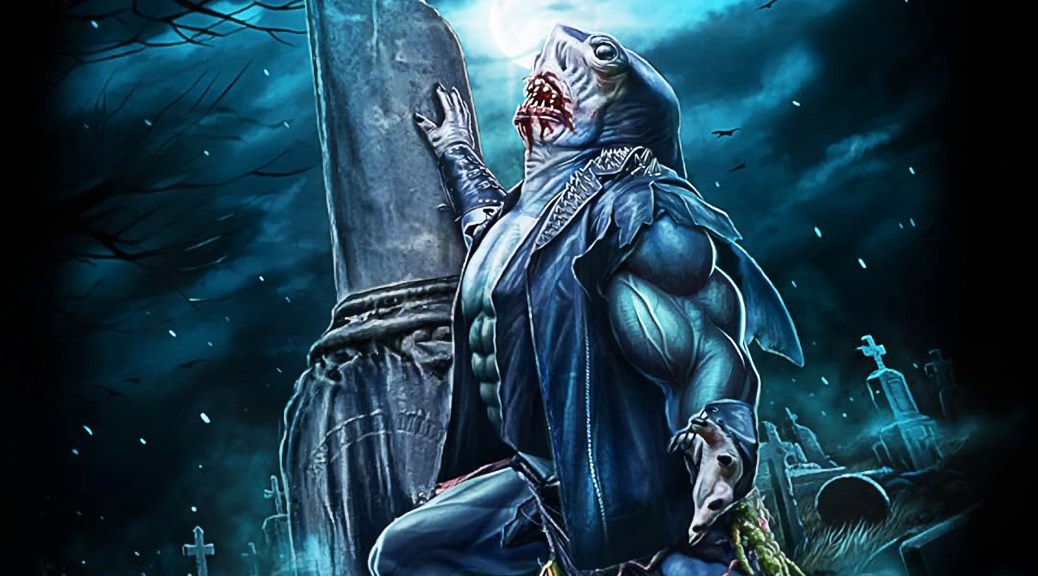
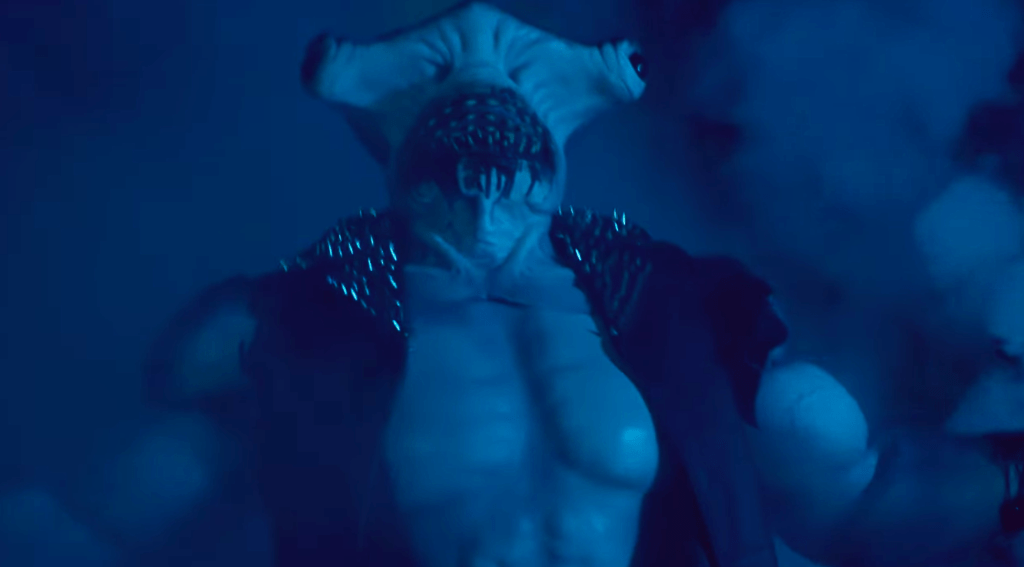
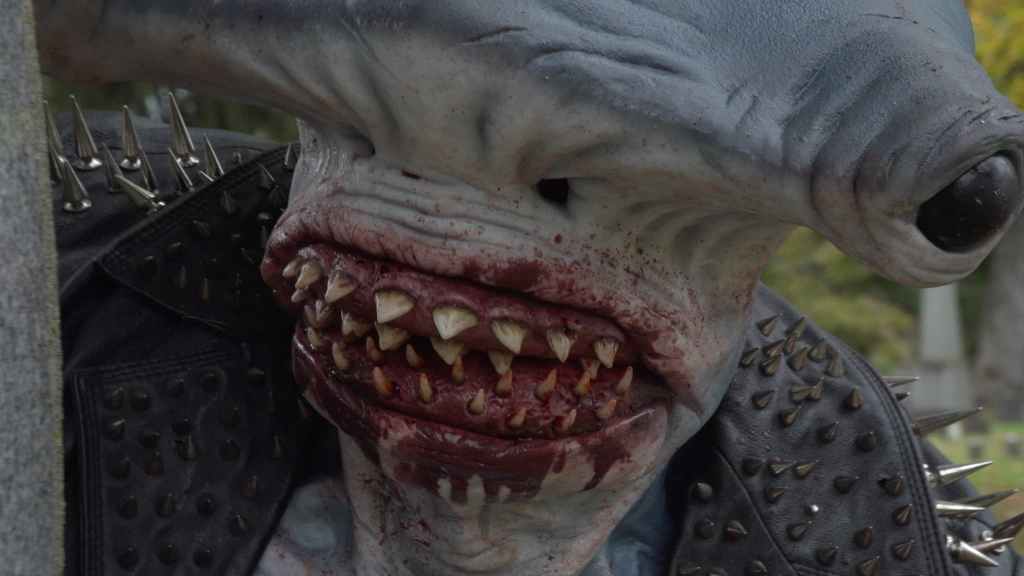
The Graveyard Shark creature has a buff, musclebound humanoid body that is topped with a toothy hammerhead shark face! I’m just a sucker for practical effects creatures, even when it is a cartoony, cheesy-but-cool costume like this one! This hammer-headed fishy freak, designed by Anthony Clark Pierce, is far preferable to the sub-par CGI effects seen in most low-price b-movies of a similar budget, that’s for sure.
This monster looks like he’s been down the gym!
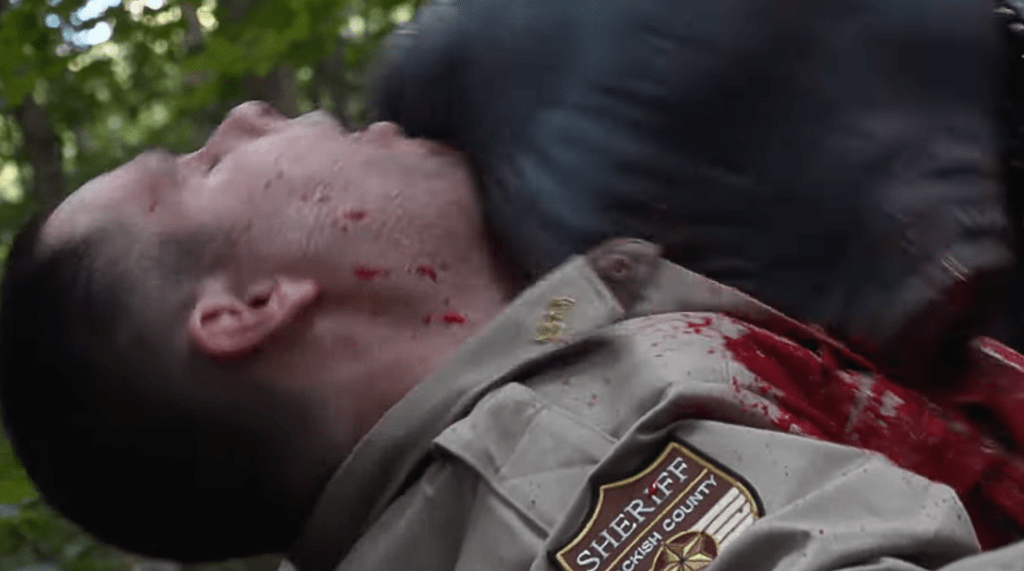
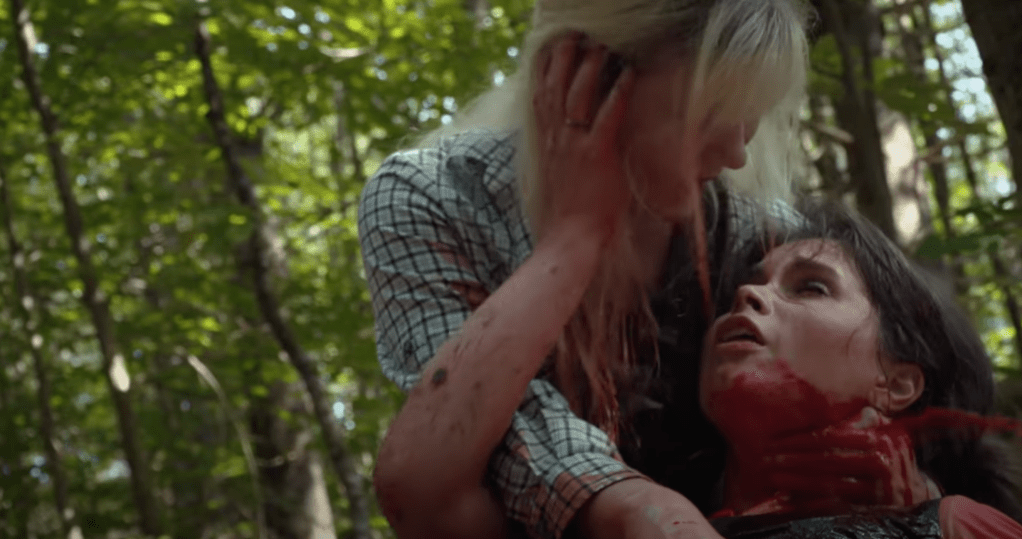
Many of the monster attacks are shot in a very similar fashion, with the suitmation actor (Brandon Wheeler) shoving the costume’s shark head against the current victim’s neck, as blood is pumped everywhere. Though the results are samey, they are bloody, and there’s the occasional disembowelment of a victim added to the mix too.
A cop gets ripped up!
Counsellor Dr. Jan Lovnik (Olga N. Bogdanova) is disemboweled!
GRAVEYARD SHARK is, without a doubt, a shoddy, cheapo production, which leaps at any chance to include some nekkid flesh and includes a lot of crass ‘humorous’ chat about going down on mermaids. But the film does end with a fight between the rubbery Graveyard Shark and a fuzzy werewolf! Yes, you read that correctly: it turns out that Greg is actually a man-wolf! This monster suit showdown is slapdash and, of course, pretty enjoyable, with the werewolf costume’s yellow-green eyes glowing so brightly they sometimes look like twin torch beams shining in the mist! So I kinda liked this flick anyway – sue me!
Zachary Knighton is pretty good in the role of gang boss Duncan
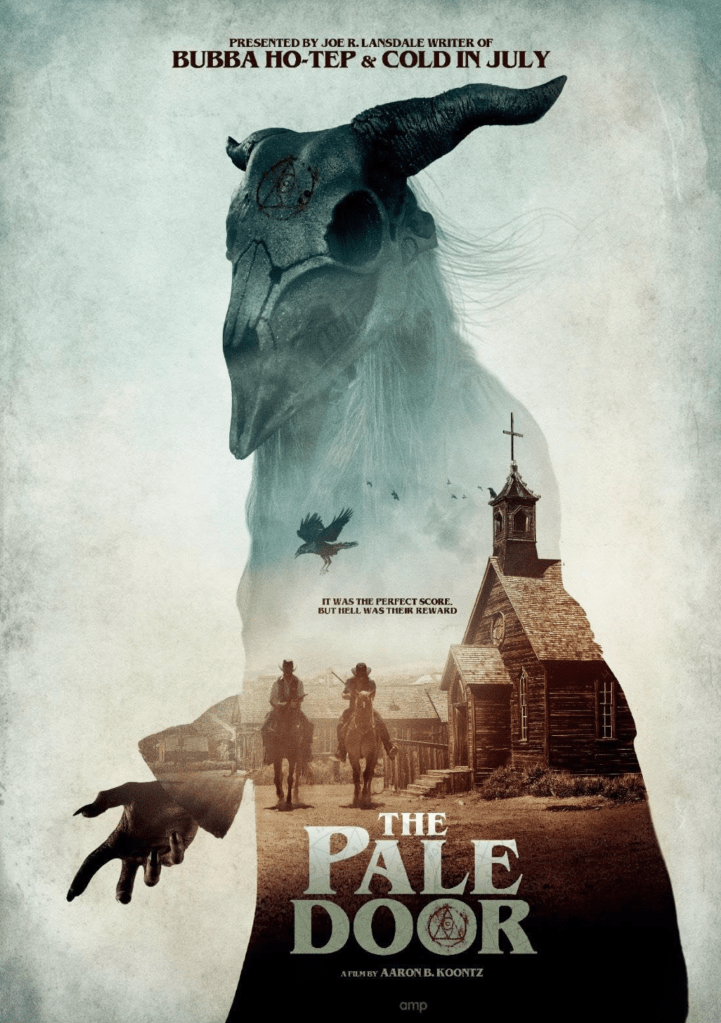
Starring Zachary Knighton, Devin Druid, Stan Shaw, Bill Sage, Melora Walters, Noah Segan, Pat Healy, Tina Parker, Natasha Bassett, Darryl Cox and Jennifer Rader. Written by Cameron Burns, Aaron B. Koontz and Keith Lansdale. Directed by Aaron B. Koontz, produced by Cameron Burns, Roman Dent and James Norrie. Paper Street Pictures/Storyteller Media/BondIt Media Capital/Title Media.
‘It was the perfect score, but hell was their reward’
After a member of his gang dies during a gun duel, Duncan (Knighton) begrudgingly allows his nice guy brother Jake (Druid) to make up the numbers for an upcoming train robbery. The outlaws (rather ruthlessly) kill all the Pinkertons guarding a locked chest in one of the carriages… but there’s no cash or gold inside it, instead there’s a young woman called Pearl (Bassett). This girl explains that she was abducted, and she tells the gang there’ll be a big reward if they take her back home, to a place called Potemkin. The outlaws decide this is the only way they can make any money now, so they head for this out of the way township. But they need to hurry, as their leader Duncan has been badly wounded and he’s in urgent need of medical attention. Once they do reach Potemkin, the place seems to be deserted at first, but Pearl leads the outlaws to a brothel, which is packed with friendly prostitutes. But these working ladies are not what they seem to be…
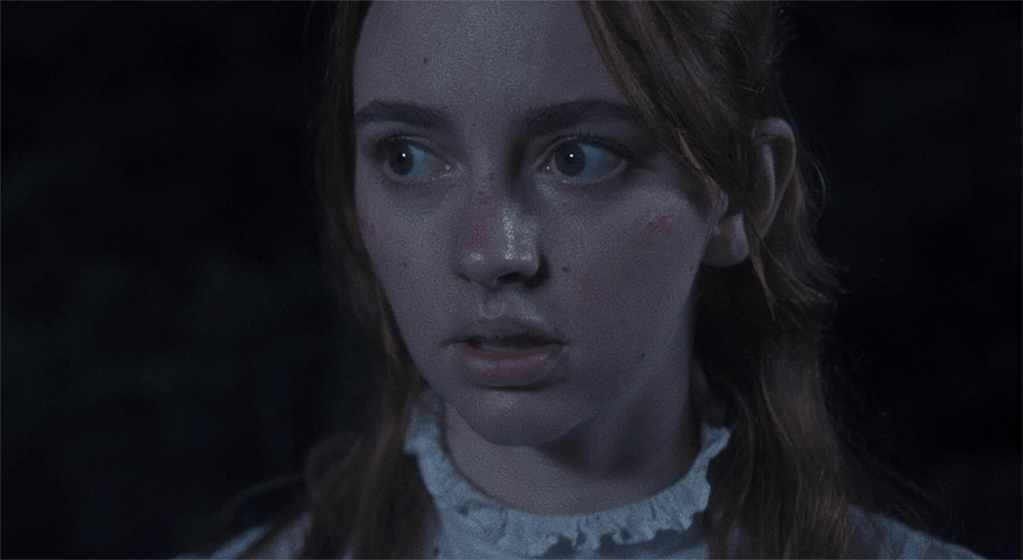
Natasha Bassett plays Pearl
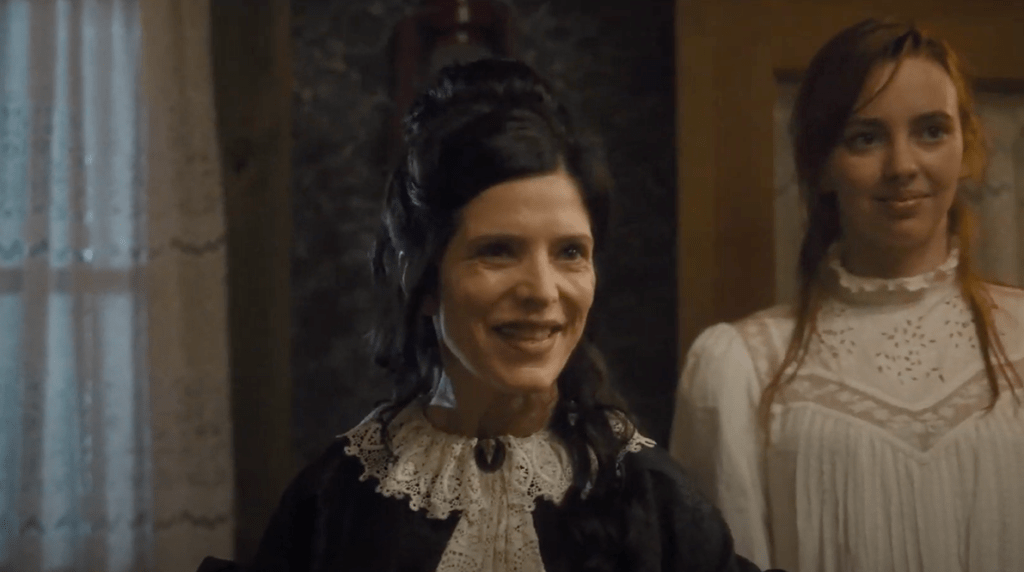
The brothel’s madam, Maria (Melora Walters), is Pearl’s mother
THE PALE DOOR really struggles at the beginning to properly paint a convincing picture of the time and place the story is meant to be set in. There’s a one-on-one gunfight scene, for instance, that in no way looks like it’s happening back in the late 1800s. It actually resembles something you’d see at a wild west historical re-enactment event. It just ain’t very convincing, pardner. I’m assuming that cash was really tight during the filming of these earlier sequences, but the filmmakers must’ve gotten themselves a little more money later on, as the movie does improve if you stick with it.
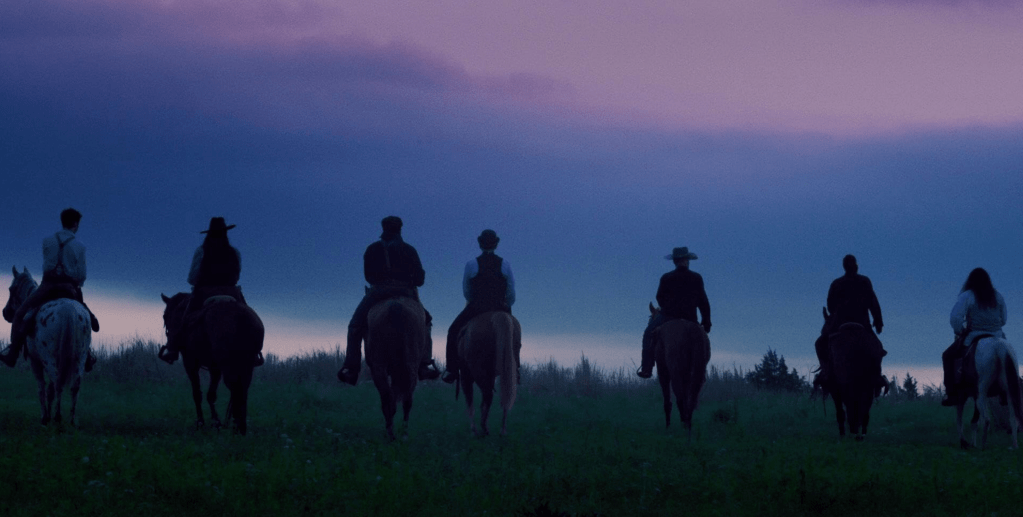
This is a nice shot
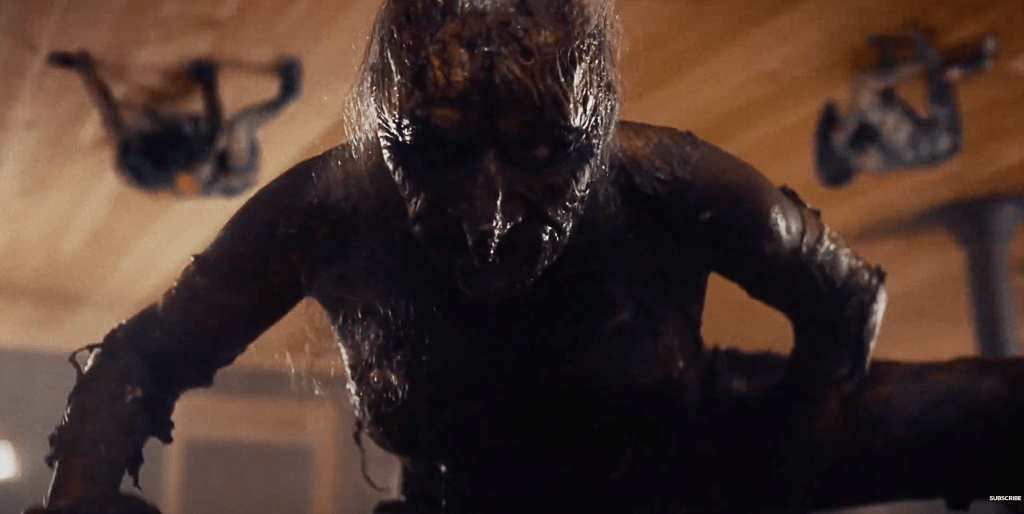
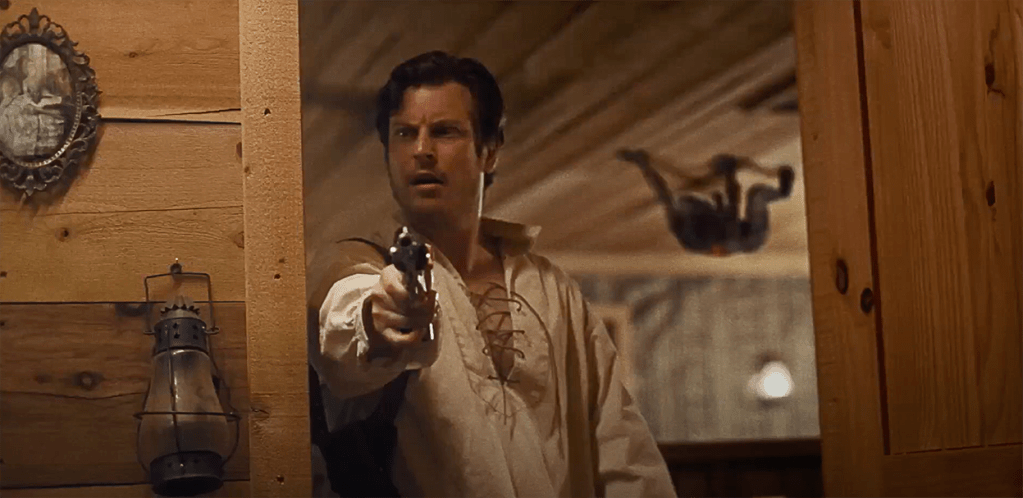
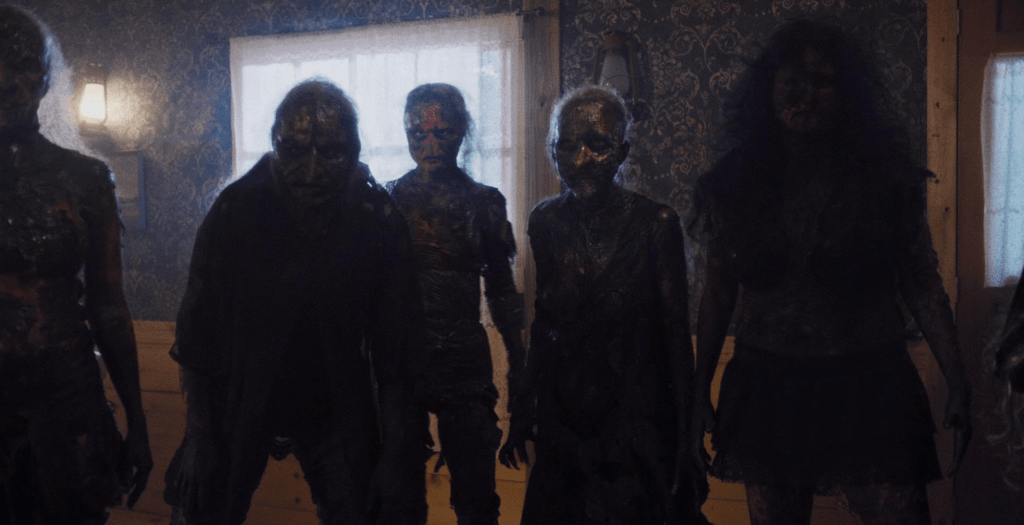
And the point at which the enjoyment levels of this film ratchet upwards occurs when the secret of Potemkin (which is kind of like a horror film version of Brigadoon) is finally revealed: all the feminine denizens of the brothel are, in actuality, ancient witches! And they’re not just your normal, average witches – these are blackened-skinned, crone-faced, scampering hags. They’re great! These hook-nosed, pointy-chinned occult harridans can defy gravity as they scuttle upside down on the ceiling, they frequently zip about in an animalistic fashion on all fours, and bullets don’t seem to keep ’em dead for long!
Witches on the loose!
Hey, dude, there’s an undead hag on the ceiling behind you!
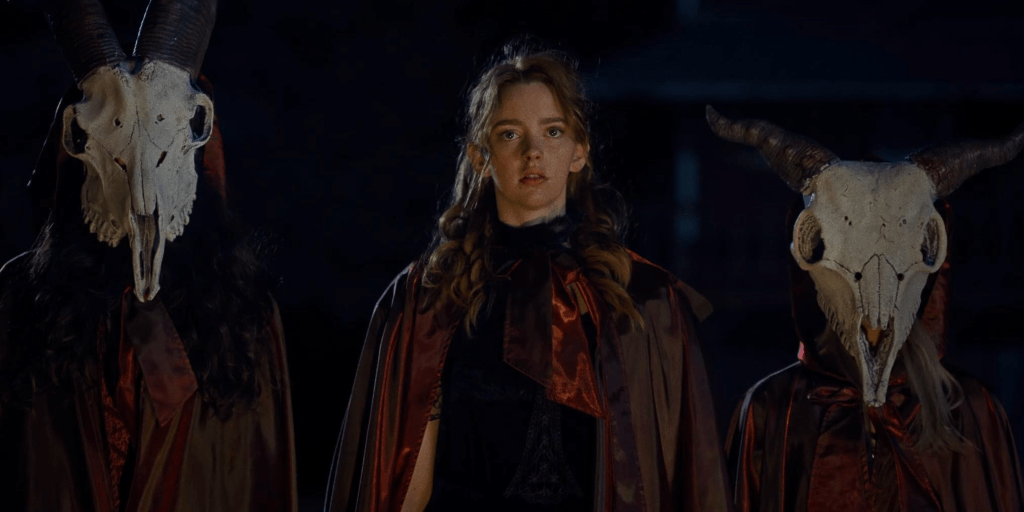
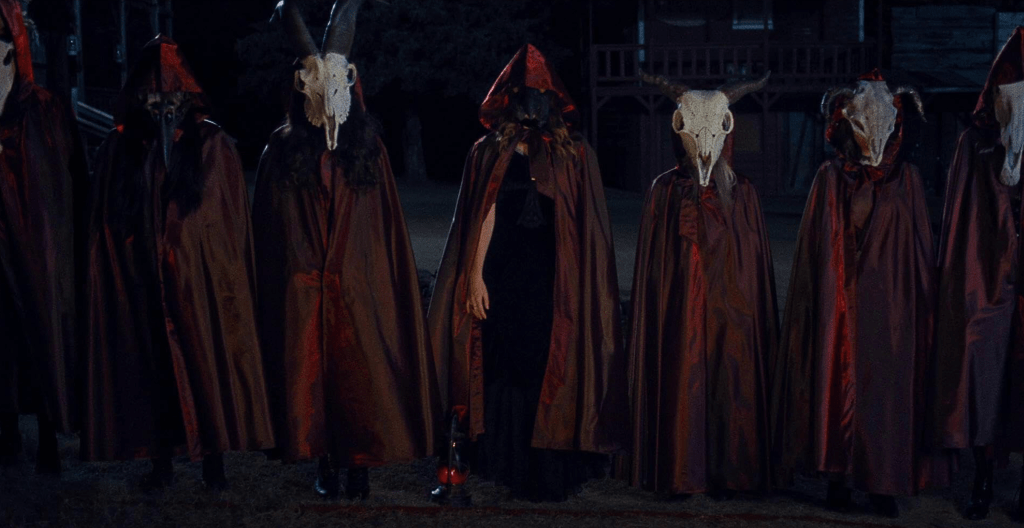
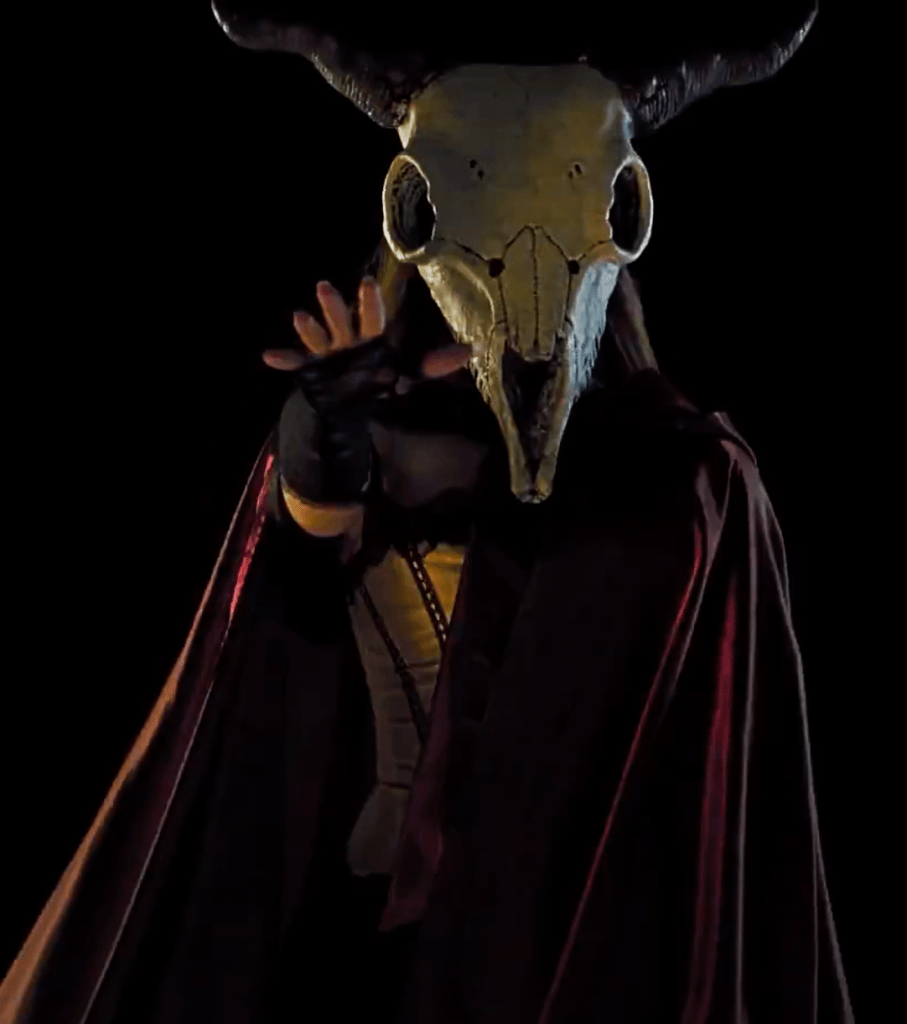
With better direction from Aaron B. Koontz, and an injection of additional funding, THE PALE DOOR might have had a chance of becoming a much more memorable horror-action-western. Maybe my expectations had been set higher than they should’ve been because I’d spotted Joe R. Lansdale (BUBBA HO-TEP, COLD IN JULY) credited as one of the film’s executive producers, though perhaps he was involved in view of the fact his son Keith is one of the writers. As it is, the quality of the acting varies a lot (Devin Druid has a cool-sounding name, but his thespian skills ain’t so hot), and better lighting in some of the scenes definitely would’ve helped matters. But, hey, the film (which was partly shot in Rollins Creek Old West Town, located outside of Guthrie, Oklahoma) does manage to gradually become better and better as it progresses, thanks to a satisfying score from Alex Cuervo, the inclusion of folk horror-style costumes that mix long cloaks with a variety of horned animal skulls, and a novel death scene involving a crow emerging beak-first from a victim’s bloody mouth.
Above: a couple of shots of the witches kitted out in their folk horror-style gear
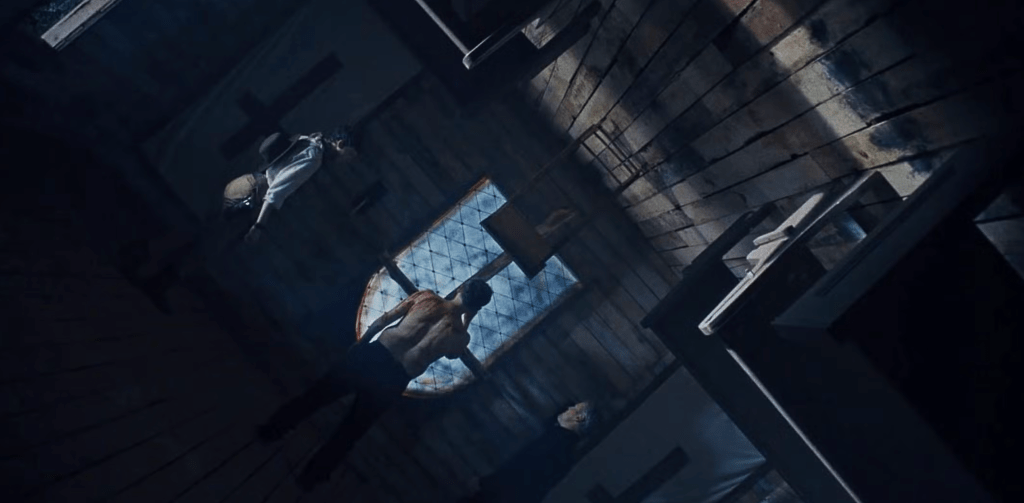
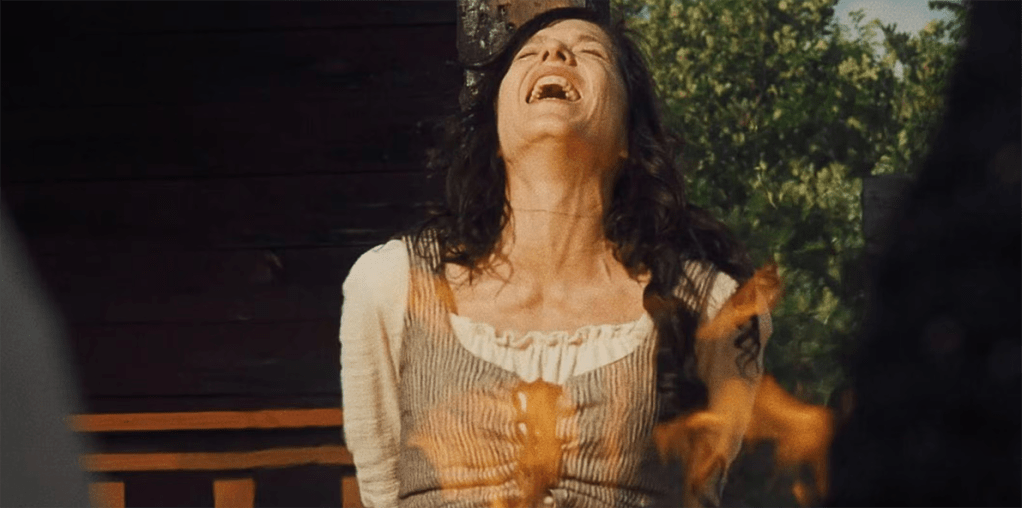
There’s a topsy-turvy sequence in a church, which involves one of the outlaws being mysteriously compelled to mutilate himself, a fleeting deluge of blood, plus several Puritan-era flashbacks, and two burning-at-the-stake scenes (which are obligatory for witch-themed flicks, right?)
The cool, off-kilter church scene
A witch-burning flashback
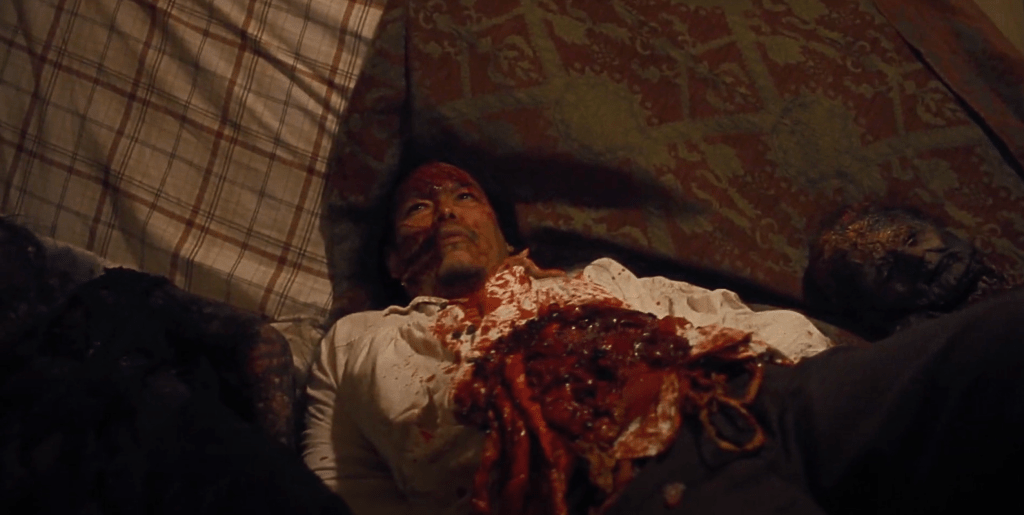
Disemboweled in the bordello!
The way in which the gang members brutally murder the Pinkerton detectives during the locomotive robbery (including some spurs-in-the-mouth violence) hardly makes these people an appealing bunch to root for (only Jake is not a die-hard killer), but attempts are made to garner sympathy for the outlaws once they come under threat in Potemkin, and some of the heartfelt melodrama between brothers Duncan and Jake featured in the film’s later stages is not totally without merit, aided as it is by Cuervo’s music. But, let’s be honest, it’s definitely the confrontations with the swarms of grimy, raggedy, semi-undressed, burnt-bodied witches that are the standout portions of this production, including one shot where a witch lurches out of a puddle of blood during a downpour. The outlaws-vs-witches-in-a-brothel set piece is without doubt the movie’s best sequence, so lets spare a moment to acknowledge the contributions made by Krista Perry, Shannon Beshears and Jennifer Rader: they were the film’s ‘Stunt witches’!
Above: two shots of the wicked witches
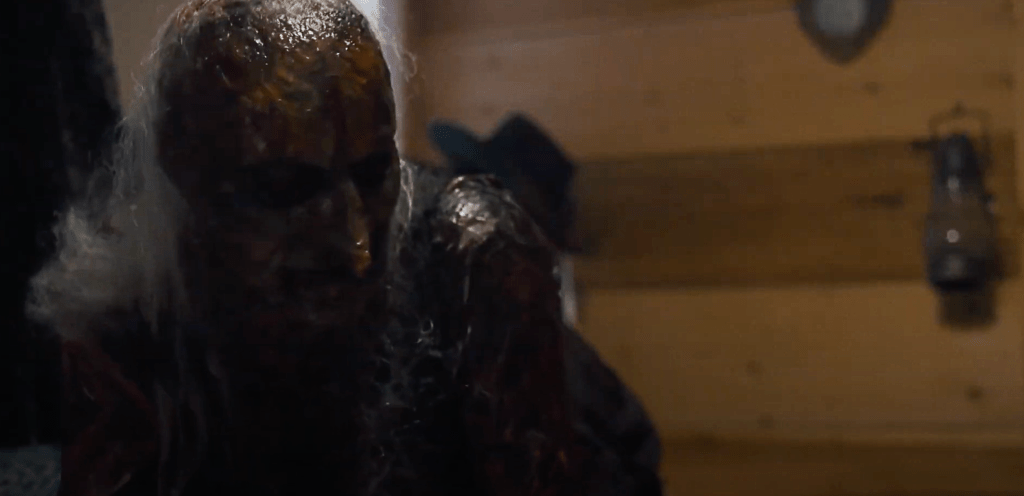
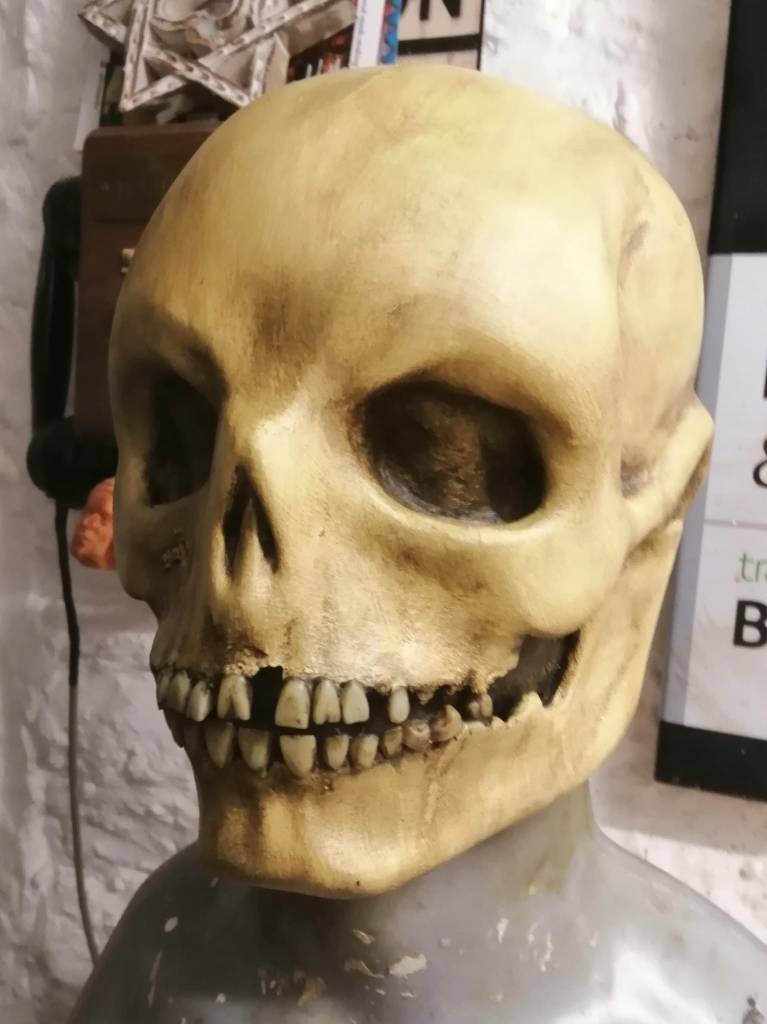
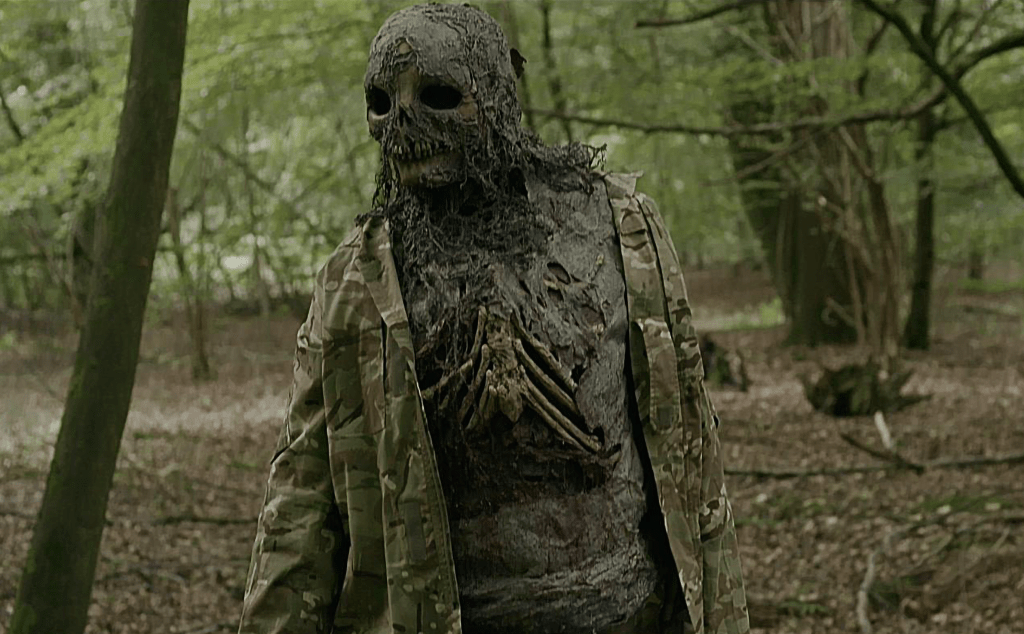
Let’s finish with another look at one of the skull-faced costumes worn by the witches…
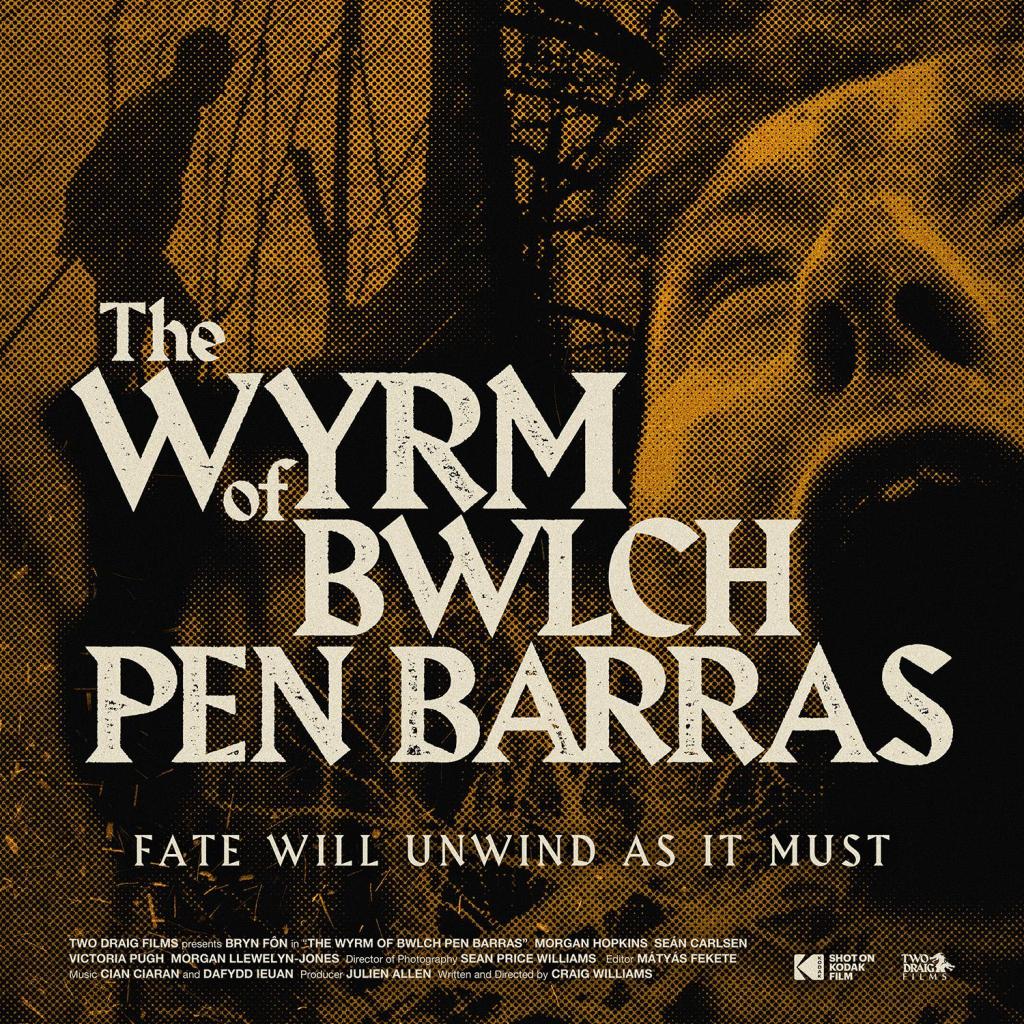
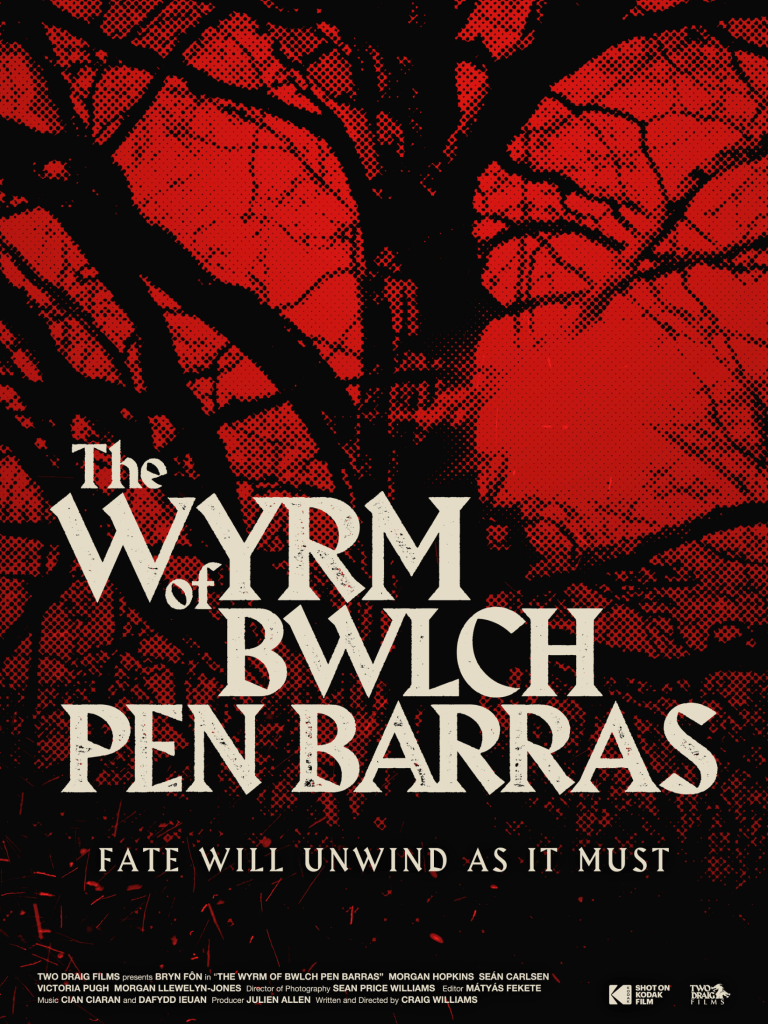
Starring Bryn Fôn, Morgan Hopkins, Sean Carlsen, Victoria Pugh and Morgan Llewelyn-Jones. Written and directed by Craig Williams. Produced by Julien Allen for Two Draig Films.
‘Fate will unwind as it must’
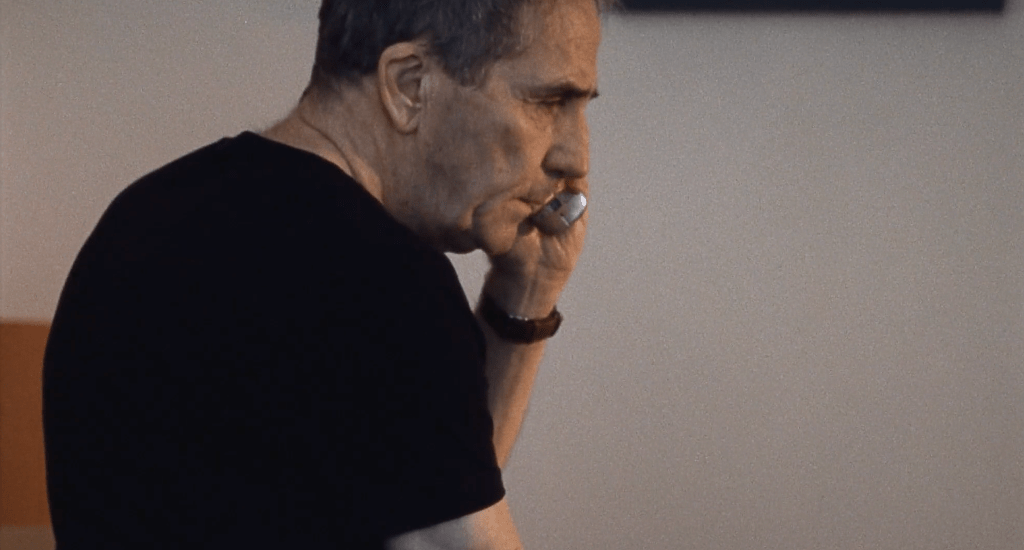
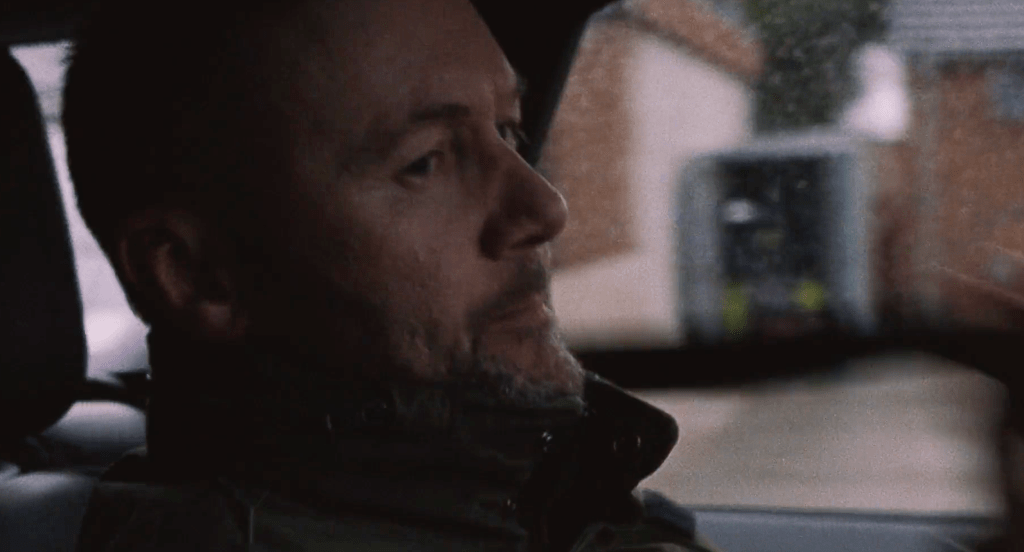
When Gwyn (Fôn) gets an early morning phone call, it’s obvious he is being informed about something that is serious, and it’s also clearly an occurrence that has happened before. What seems to concern Gwyn and his wife Anwen (Pugh) most is the fact that this event has started sooner this time around..
Gwyn gets an unwelcome call
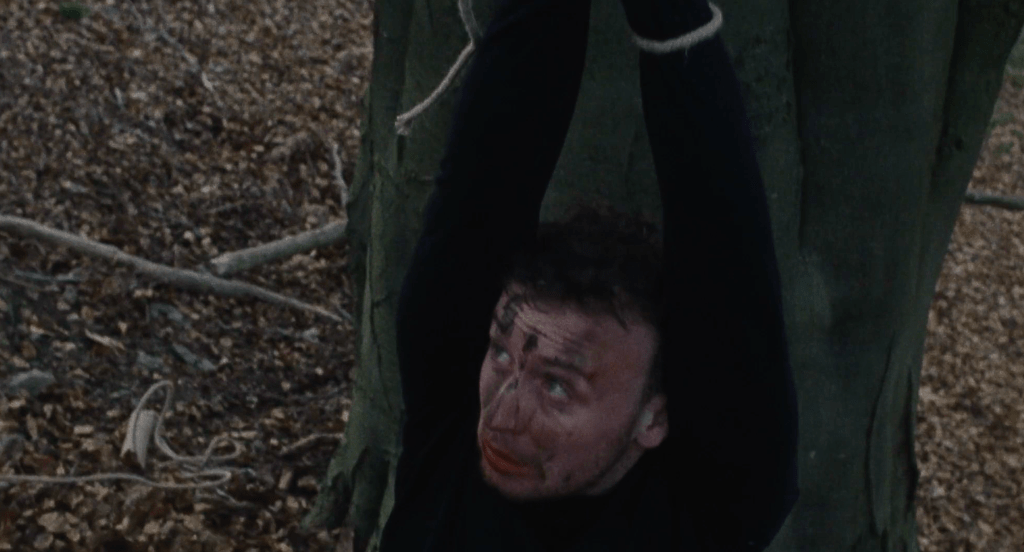
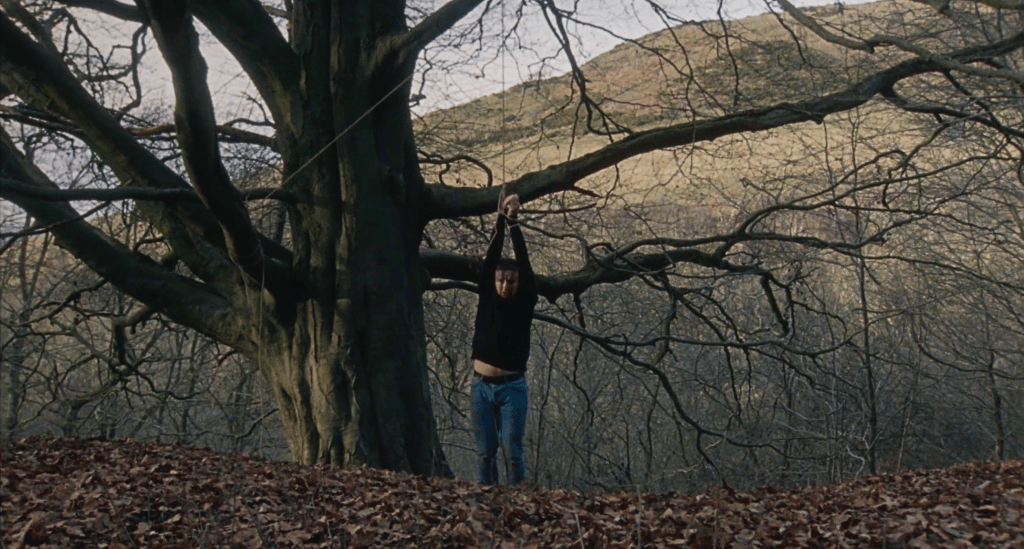
We follow Gwyn as he fetches items hidden in his attic, makes another call, then heads out to pick up the two other members of his team, Emlyn (Hopkins) and Dai (Carlsen). These men drive over to a farm, where they physically attack and subdue Dafydd (Llewelyn-Jones), who they shove into the boot of their car. They drive Dafydd to Bwlch Pen Barras mountain, get him out of the vehicle, and lead him further up the slope. The young captive’s wrists are tethered to a tree branch with rope, black markings are applied to Dafydd’s face, and Gwyn calls out to the Queen of the Mountain as something horrible happens to Dafydd off-screen…
Dafydd is the latest sacrifice…
This short Welsh movie, shot on nicely-grainy Kodak Super 16mm film, purposefully leaves a lot of details unanswered, so viewers must fill in the blanks themselves. Just what is it that has happened sooner this time? How are the sacrificial victims chosen? Is this a ritual tradition that has been undertaken by multiple generations of Gwyn’s family?
The film’s title is the main clue to explain what is actually occurring in the story: the word ‘Wyrm’ relates to dragons, such as the one featured in the Anglo-Saxon poem Beowulf. A red dragon, of course, is the most prominent symbol of Wales and it is included on the kingdom’s flag. Though the legendary creature is a symbol of national pride in Wales, in local myths dragons can have a more ambiguous or infernal significance. Writer-director Craig Williams has said in an interview that there are still folk stories which carry symbolic weight today in which dragons protect villages for a price, and he explained that he wanted to draw on that idea in the context of a horror film.
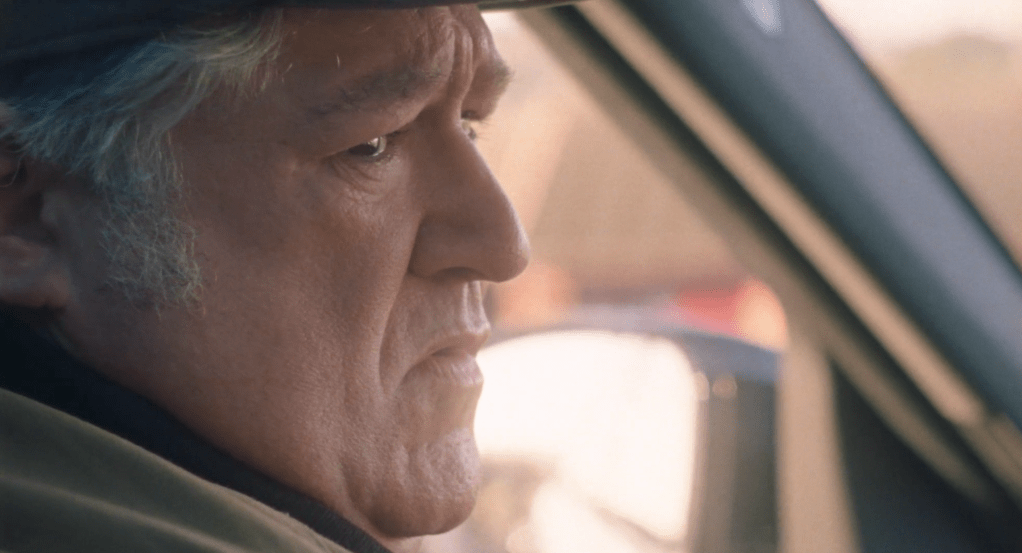
Some viewers will be frustrated that the finale refrains from actually showing the creature: THIS IS A MONSTER-RELATED MOVIE THAT DOESN’T SHOW THE MONSTER! But, though I can sympathise with that opinion, I found some tasty tidbits to savour throughout this folk-horror-urban-fantasy’s brief running time, including the sweetly unnerving opening music by Dafydd Ieuan & Cian Ciarán (of the band Super Furry Animals). The overall no-nonsense vibe of the piece is the film’s main selling point, as it depicts the average Joe characters going about their business in a down-to-earth manner. Gwyn is very restrained and world-weary, Emlyn is rather fretful, out of shape, and is evidently content to follow Gwyn’s lead, whilst Dai likes to act the hard man, obviously getting a kick out of what he’s doing.
Above – shots of the protagonists (top to bottom): Gwyn, Emlyn and Dai
THE WYRM OF BWLCH PEN BARRAS was originally shot as two versions, one in English and one in Welsh. But it soon became apparent to Williams, during the postproduction process, that the Welsh version felt far richer and seemed more true to the material, so that was the one the director submitted to film festivals.
This unflashy short film acts almost like an extract from some larger work, and it poses enough questions (Why has the Wyrm’s need for a sacrifice become more regular? When will the rituals not be enough?) to make me want to see them answered in a more substantial follow-up movie – and hopefully a sequel would put the scaly ‘Queen of the Mountain’ on screen!
We didn’t get to see what attacked Dafydd in this film. If there’s a sequel we want to see the dragon!
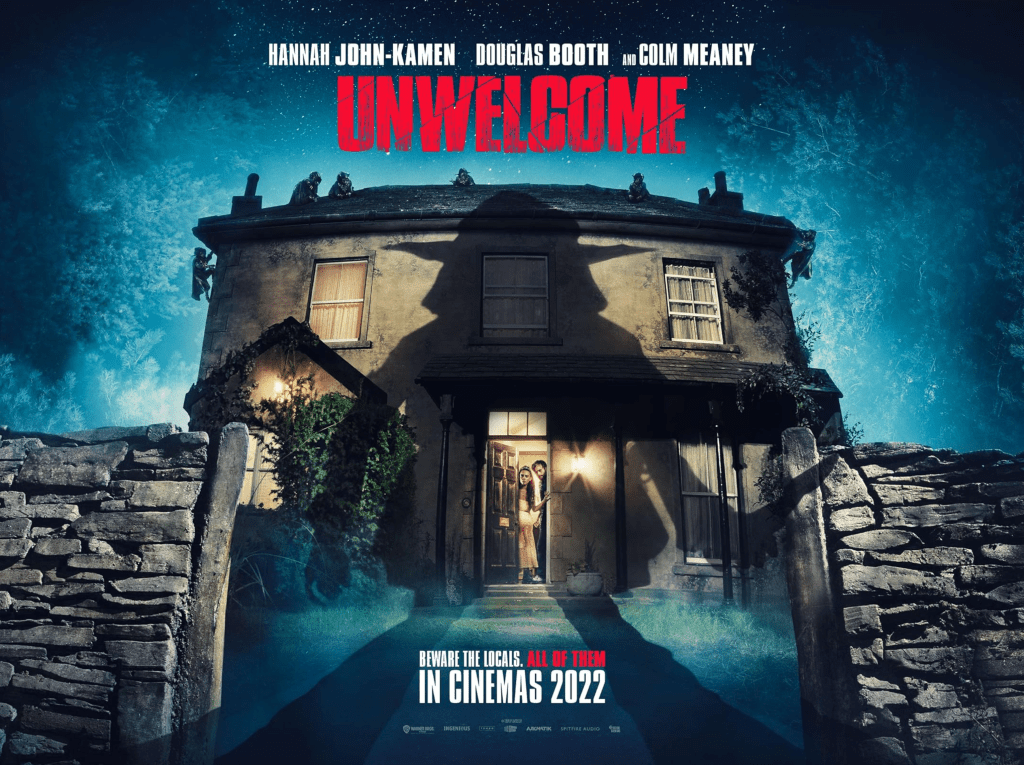
Starring Hannah John-Kamen, Douglas Booth, Colm Meaney, Kristian Nairn, Chris Walley, Niamh Cusack and Jamie-Lee O’Donnell. Written by Jon Wright and Mark Stay. Directed by Jon Wright. Produced by Piers Tempest, Peter Touche and Lauren Cox. Tempo Productions/Ingenious Media/Rococo Films
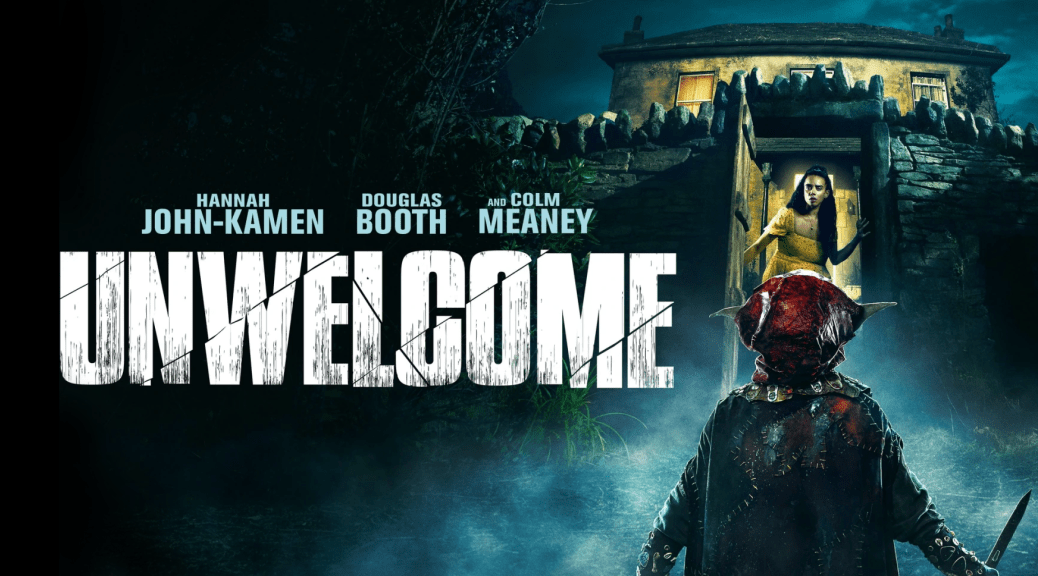
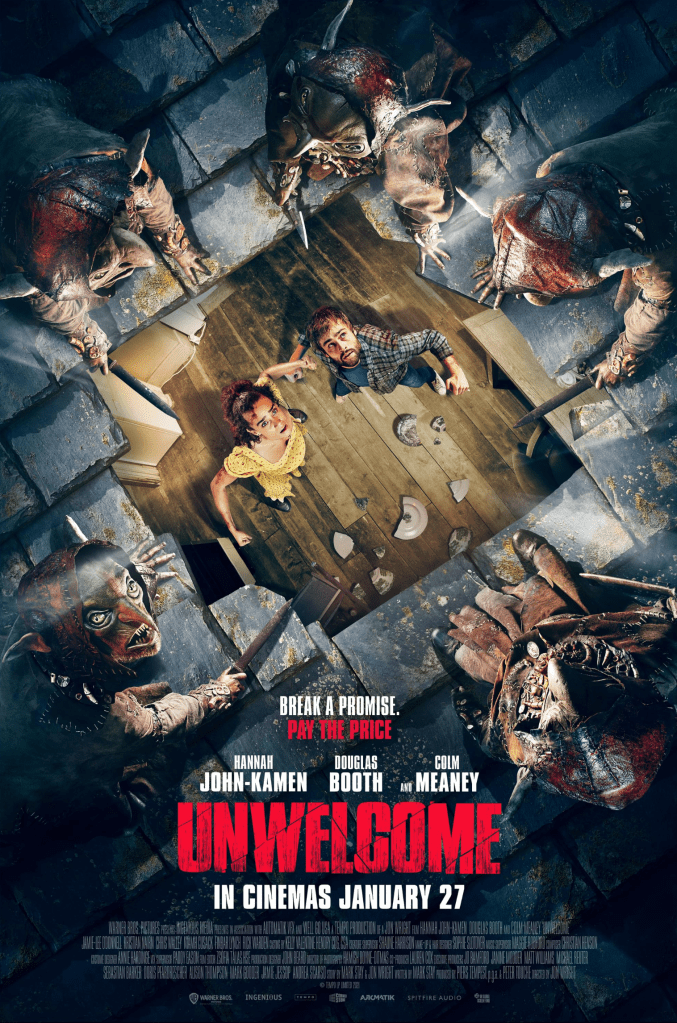
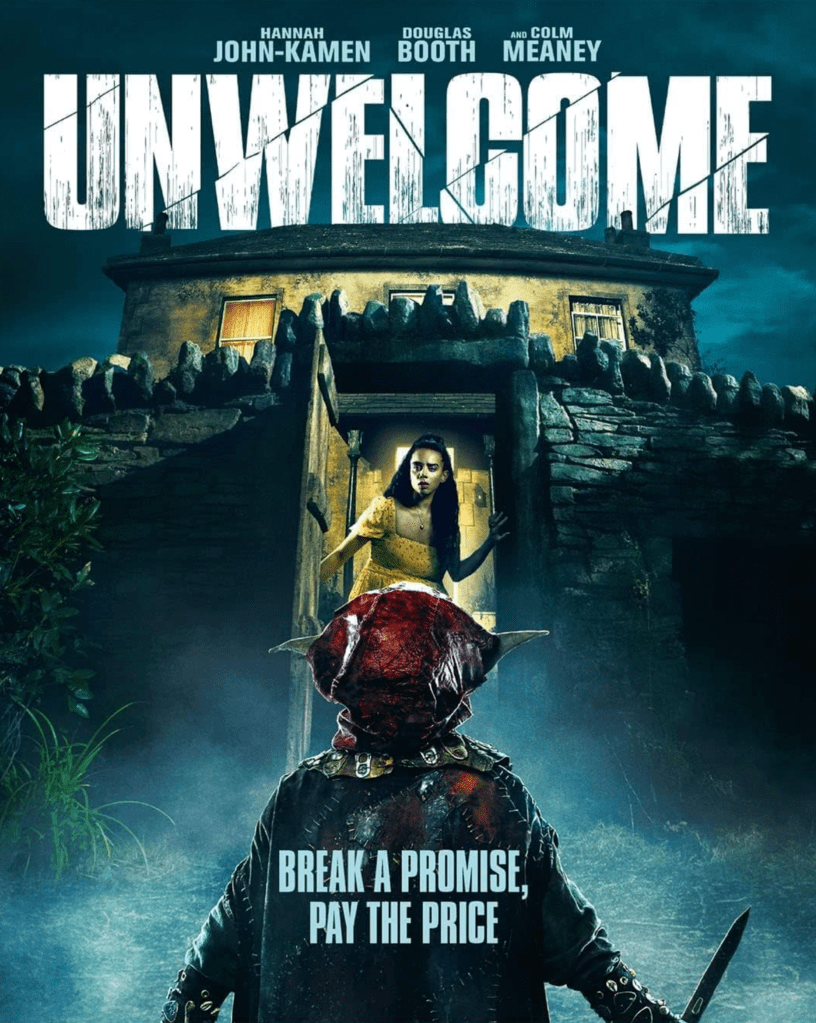
Poster
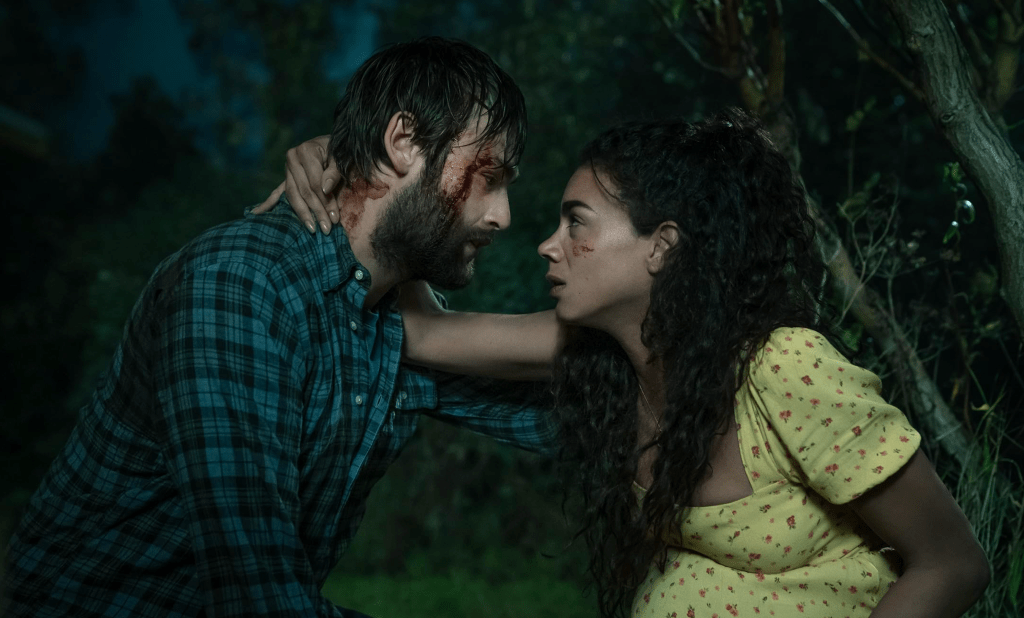
Jamie and Maya
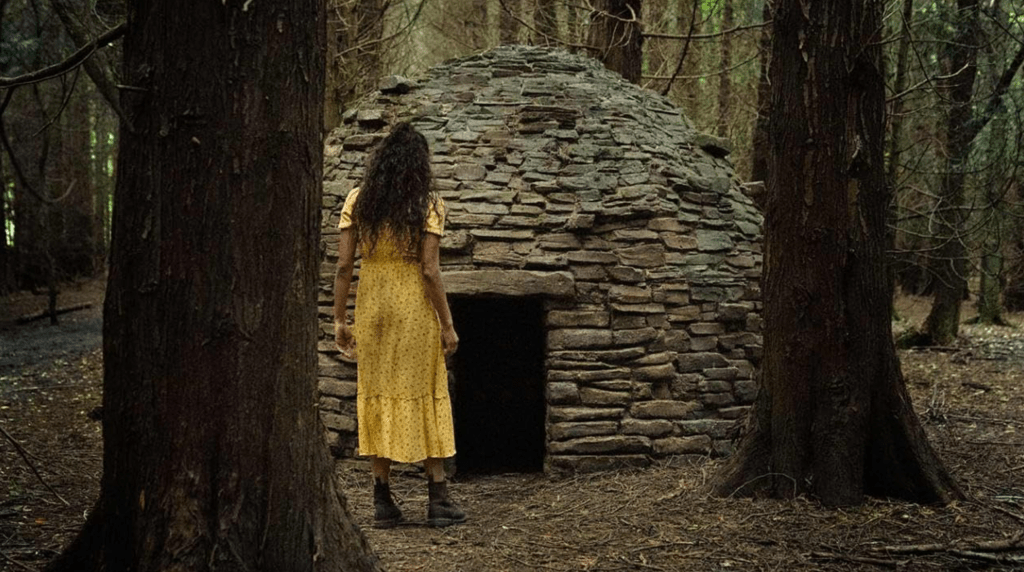
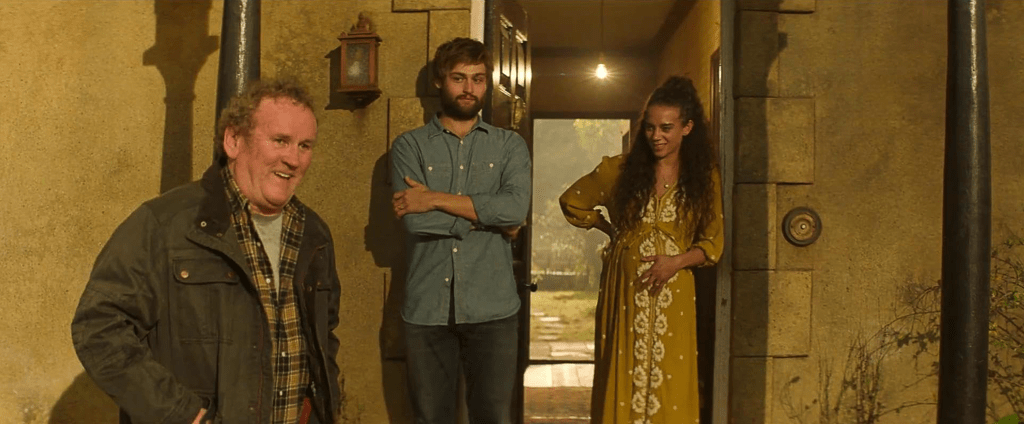
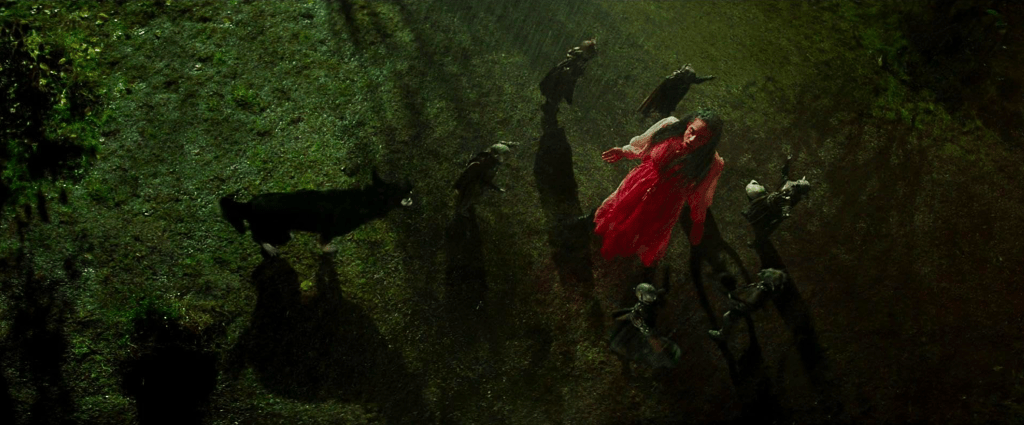
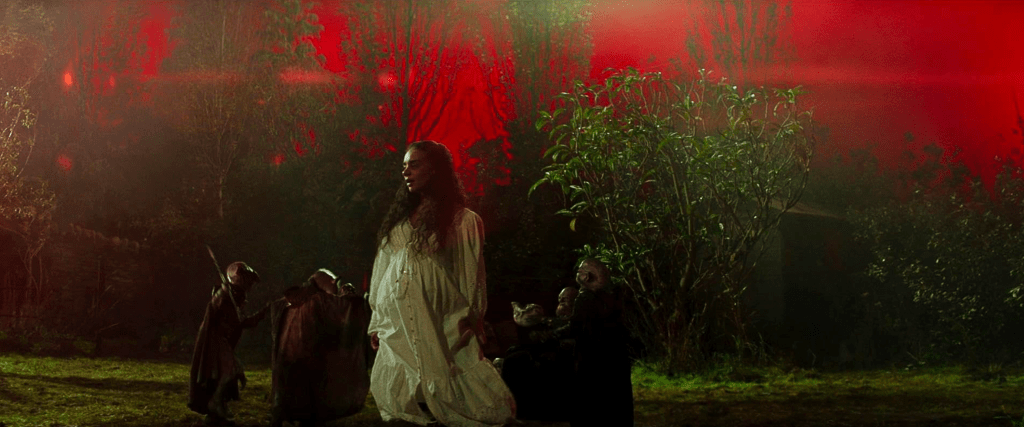
Several months after they suffer a violent home invasion incident in their inner city London apartment, young couple Maya (John-Kamen) and Jamie (Booth) eagerly move to a village in Ireland when Jamie inherits a house from his recently deceased aunt. To fix a hole in the roof, they hire the Whelan family building firm, but these four individuals prove to be a loutish, aggressive and strange bunch. To add to their woes, Maya and Jamie are informed by local landlady Maeve (Cusack) that their late aunt had believed in the ‘old ways’ and used to leave blood offerings at the bottom of her garden to appease the Little People… and Maeve emphasises that these creatures, also known as the Far Darrig or Redcaps, are not jolly little elves: they’re hungry and they’ll need feeding every day. Not wanting Maeve to be trespassing onto their land to continue this tradition, Maya promises that she will regularly leave a plate of raw liver near the garden gate… which leads into the vast woodland beyond, where a small, domed stone building lurks amongst the trees…
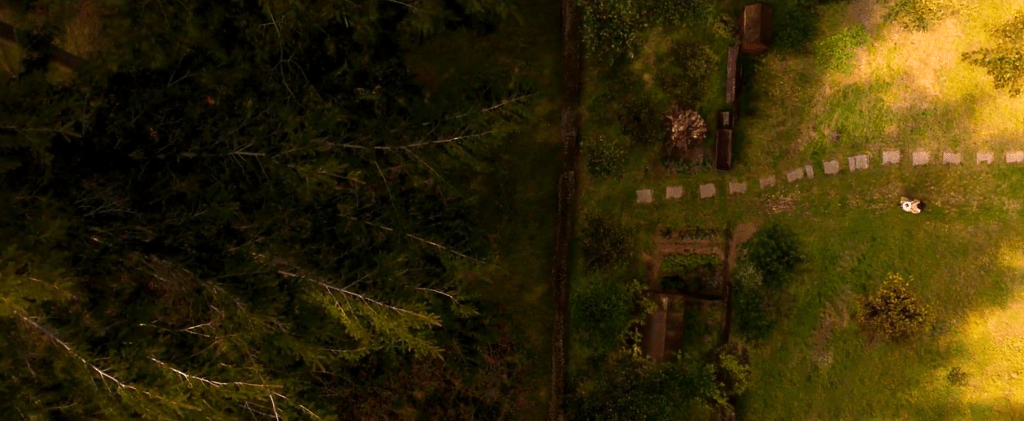
The forest awaits beyond the garden wall…
What lurks below?
Hannah John-Kamen is on top form as the heavily pregnant Maya, nicely balancing her character’s varied emotions, ranging from happiness (especially when she discovers she’s pregnant), to fearfulness, to (when required) boldness, as she faces various challenges throughout the story. Douglas Booth, whether intentionally or not, comes across as rather irritating playing the pleasant-but-wimpy Jamie, who is always striving, but failing, to stand up to the bullies in his life. Niamh Cusack, as Maeve, manages to make her friendly warnings regarding the Redcaps come across as sincere and believable, and Colm Meaney seems to be having fun playing ‘Daddy’ Whelan, the rough patriarch overseeing his obnoxious adult kids, who are all pretty weird but played straight by Chris Walley, Jamie-Lee O’Donnell and Kristian Nairn.
‘Daddy’ Whelan, Jamie and Maya
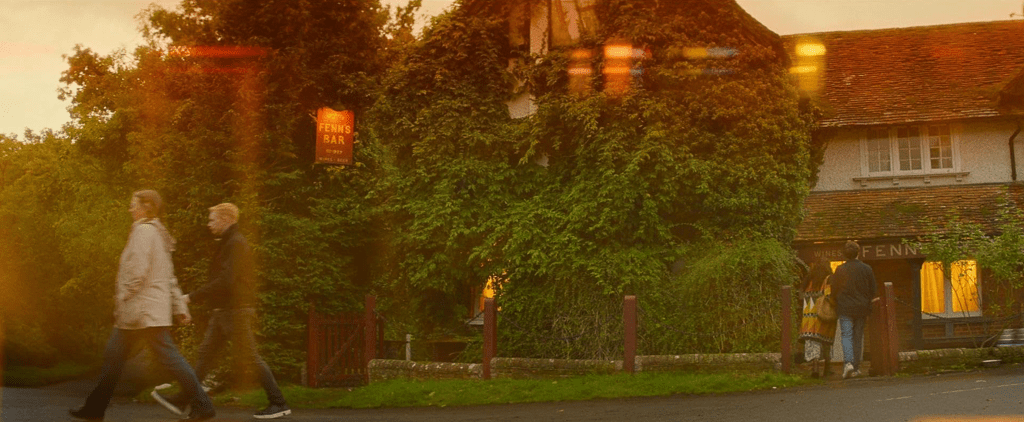
There’s a pleasant use of lush colours in the film, with cinematographer Hamish Doyne-Ditmas ensuring the surrounding countryside is verdantly green and the sun is always golden. The large garden seems to be a big indoor set most of the time, and this slight artificiality adds to the twisted fairytale look and feel of the production.
The film features lots of yellowy golds and greens for its colour palette
Director Jon Wright, who also made the wonderful sci-fi-horror-comedy GRABBERS (2012), has described UNWELCOME as ‘GREMLINS meets STRAW DOGS’, and this production does, to a degree, fit this description, though it seems that Wright couldn’t quite make up his mind whether to make his film a gritty home invasion movie, or a horror movie, or a creature feature comedy. GRABBERS certainly balanced its horror and humour elements better, but UNWELCOME does prove to be an enjoyably watchable yarn.
‘Beware the locals. All of them.’
The UK/Irish production holds back from showing the Redcaps till later in the tale and, when the Little People do make their appearance, the movie’s entertainment value really rockets skywards!
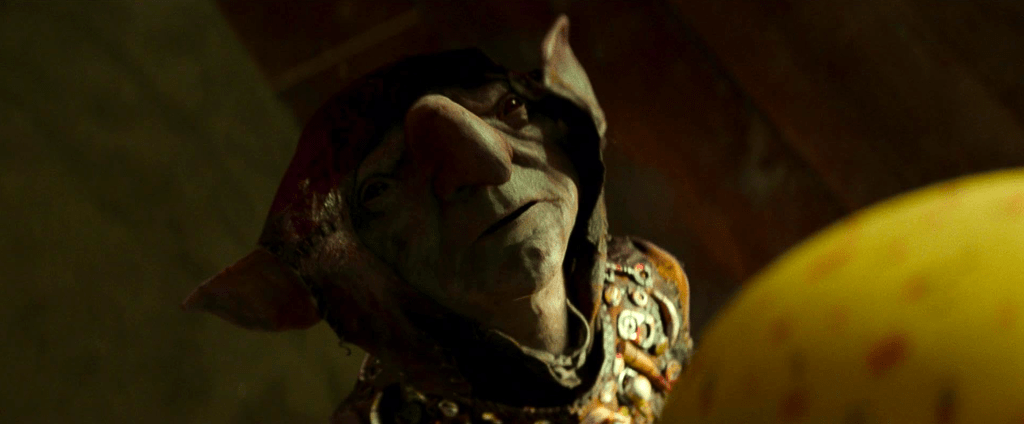
A Redcap!
The sharp-nosed, pointy-eared, caped Redcaps are so much fun! They are violent, belly-slitting, dagger-throwing little buggers, but they’re also almost sweet somehow due to their interactions with each other. These Little People will help you out if you ask a favour… but you must pay a price! This last point, of course, leads to a finale in which Maya must prove herself to be really ruthless in order to get her child back.
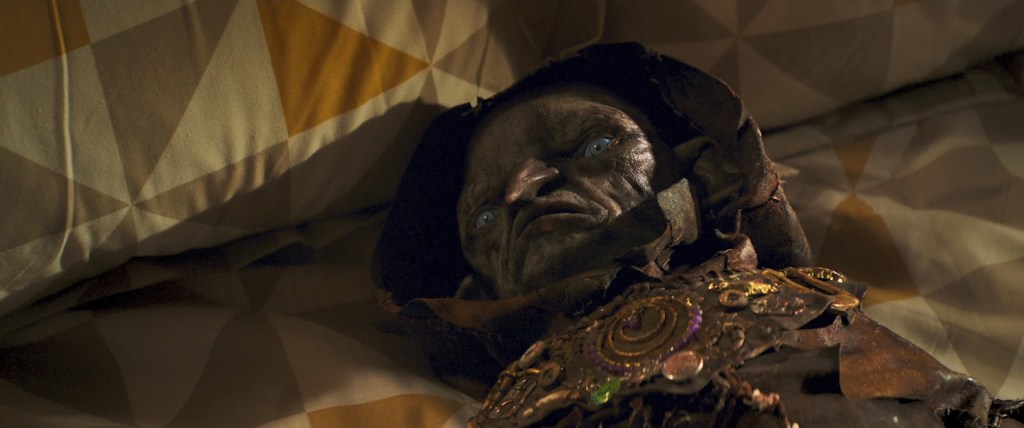
A Redcap gets knocked onto a bed
The first time we see one of the Far Darrig properly is when one of the cowled critters lets itself into the house, walks over to Maya, and presents her with the severed head of a would-be rapist in a plastic bag. The lil’ Redcap in this scene looks great, thanks to the fact the wee fellow is obviously a fine example of the use of practical effects. Soon we get to see more of the Little People, and they all boast different facial features!
Lots of wee Redcaps!
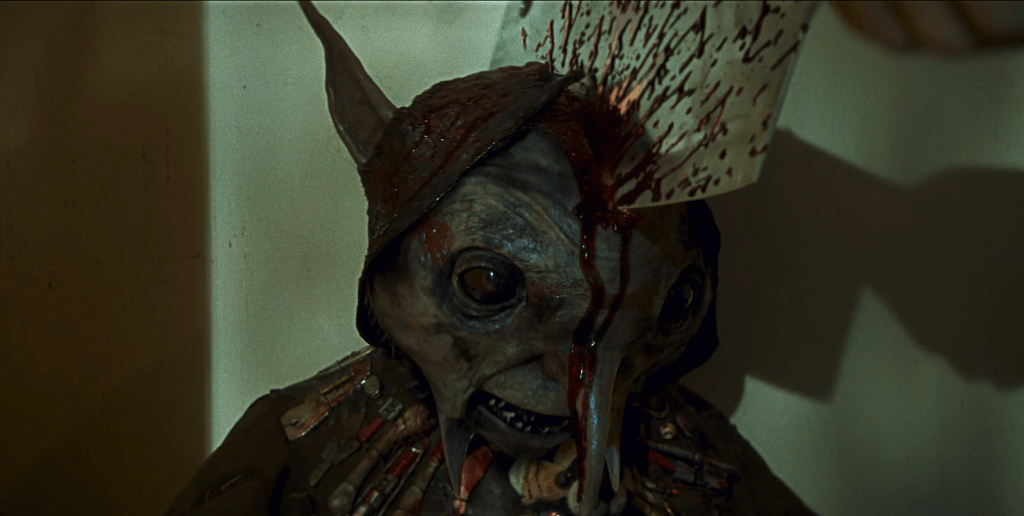
These superbly crafted Redcaps are played by short actors wearing costumes and latex masks. For a lot of the shots, this simple approach (which included the use of double-sized sets) is enough, with no VFX required. When one Redcap is hacked in the head with a cleaver, the filmmakers simply smash the cleaver into a puppet! But, when the Redcaps are required to talk, or to emote, the filmmakers replace the masks and use the minimum amount of 3D VFX possible. This approach, for me, looks far better than the use of CGI-only creatures: the in-camera effects and the post production digital VFX here work wonderfully together! And this all helps make the violent set piece showdown towards the end of the movie so memorable, when Maya (who ends up going into labour!) and Jamie take-on the psycho Whelan family in their home… and the Redcaps join the bloody skirmish too!
A Redcap is hacked in the head with a cleaver!
Perhaps UNWELCOME underplays the comedy a little, and it doesn’t quite hit the mark when it comes to the horror moments sometimes, but it is entertaining. And I really enjoyed the finale, which reaches an unexpectedly triumphant, strange & very exuberant climax!
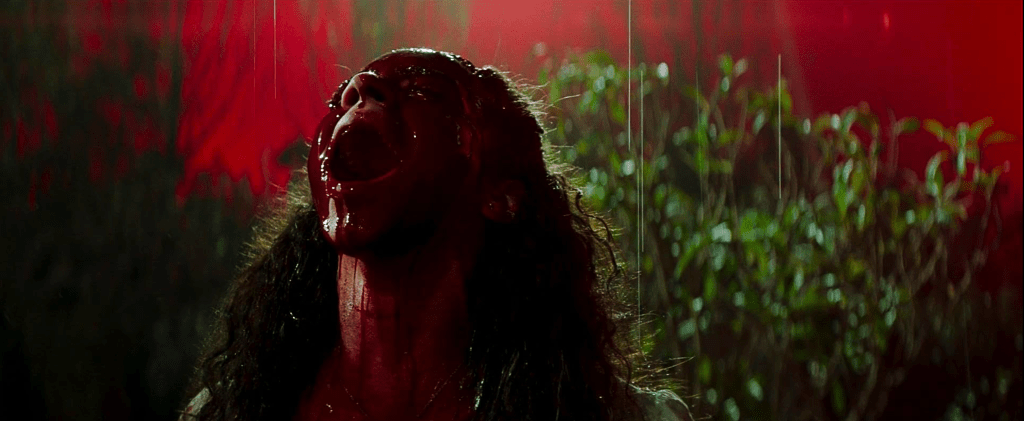
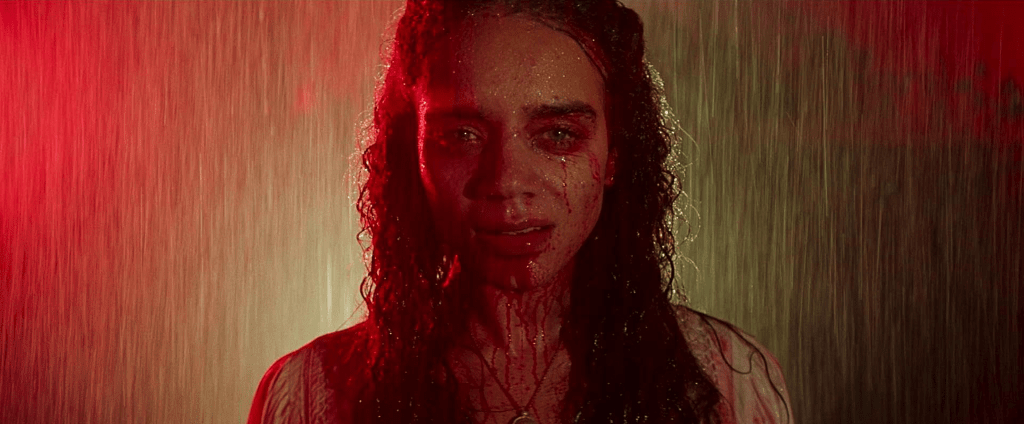
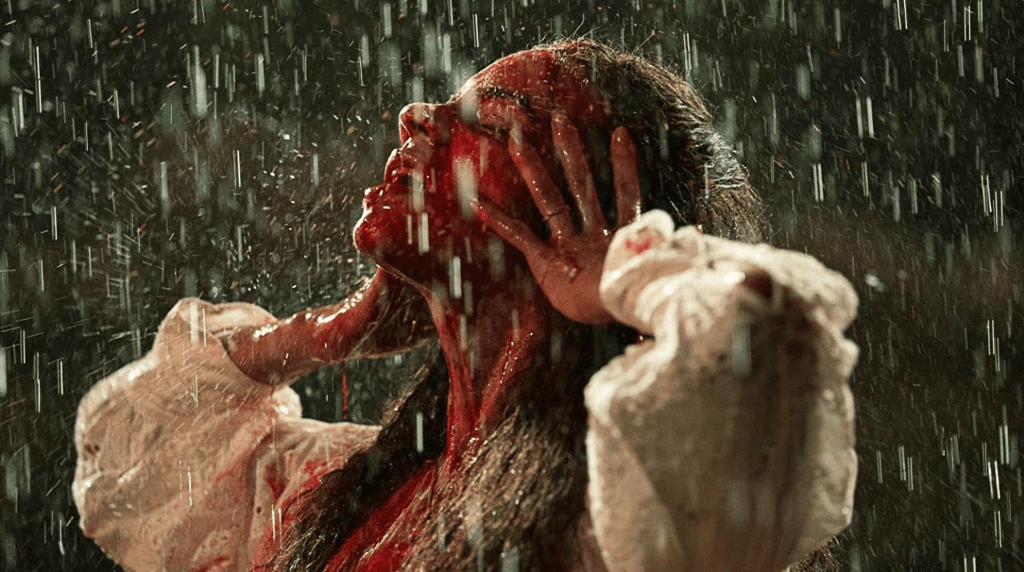
Above: four shots from the film
But, yeah, for me it is the excellent Redcaps (which remind me, design-wise, of the illustrations seen in the book Faeries by Brian Froud and Alan Lee) that help make the movie such a satisfying fantasy-horror picture!
‘Break a promise, pay the price’
SOME BEHIND THE SCENES SHOTS.
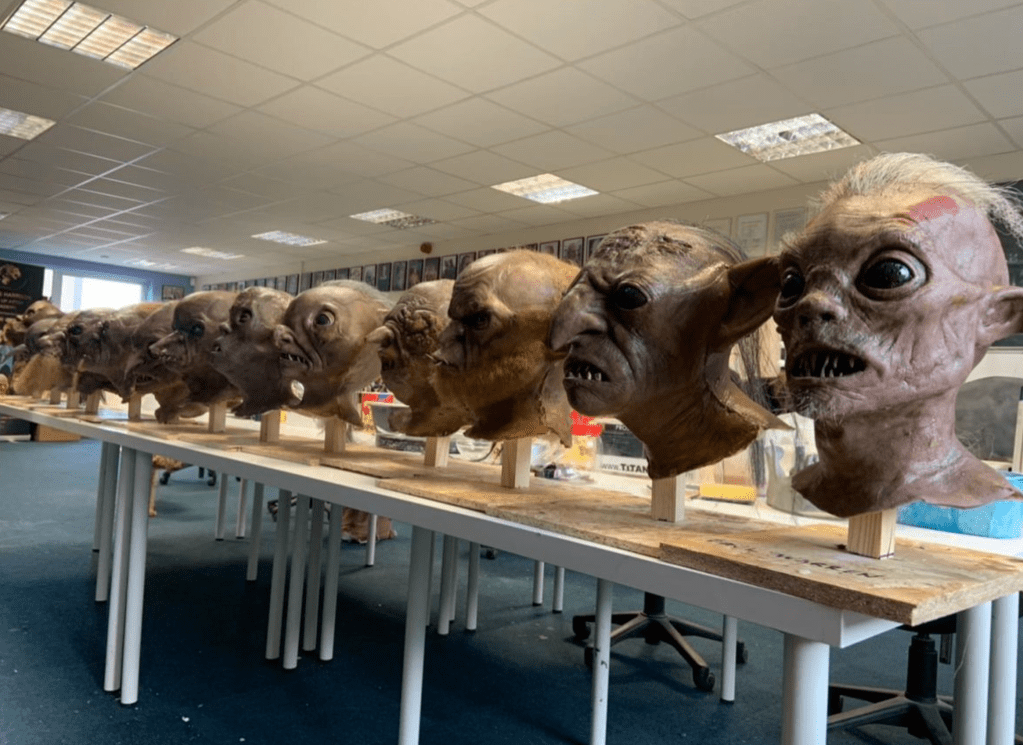
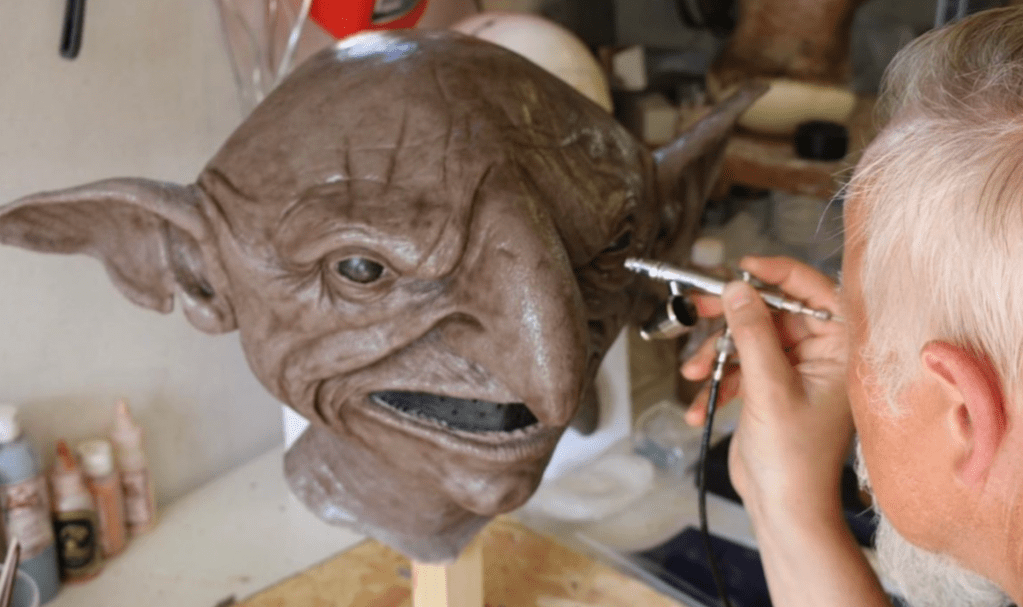
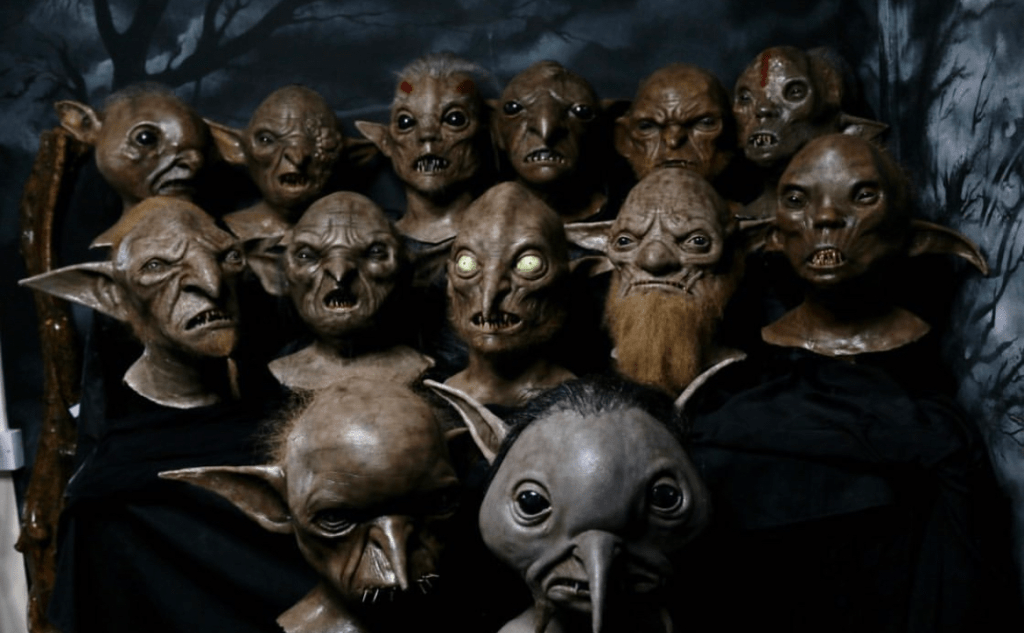
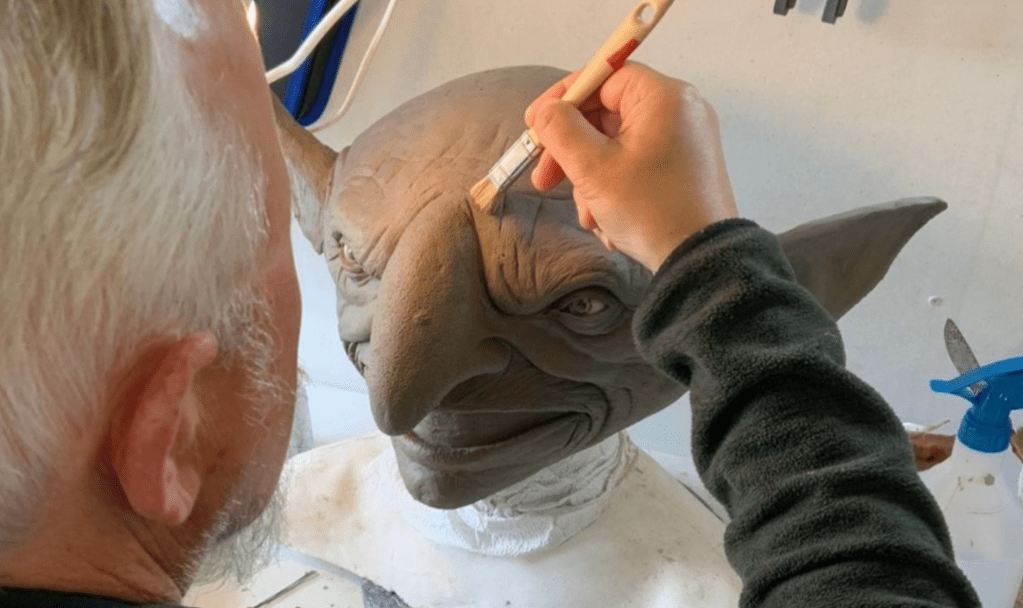
The Prosthetics Studio, run by Shaune Harrison and Paula Anne Booker-Harrison, created the Redcap masks and other prosthetics for UNWELCOME. Take a look at these beauties…
Starring Wang Zhener, Han Dong, Liu Lincheng and Wang Jianguo. Written by Chien Shih-Keng. Directed by Xiang Qiuliang and Xiang Hesheng. Produced by Guo Runze, Jing Wu and Xiang Weibin. Beijing Tmeng Network Technology Co/Hainan Golden Seagull Media
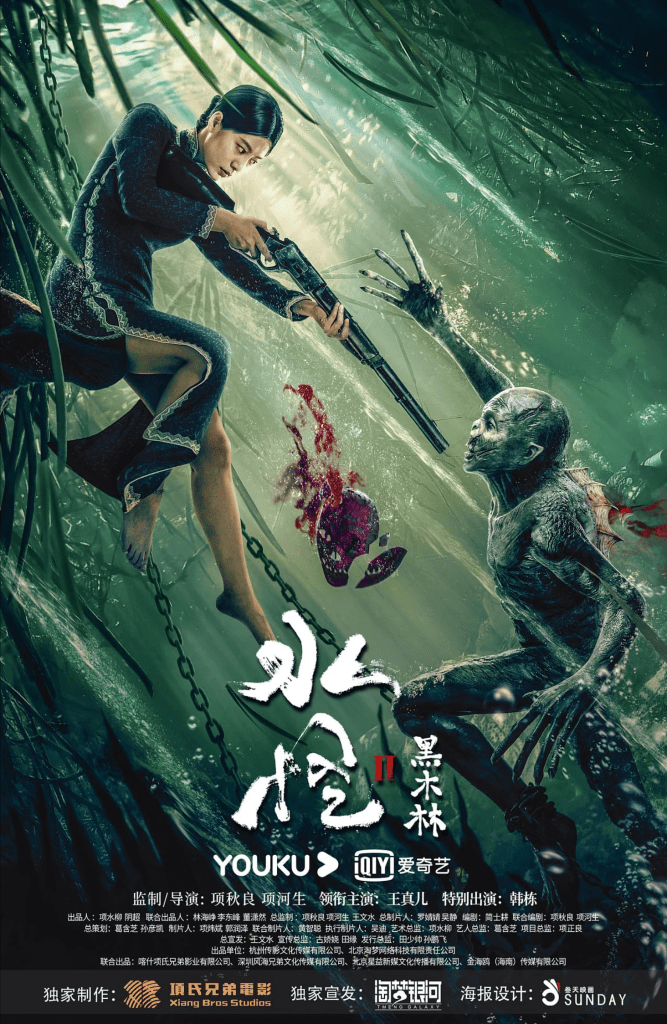
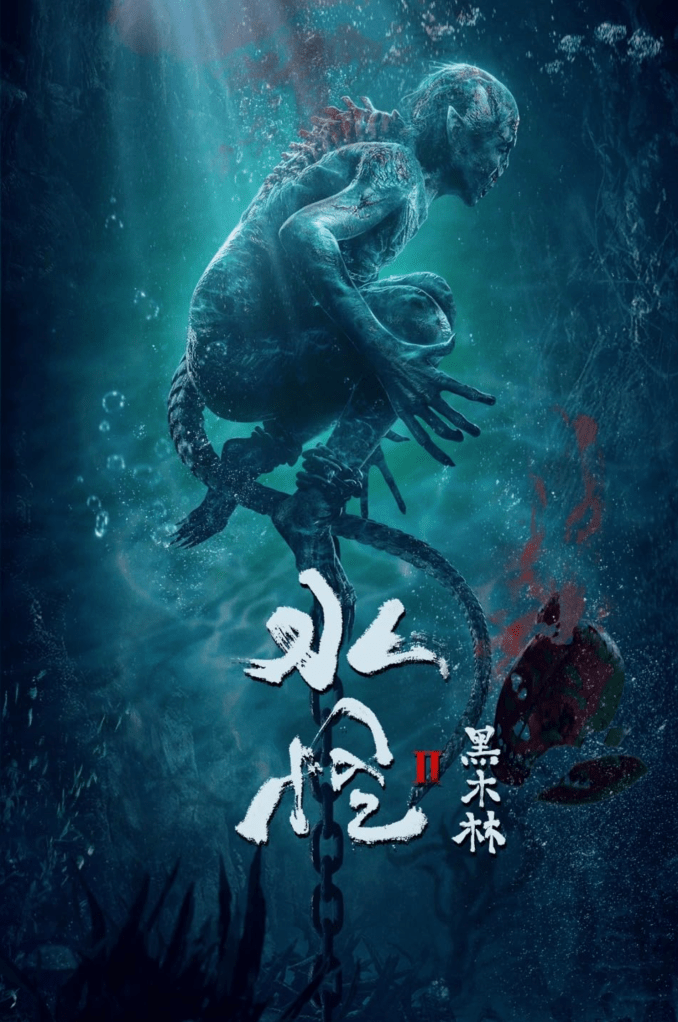
Cool poster
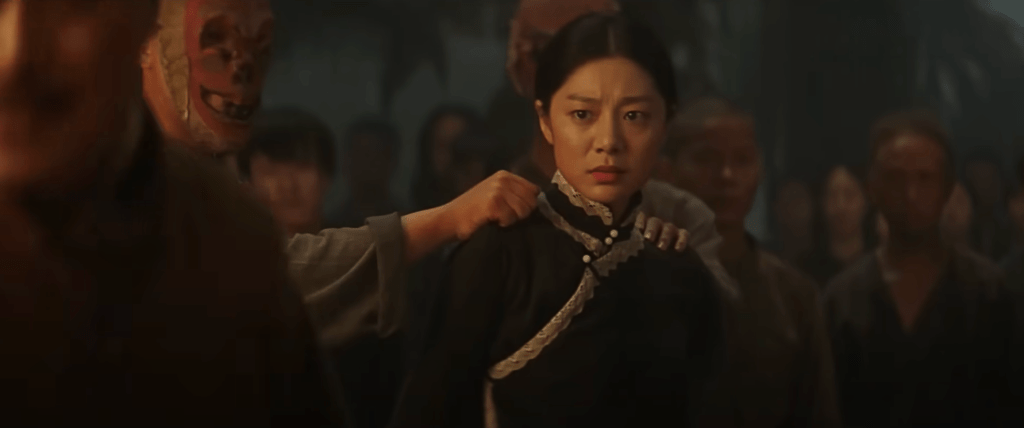
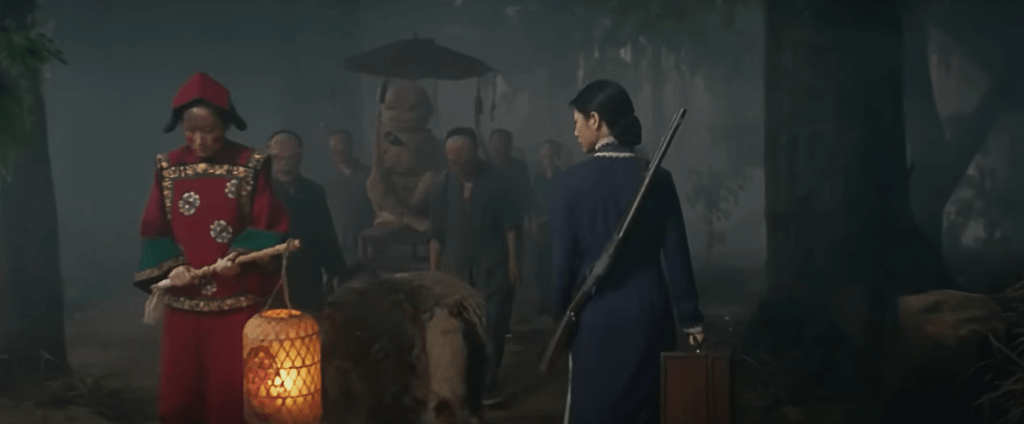
A forensic doctor, Du (Zhener), ventures to a misty, boggy settlement called Shangshui Town to look for her missing brother. The townsfolk are not too willing to help her, however, because they are in thrall to a superstition involving an aquatic monster they call Lord Water Monkey, whom they fear might punish them if they get involved. Du digs deeper into the local mysteries, people continue to get killed, she finds her brother’s body, and plans are made to trap the swamp-beast, but things are not as they seem…
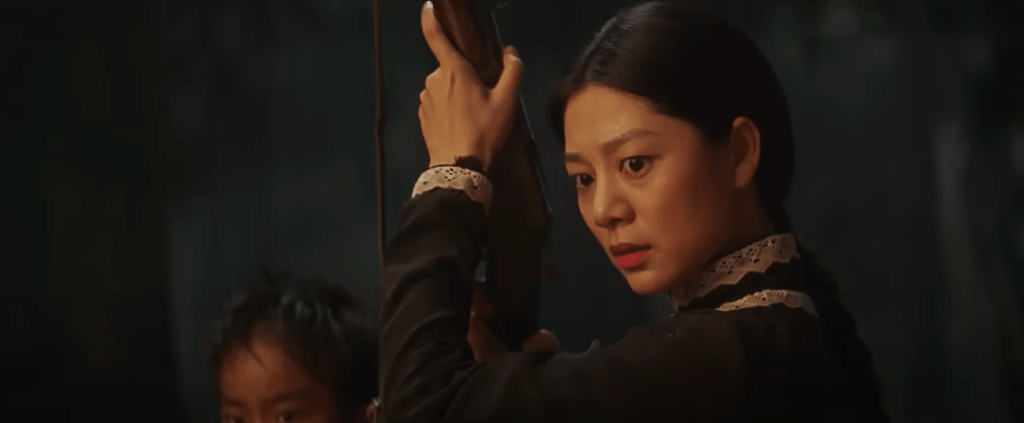
Wang Zhener plays the gun-toting doctor Du
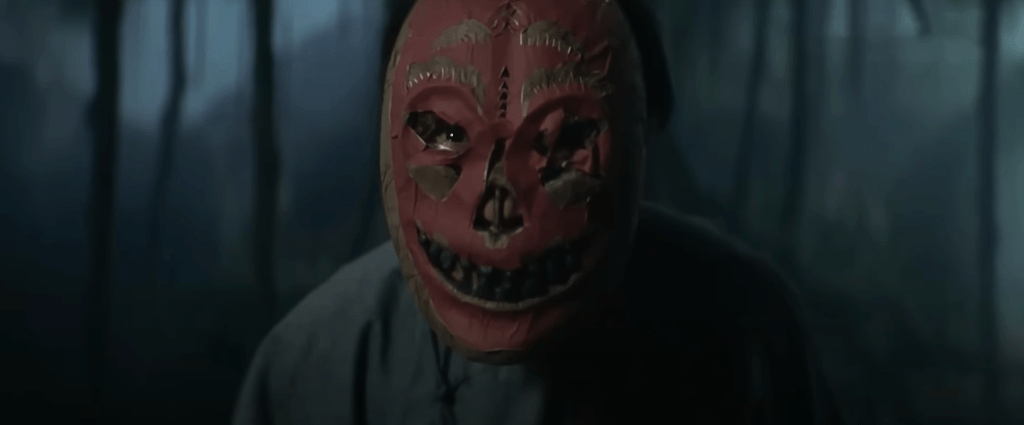
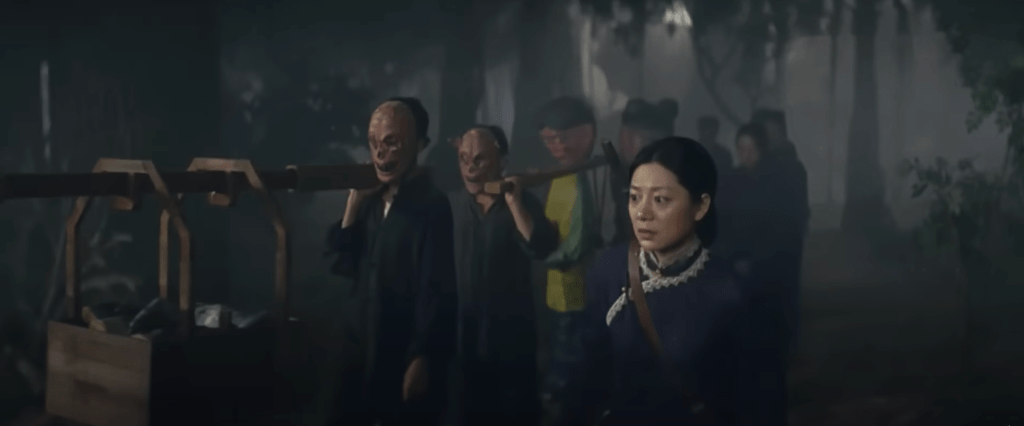
A villager wearing a ceremonial mask
This sequel to WATER MONSTER (2019), made by the same two directors, tells a different story with different characters, and is a pleasingly shot and art directed production, using the waterlogged, mist enshrouded locations effectively.
Another poster
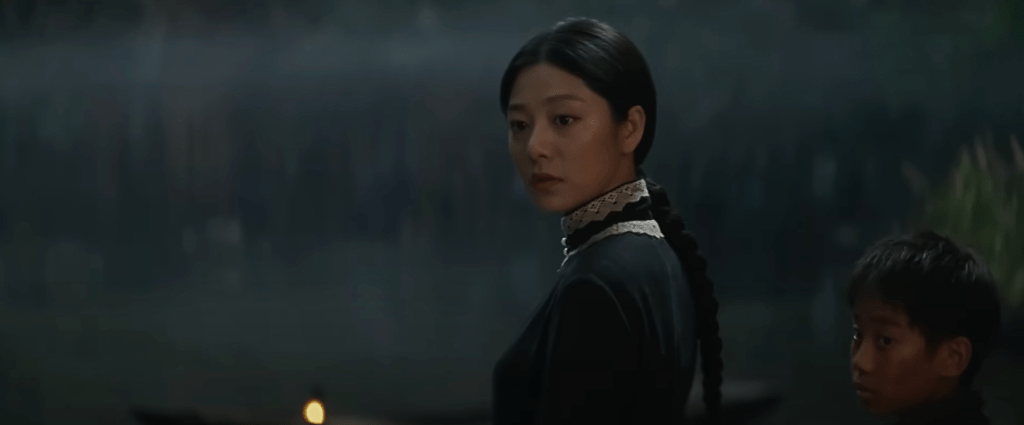
Central to the enjoyment of WATER MONSTER 2 is Wang Zhener’s performance as the outsider who, after black and white flashbacks, dreams, and meetings with various characters, learns that her name is actually Qingling and she originally lived in this town as a girl, involved in a tragic backstory inextricably linked to the origins of Lord Water Monkey. Zhener has a well maintained composure about her, playing Qingling/Du as a calm, smart and driven character. She really stands out, especially in a sub-genre (modern Chinese creature features) where many female leads teeter on being pretty, tough and rather one-dimensional. This film might feature a slimy, leaping marsh monster, but it is obvious that Zhener is totally committed to her role and really shines in every scene.
Wang Zhener is good as the forensic doctor
At one point the locals want to use Du as a human sacrifice
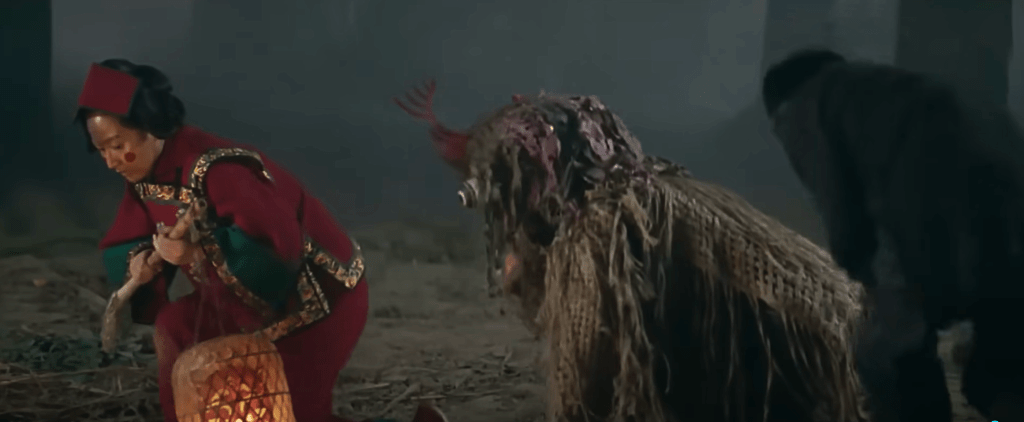
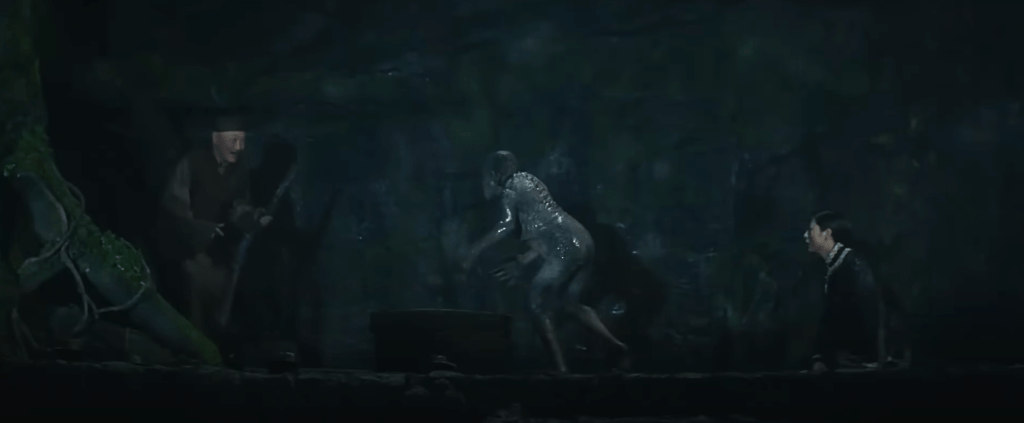
The town people’s ceremonies, aimed at appeasing the water monster, which they regard as a deity, imbue the film with a folk horror atmosphere, while a fast-paced sequence showing the eventual capture of Lord Water Monkey injects some vital energy into the tale. This set piece is full of invention, as Qingling and a group of locals use a series of elaborate boobytraps and other rope & wooden mechanisms to attack the Gollum-esque creature, keep the heroine out of harm’s way, and then trap the man-beast.
Above: three shots showing the local folks taking part in their Lord Water Monkey ceremony
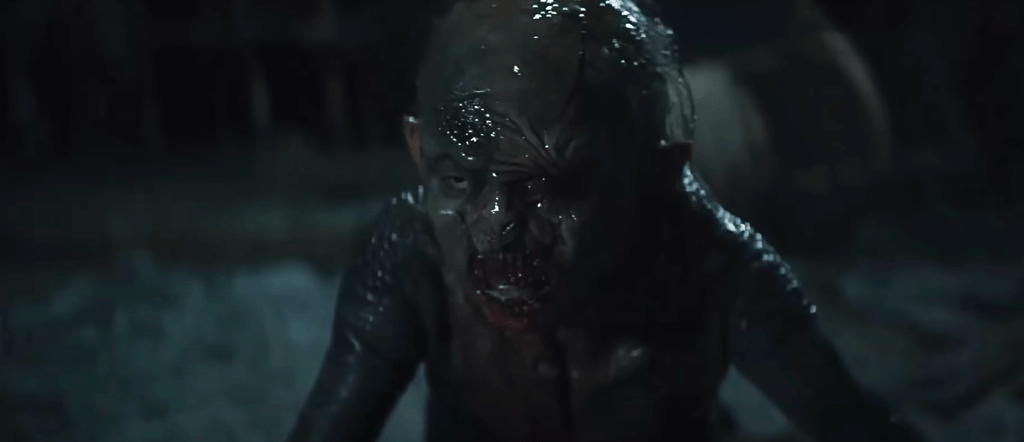
The story now takes an interesting turn, as Qingling uncovers information revealing that the town elders are corrupt, lying opium-smuggling gangsters: they are the real culprits behind the ongoing spate of child disappearances and murders! The slimy-skinned, hunched, ridge-backed water ‘monster’ turns out to be Qinghe, the biological brother of Qingling, a sibling she’d lost all memories of. Qinghe’s grotesque form is, it’s explained, due to a rare hereditary disease, and his feral nature was triggered by the vile actions of the elders many years ago. After these revelations, Qingling finally gets to fight back against the bad guys and really looks striking as she goes into action, keeping commendably cool, wearing her traditional cheongsam dress and toting a rifle that she’s ready and willing to use!
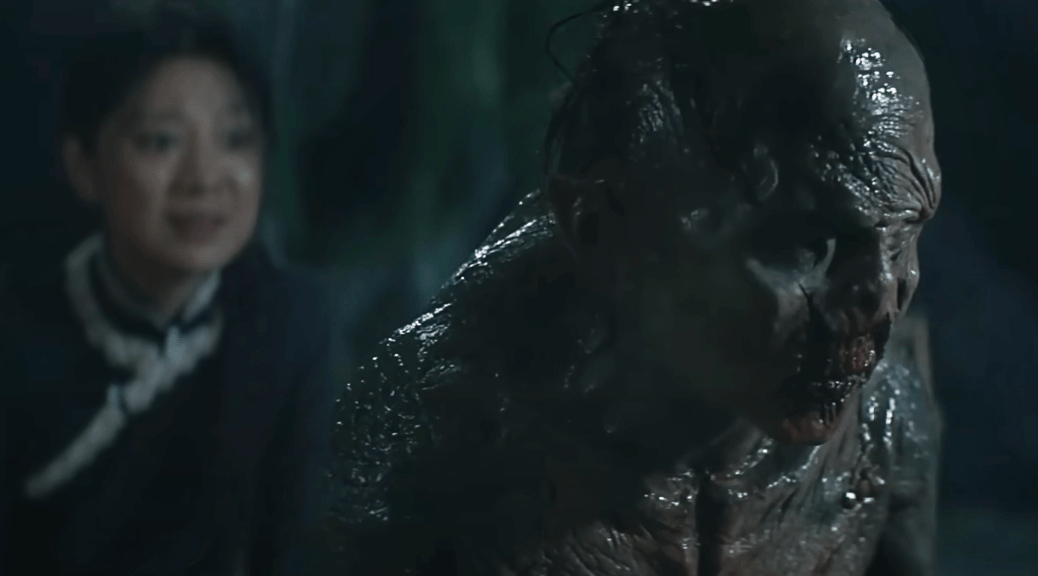
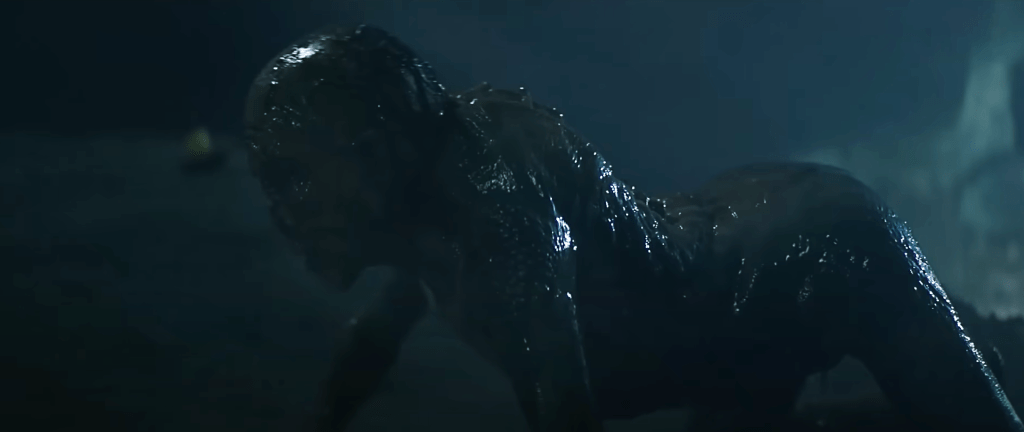
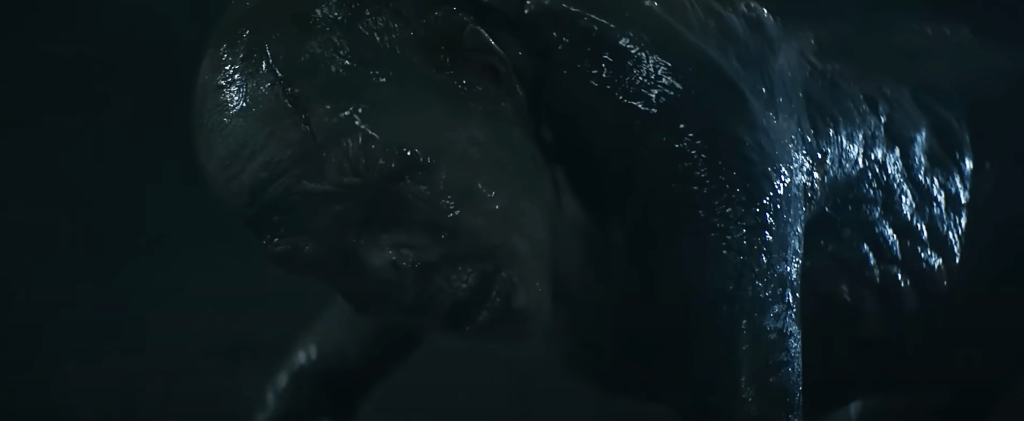
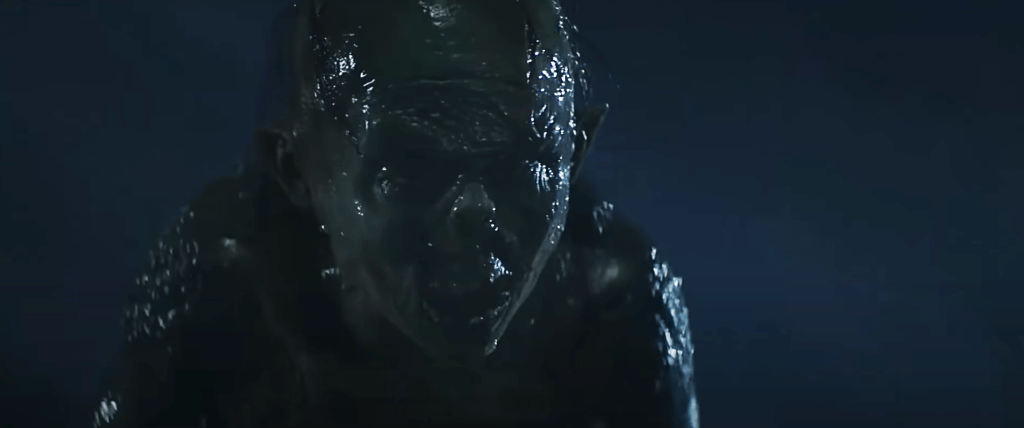
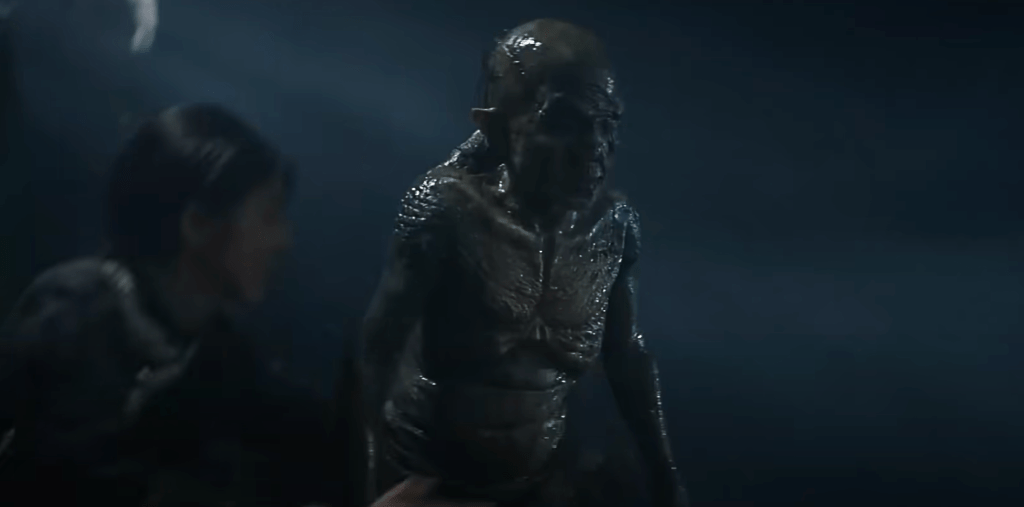
Above: two pics showing the deformed, slimy Qinghe
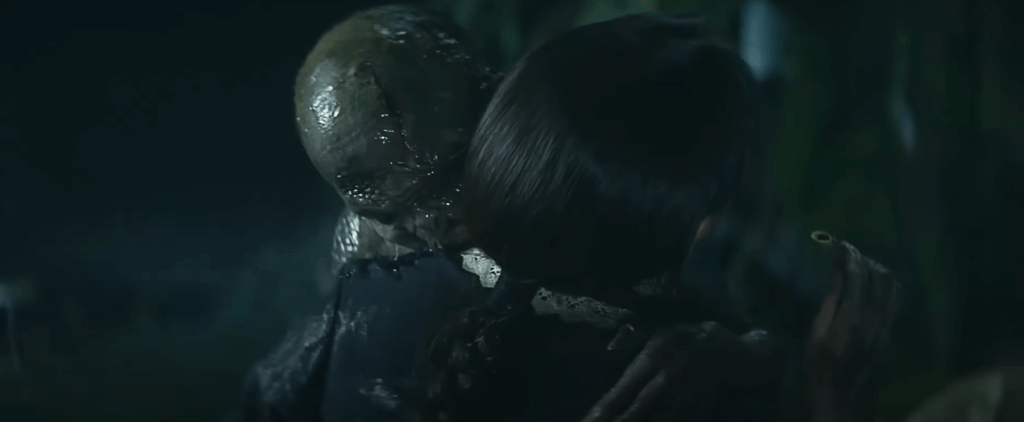
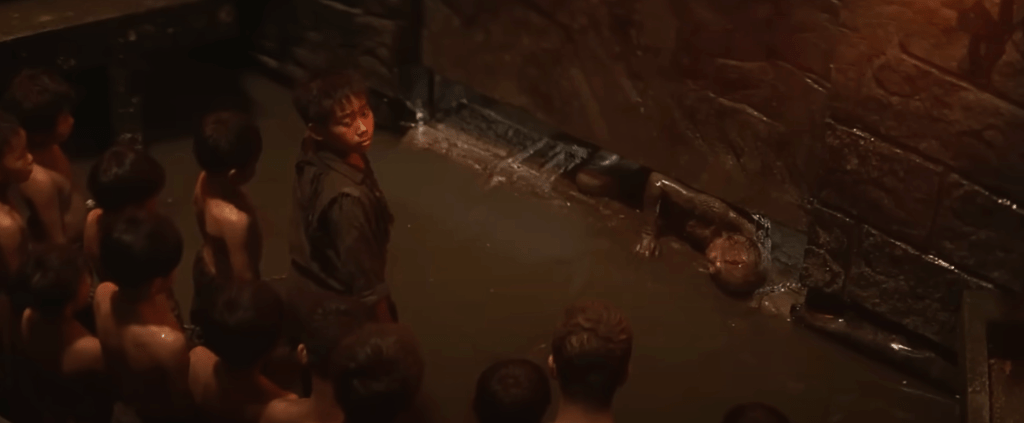
The titular aquatic monster is often CGI in the fast-moving action shots, but he looks much better when a practical creature suit is used, especially during the finale, where we can see Qinghe in more detail. Here the heavily deformed Qinghe is treated in an empathetic manner, as he overcomes his urges to harm his sister, then dies saving child slave opium workers from drowning. It’s actually quite a touching finale!
Above: four more shots of Qinghe, formerly known as Lord Water Monkey
WATER MONSTER 2 is well-handled, well-paced and is, all in all, an entertaining murder-mystery-creature-feature-drama.
Written by Roy Thomas and Gerry Conway. Directed by Ralph Bakshi. Produced by Ralph Bakshi, Frank Frazetta, Lynne Betner, John W. Hyde and Richard R. St. Johns. Polyc International BV/Producers Sales Organization.
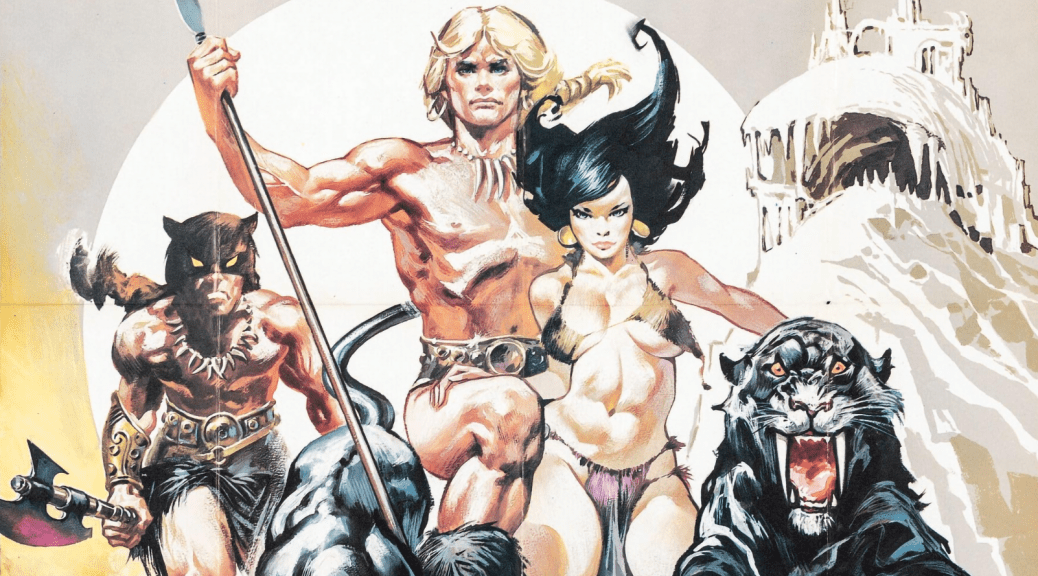
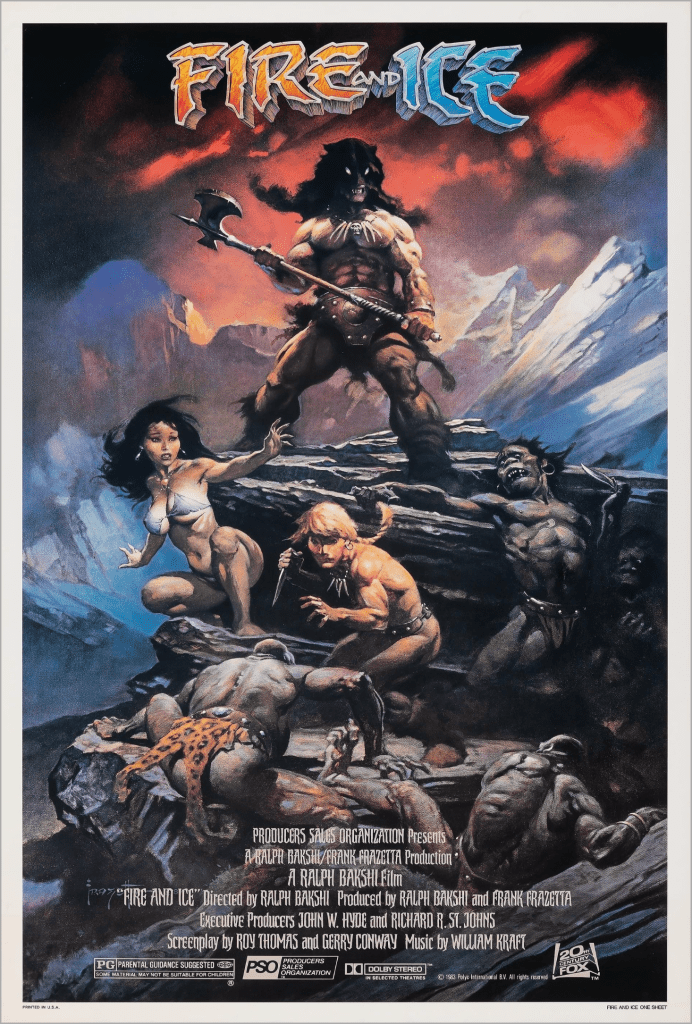
US one sheet poster
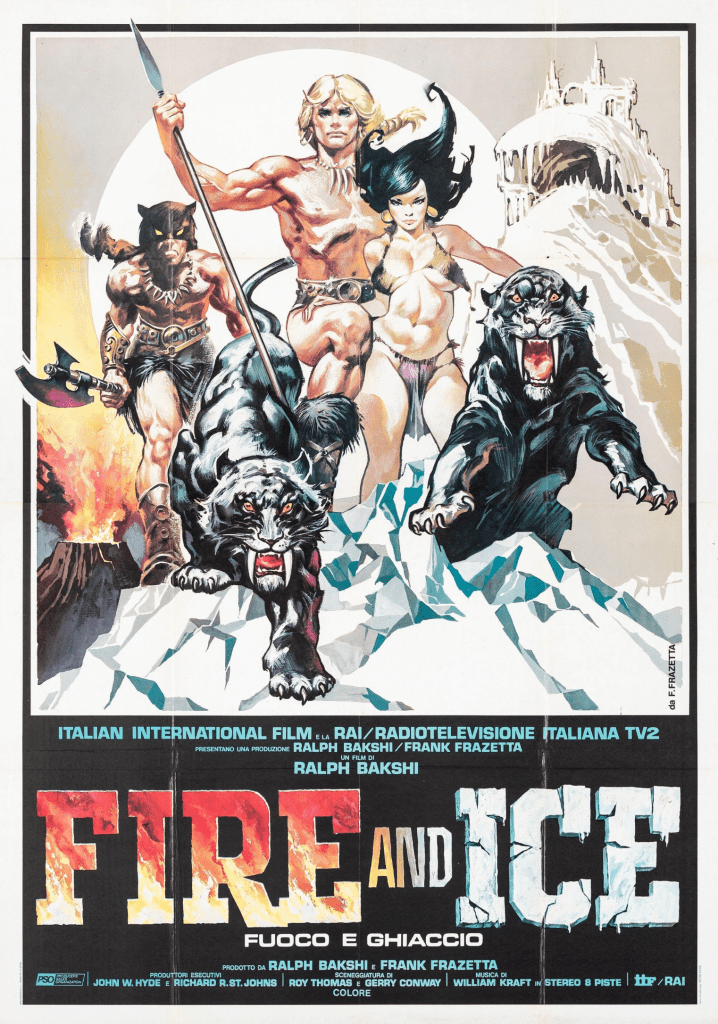
Italian poster
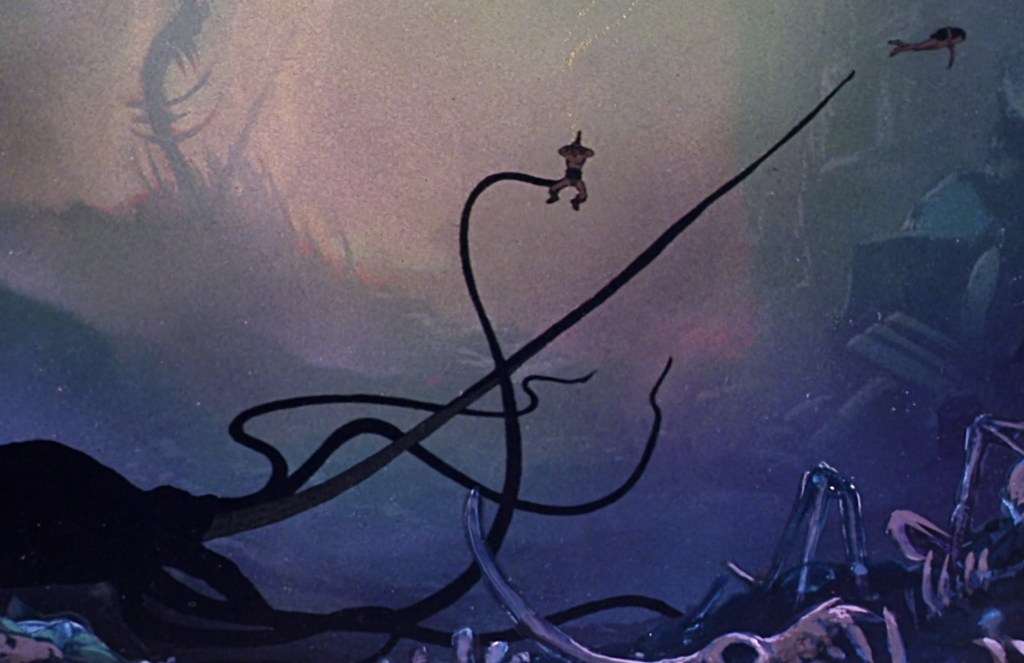
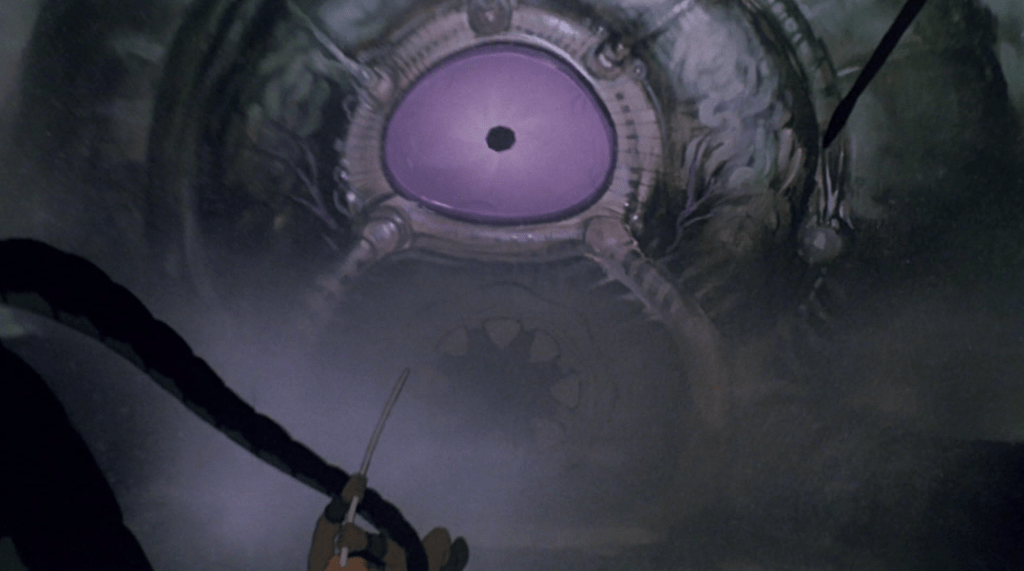
An enormous octo-monster attacks!
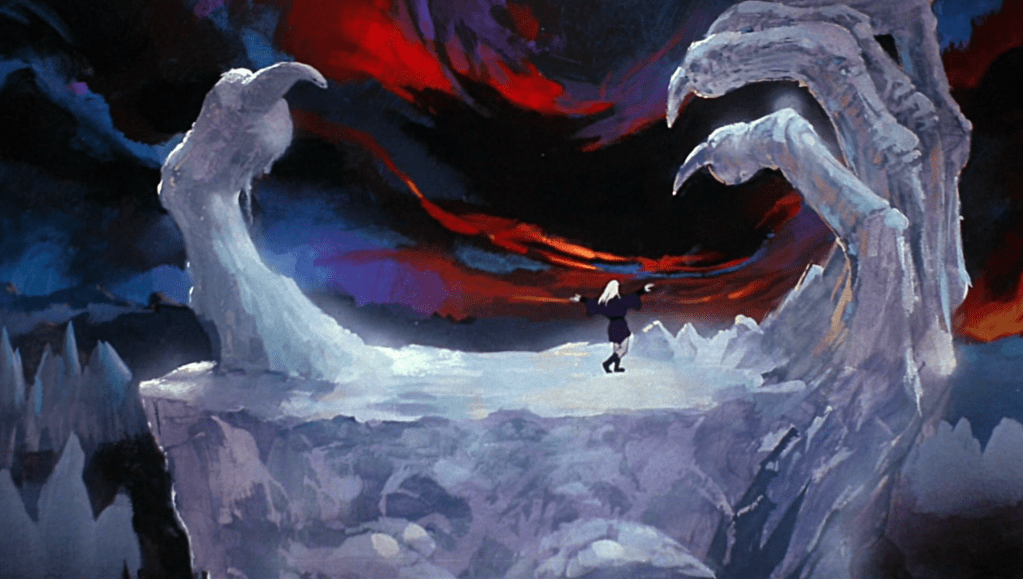
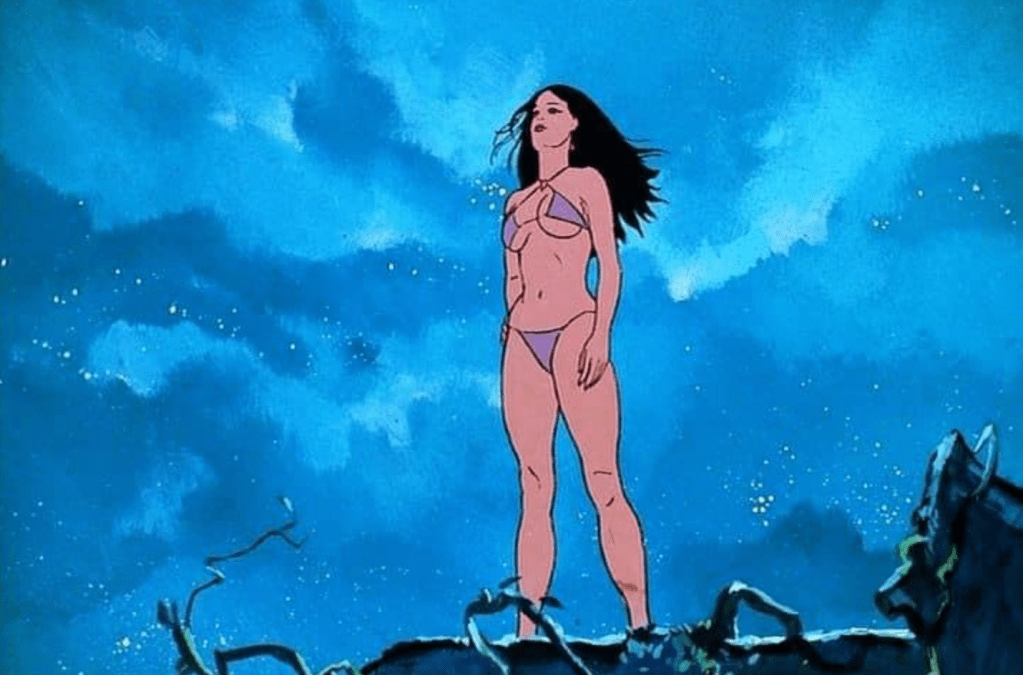
The evil Queen Juliana and her son Nekron utilise their ability to weaponise glaciers to force their opponents to retreat southwards. Princess Teegra, the daughter of opposition leader King Jarol, is kidnapped by Juliana’s subhuman minions, because the ice queen believes Teegra should be her son’s bride.
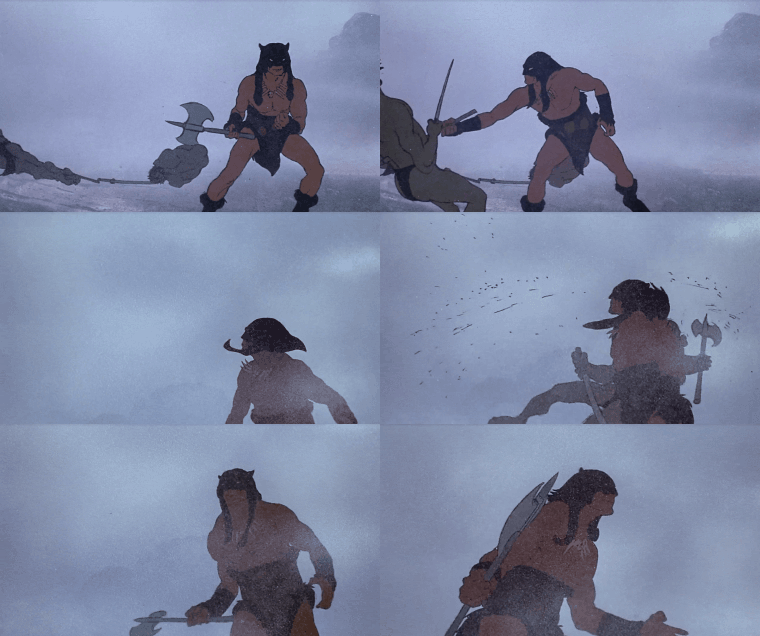
Above: five images from the film
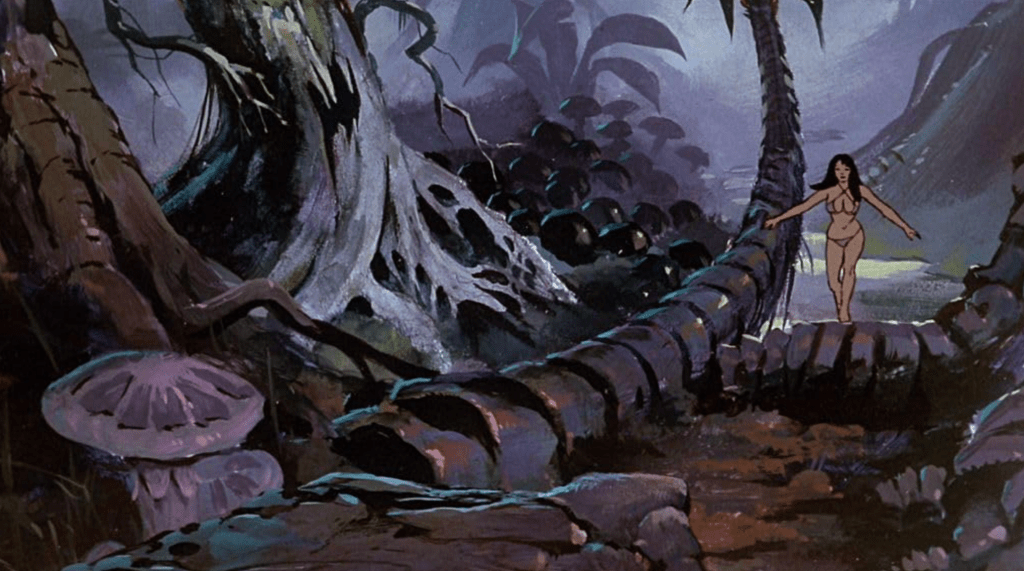
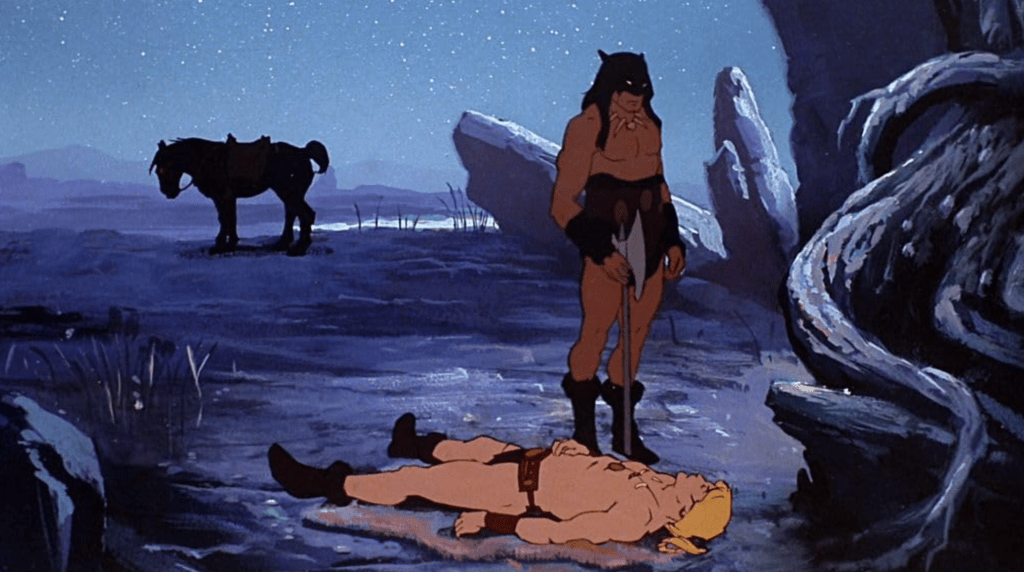
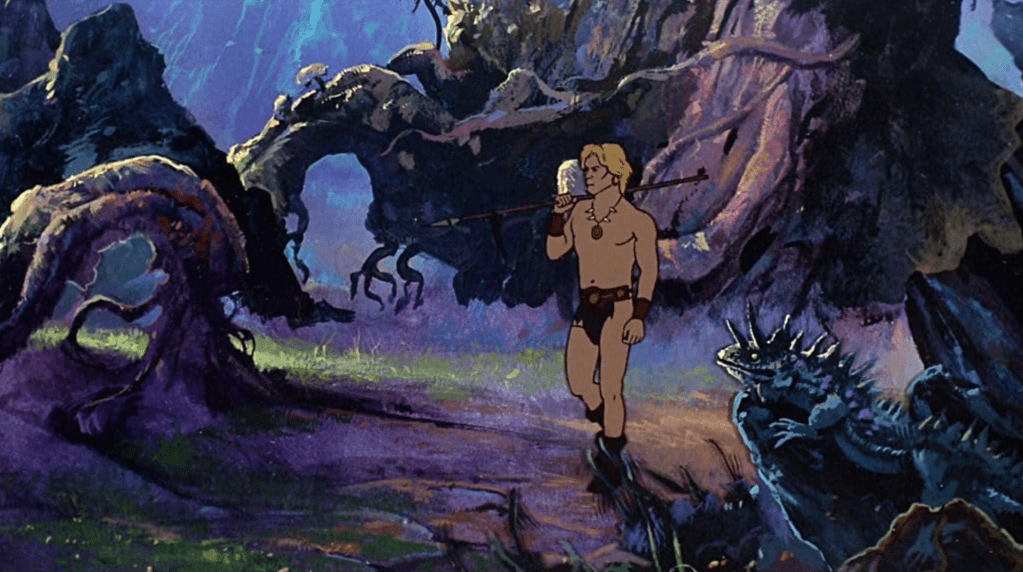
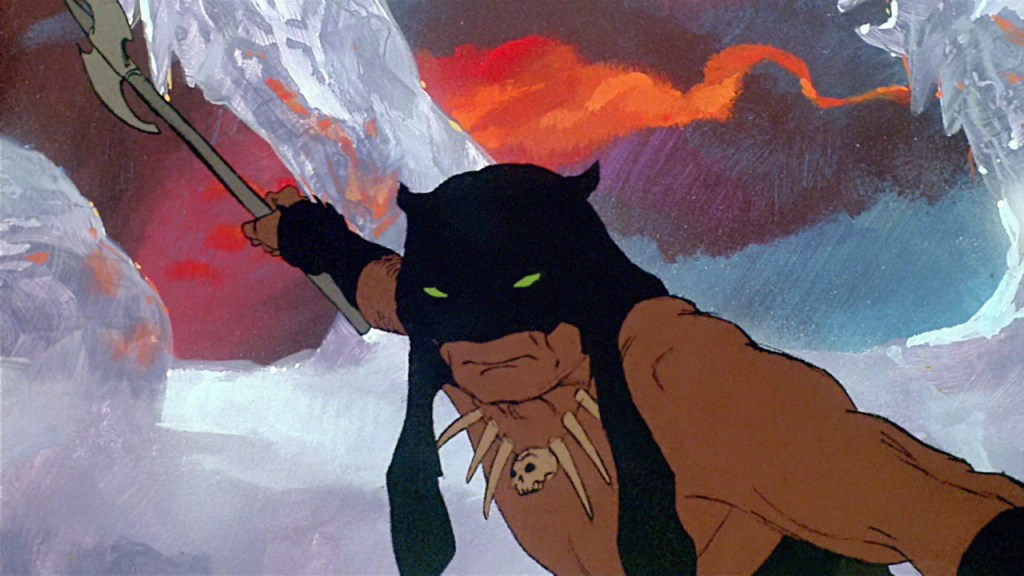
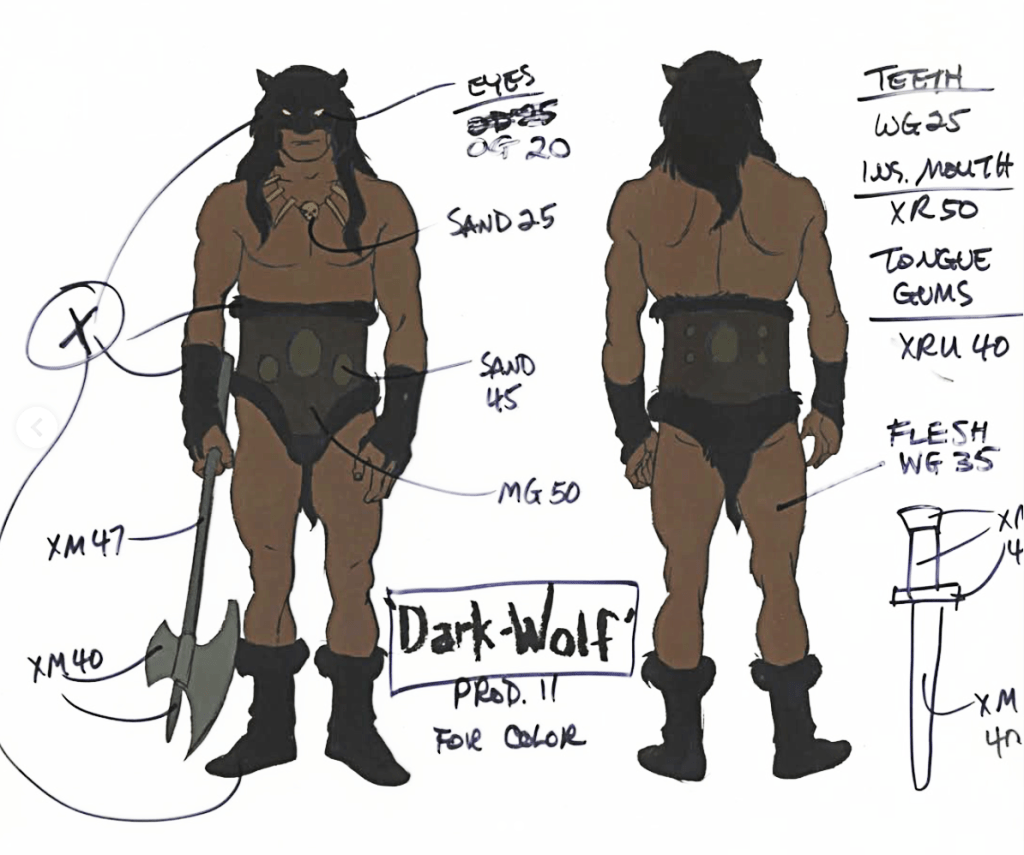
In the ensuing adventure, Teegra escapes from the subhumans but is eventually recaptured, blond-haired hero Larn, who grows close to the princess, vows to free her from Nekron’s icy lair, and wolf-masked warrior-dude Darkwolf kicks subhuman ass! Added to the mix are various monsters, a witch, and lots of lava at the end.
Teegra!
Larn!
Darkwolf!
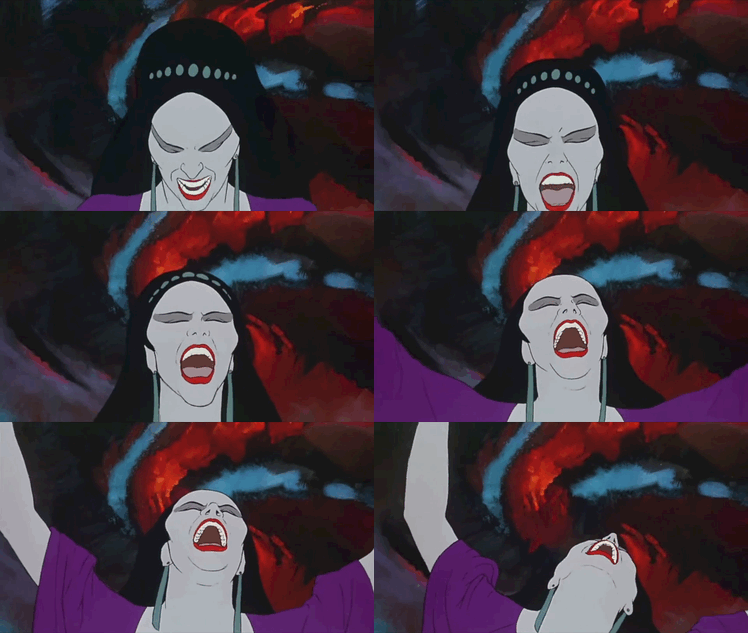
You can tell Queen Juliana is evil just by the way she laughs
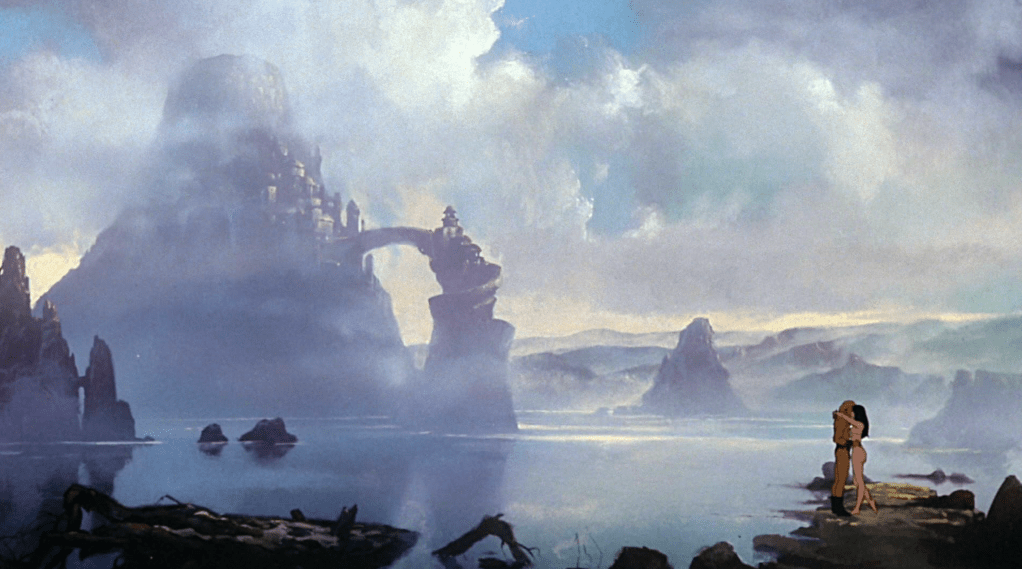
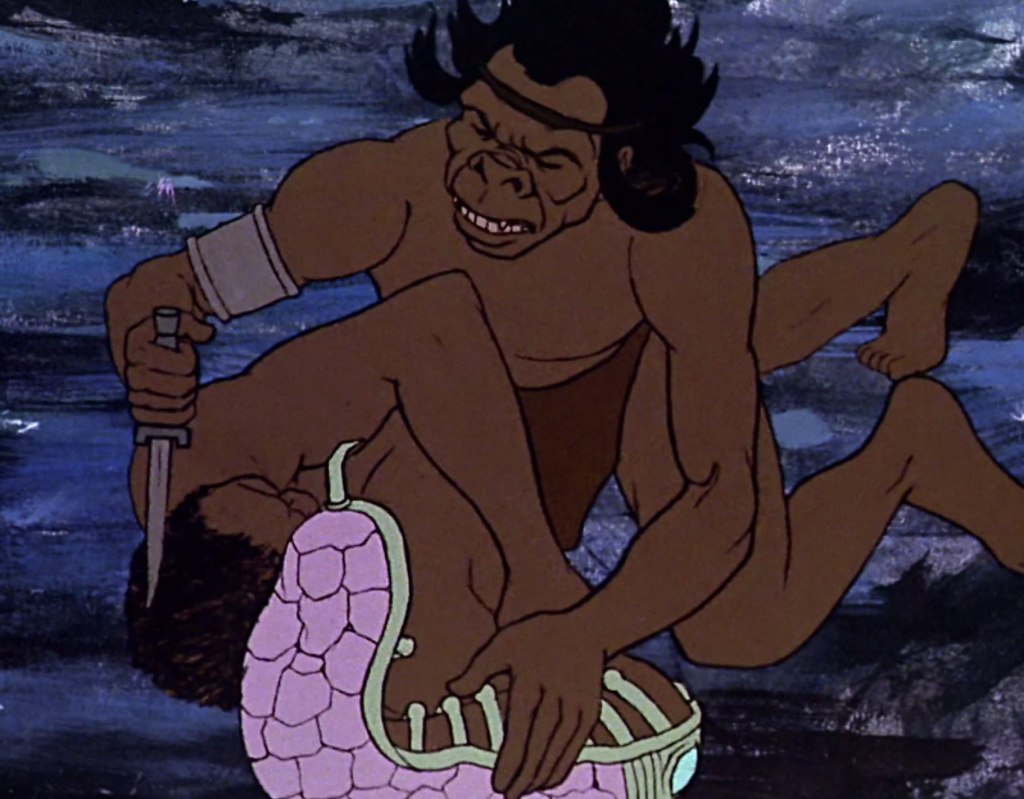
Part of the wave of early 80s sword and sorcery films, this Ralph Bakshi animated production has a fairly minimal plot, written by Marvel scribes Gerry Conway & Roy Thomas, that provides lots of opportunities for the underdressed protagonists to be chased by or fight caveman-like subhumans. Adding to the sword and sorcery credentials of this film is the fact that fantasy artist supreme Frank Frazetta was Bakshi’s main collaborator on the project.
Princess Teegra has a quick wash during her adventure
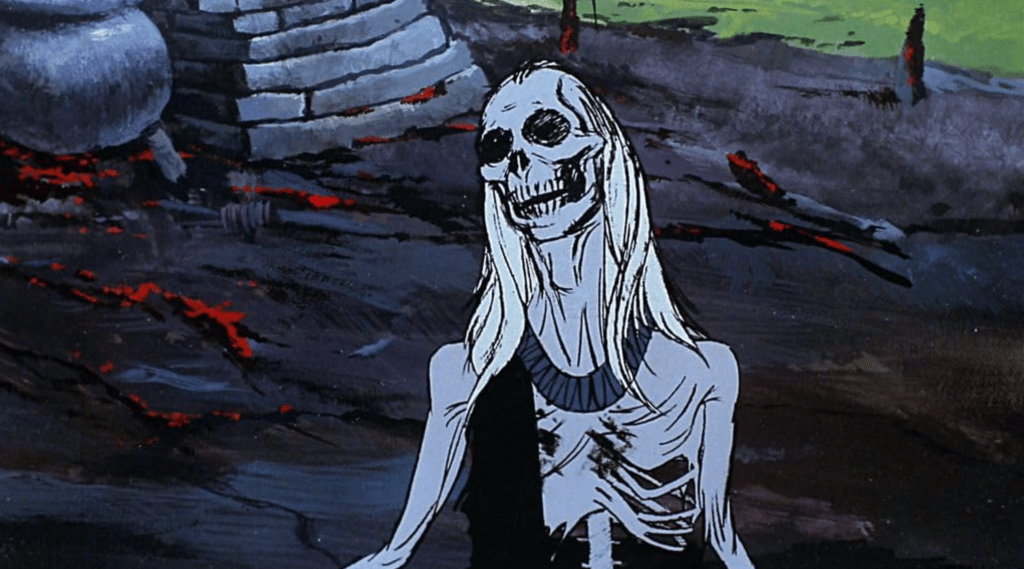
The mix of rotoscoped characters and painted background scenes (painted by Thomas Kinkade and James Gurney) lacks the finesse of Disney, but the style does capture the feel of Marvel’s Conan comics (which were written by Roy Thomas) and the action is more violent than anything seen in a Disney movie.
Ouch! This isn’t the kinda thing you see in a Disney cartoon!
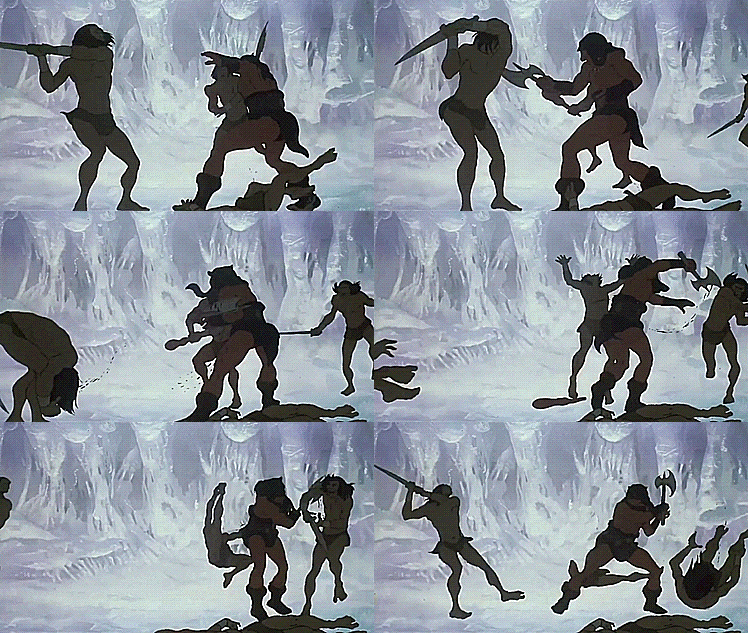
Since my first viewing of the film when it was released, I have retained a fondness for it. Being a Bakshi film, FIRE AND ICE has a small budget that hurts its large scale moments (such as shots of a fast-moving glacier wrecking a village): these scenes are somewhat lacking in detail and seem a little rushed. But the smaller scale action sequences (all the hand-to-hand combat stuff ) are really well handled. There’s something about Bakshi’s rotoscope technique (the use of live action photography to act as the source material for the cell animation) that gives the fight action a vicious, realistic-looking, adult edge.
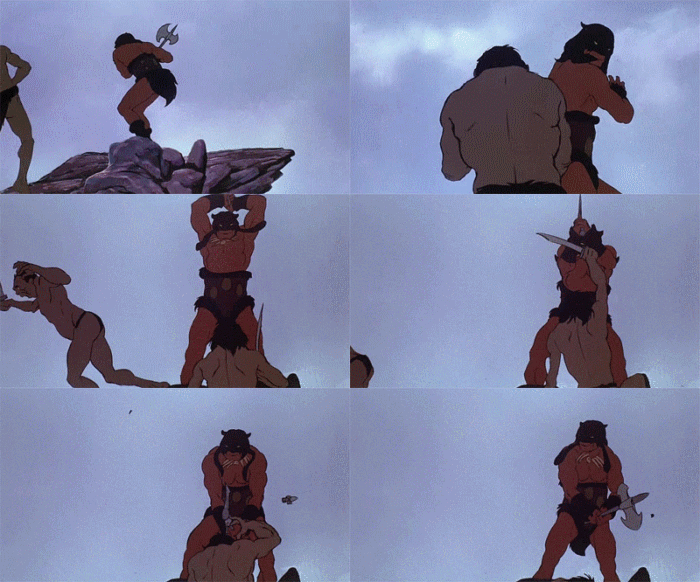
Darkwolf hacks up some more enemies!
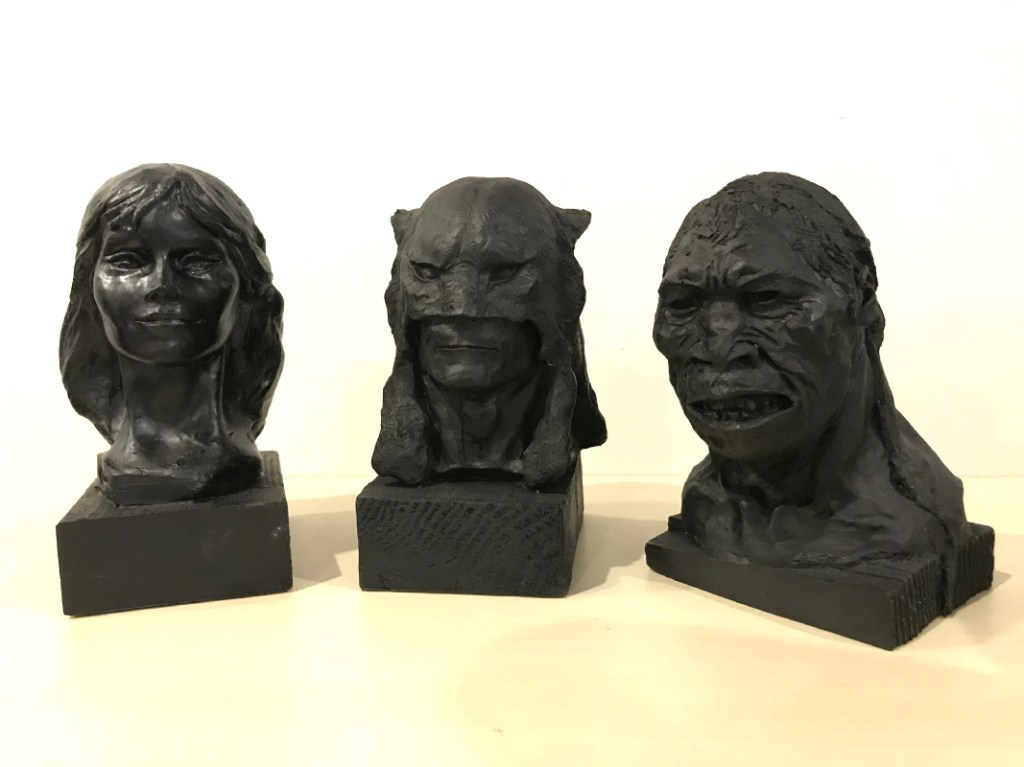
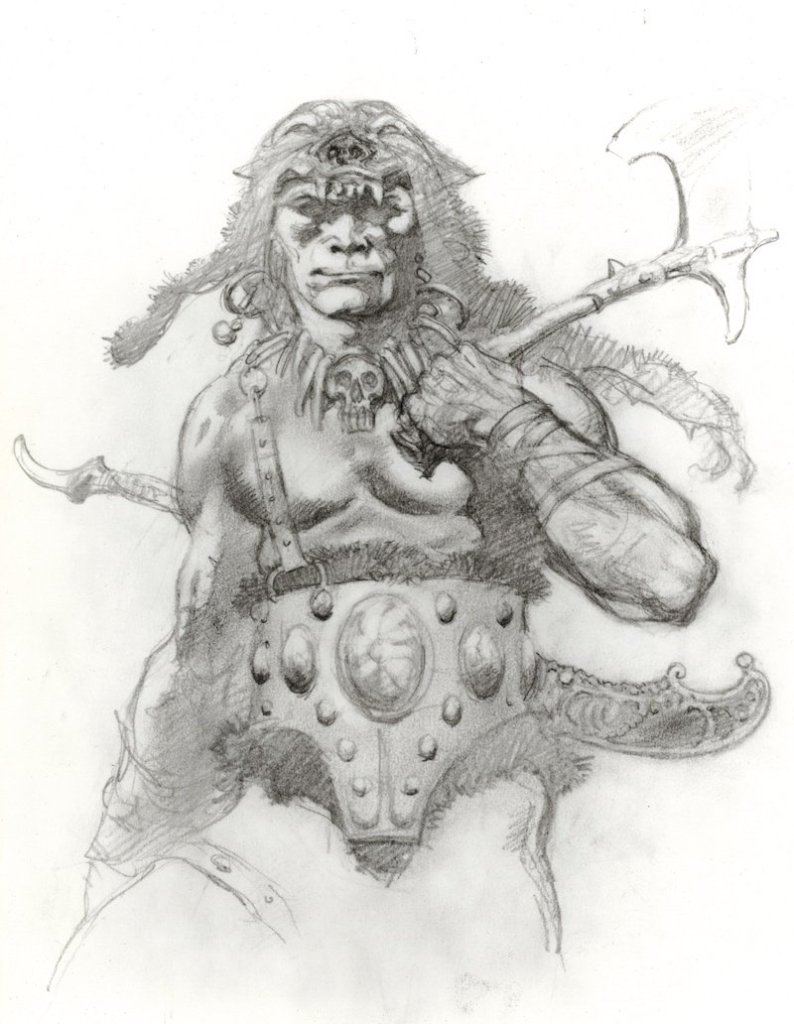
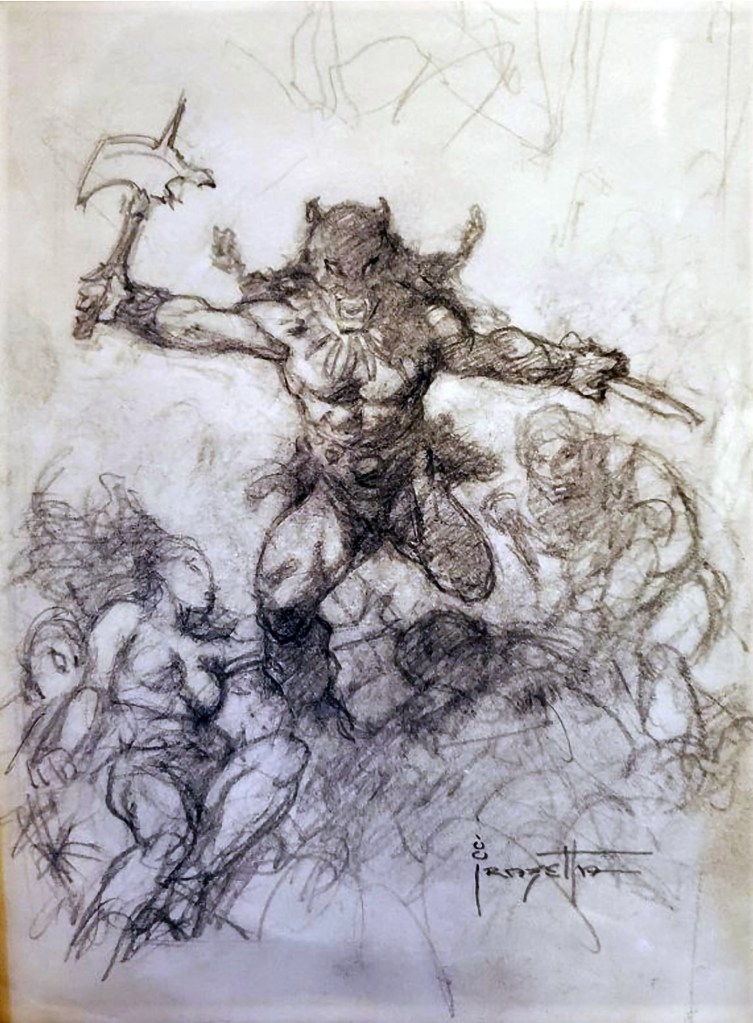
The design of the production definitely has Frazetta’s aesthetic fingerprints plastered all over it. Amongst other things, Frazetta created sculpted busts to aid the animators, and he produced character designs.
Three busts, of Teegra, Darkwolf and a subhuman, which were sculpted by Frank Frazetta to aid the animators
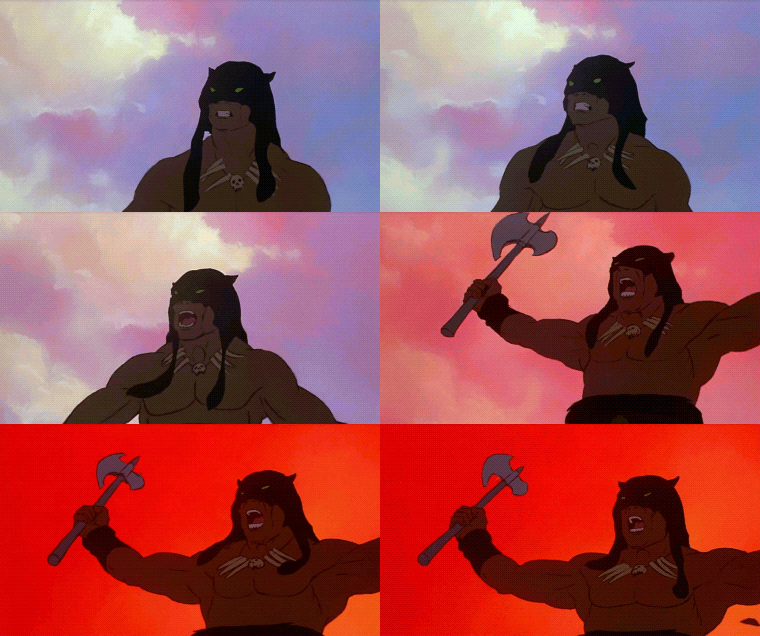
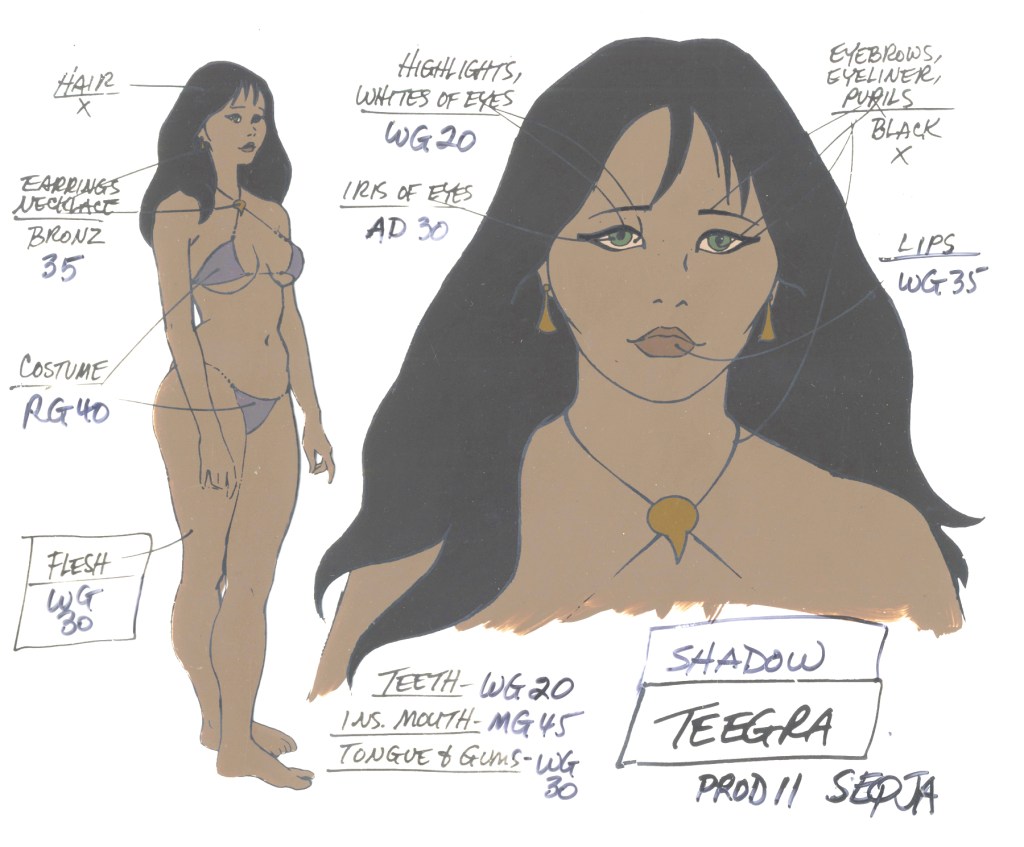
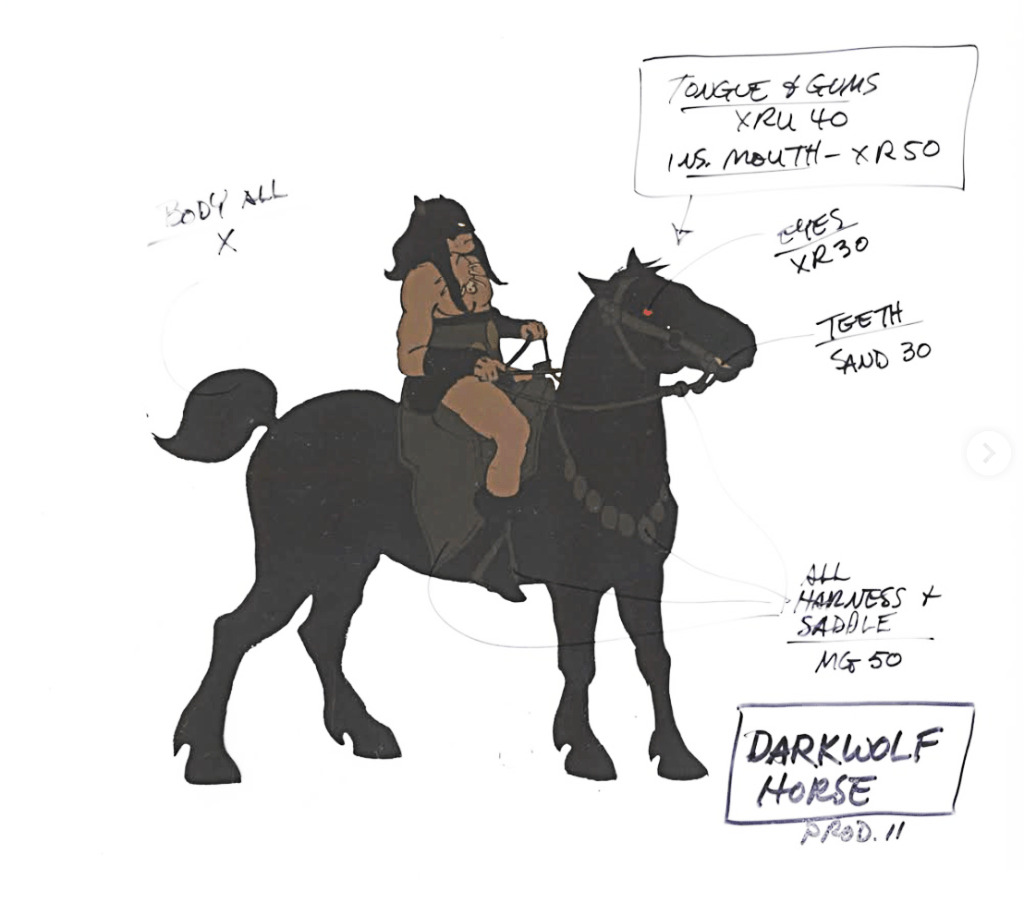
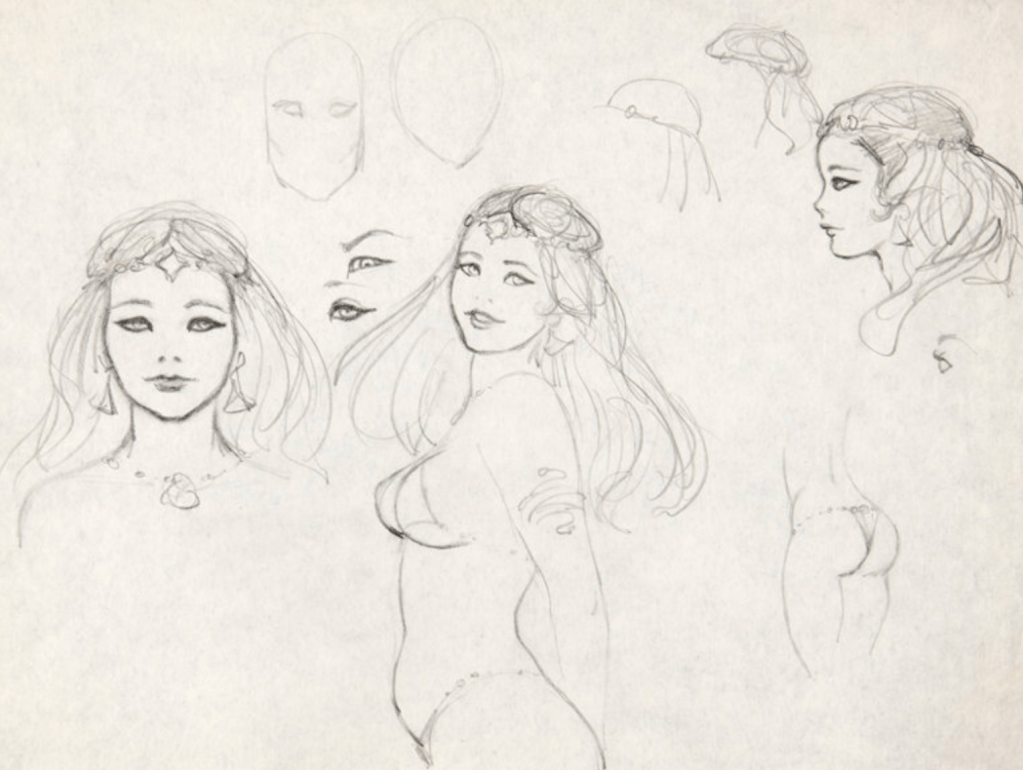
The shapely fantasy femme Teegra, the Neanderthal-like subhumans, and the axe-wielding berserker Darkwolf are all obviously the creations of Frazetta: you can see their likenesses in many of his paintings. Most of the characters are very under-clothed, and it’s no surprise that the film’s Costume Designer was Frazetta!
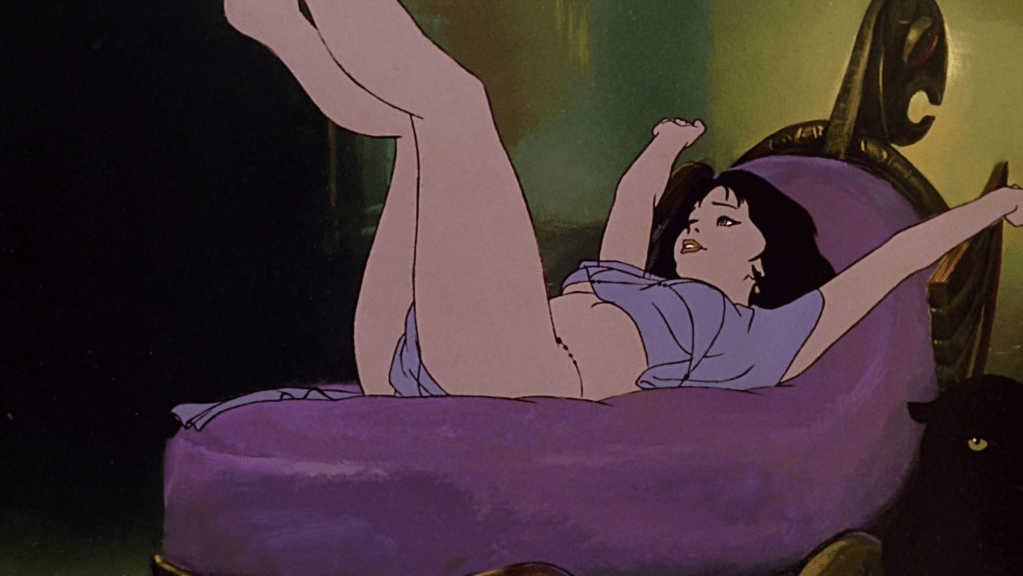
Teegra likes to roll around
Don’t make Darkwolf angry!
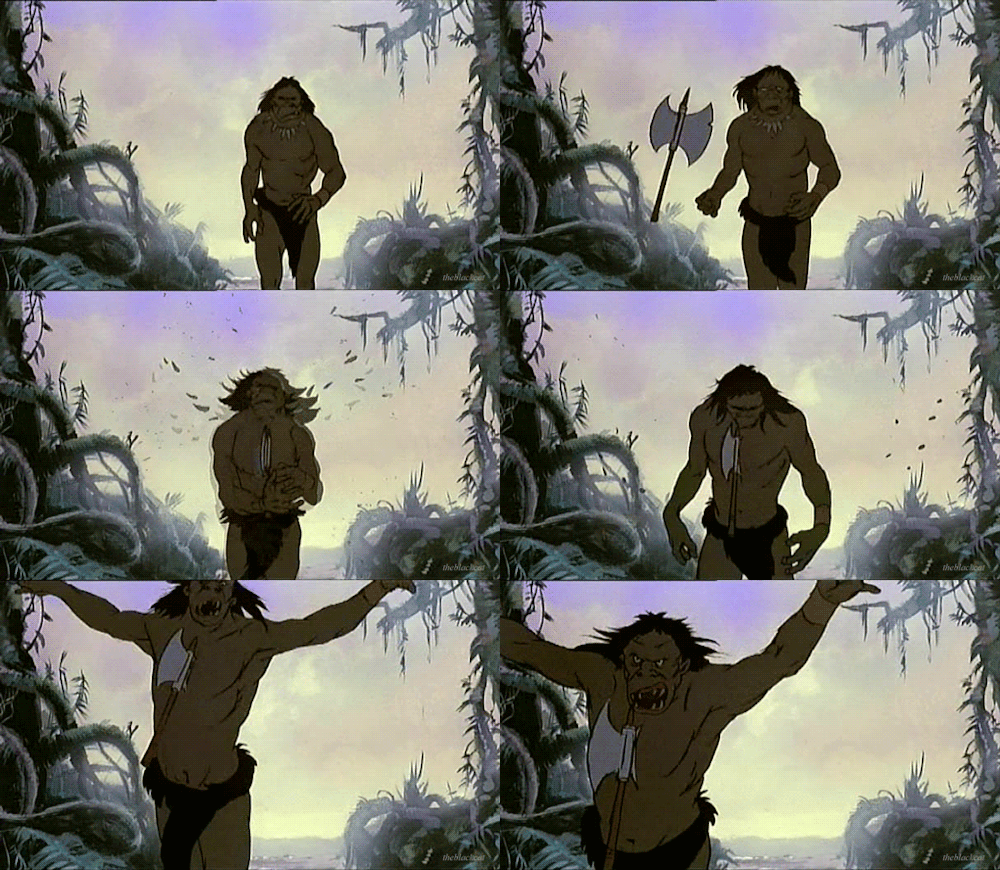
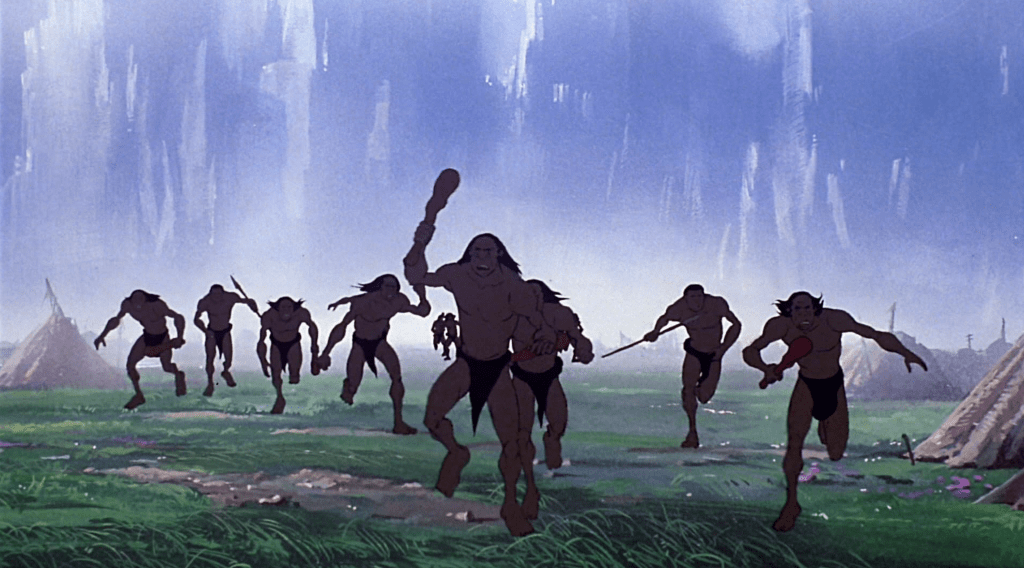
Charging subhumans!
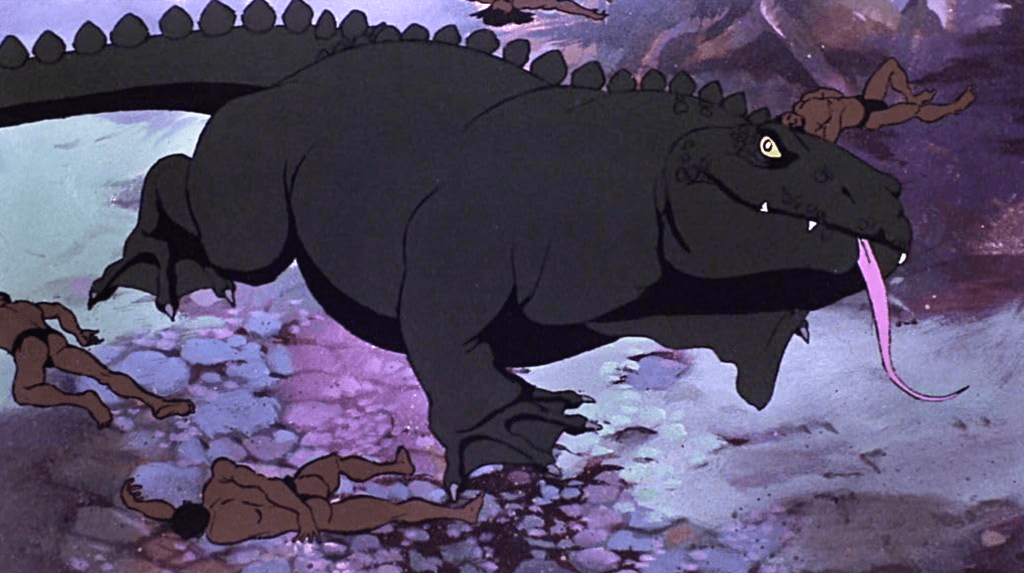
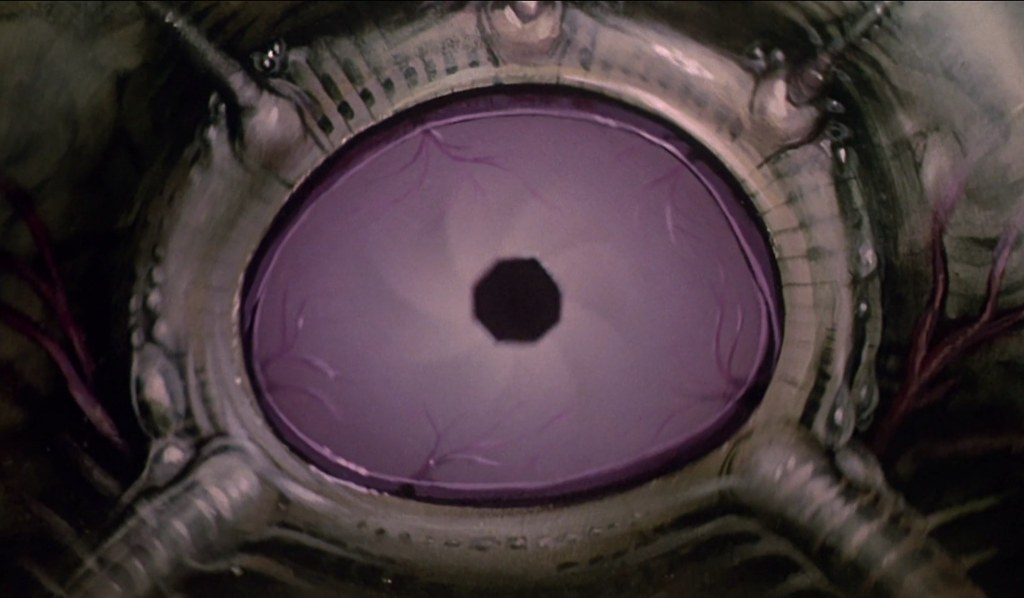
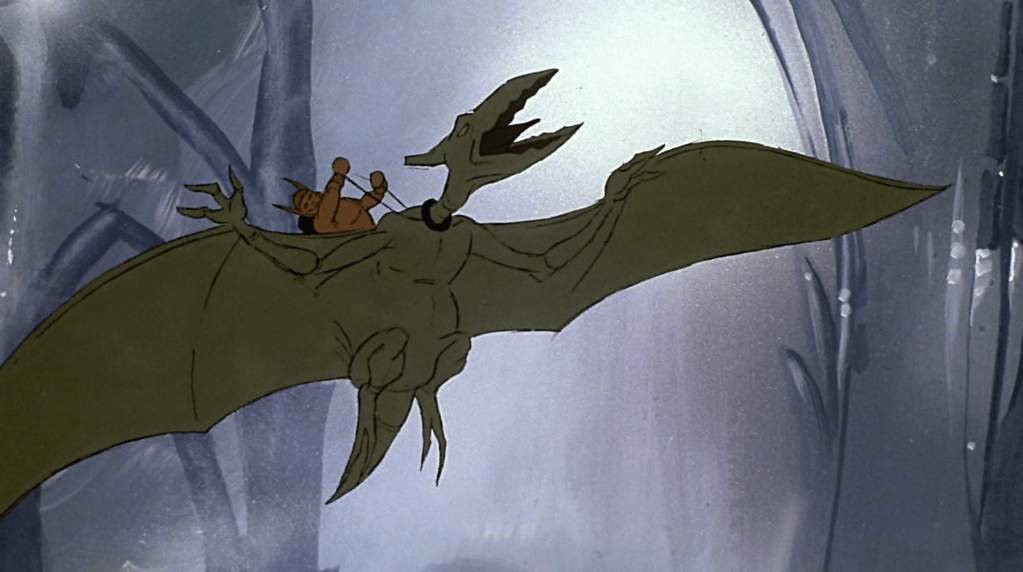
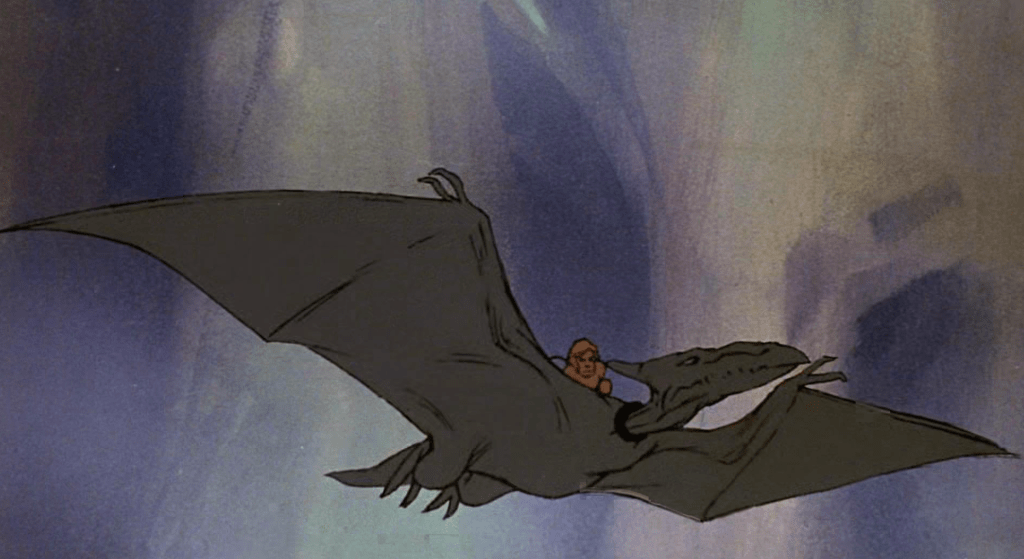
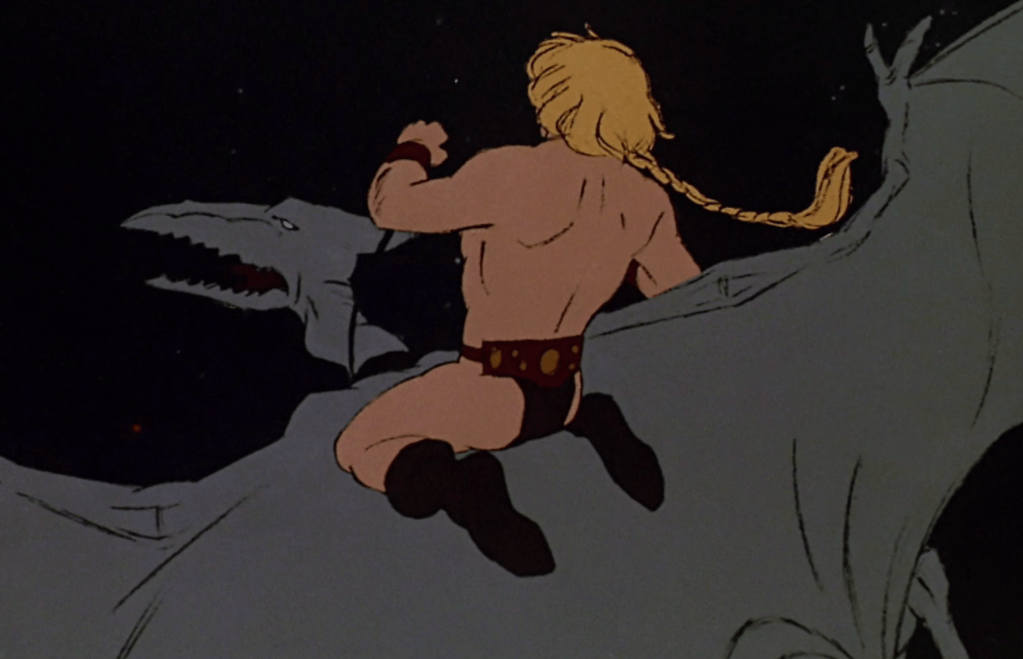
The creatures featured in the film include a cyclopean lake octopus, a giant swamp lizard, black-furred wolves, a bug-like beast that chows down on a subhuman’s arm, and pterosaur-esque flying reptiles that are ridden into battle against the villains.
A reptile runs rampant!
Above: two shots of the lake octopus-monster’s purple-coloured eye!
A subhuman dude falls victim to a weird bug-thing that attaches itself to his arm!
Above: three pics showing the pterodactyl-type creatures that are used for an aerial assault on the bad guys
FIRE AND ICE is a pulpy, fast-paced, rollicking fantasy-action adventure that doesn’t pretend to be deep or meaningful. Basically, it’s a fine piece of animated eye candy that’s always worth an occasional rewatch.
A Teegra model sheet
Above: two Darkwolf model sheets
Teegra concept art by Frank Frazetta (graphite on 12 field 3-peghole animation paper)
One of Frank Frazetta’s original Darkwolf character designs
This was Frazetta’s suggestion for how the US poster for FIRE AND ICE should look
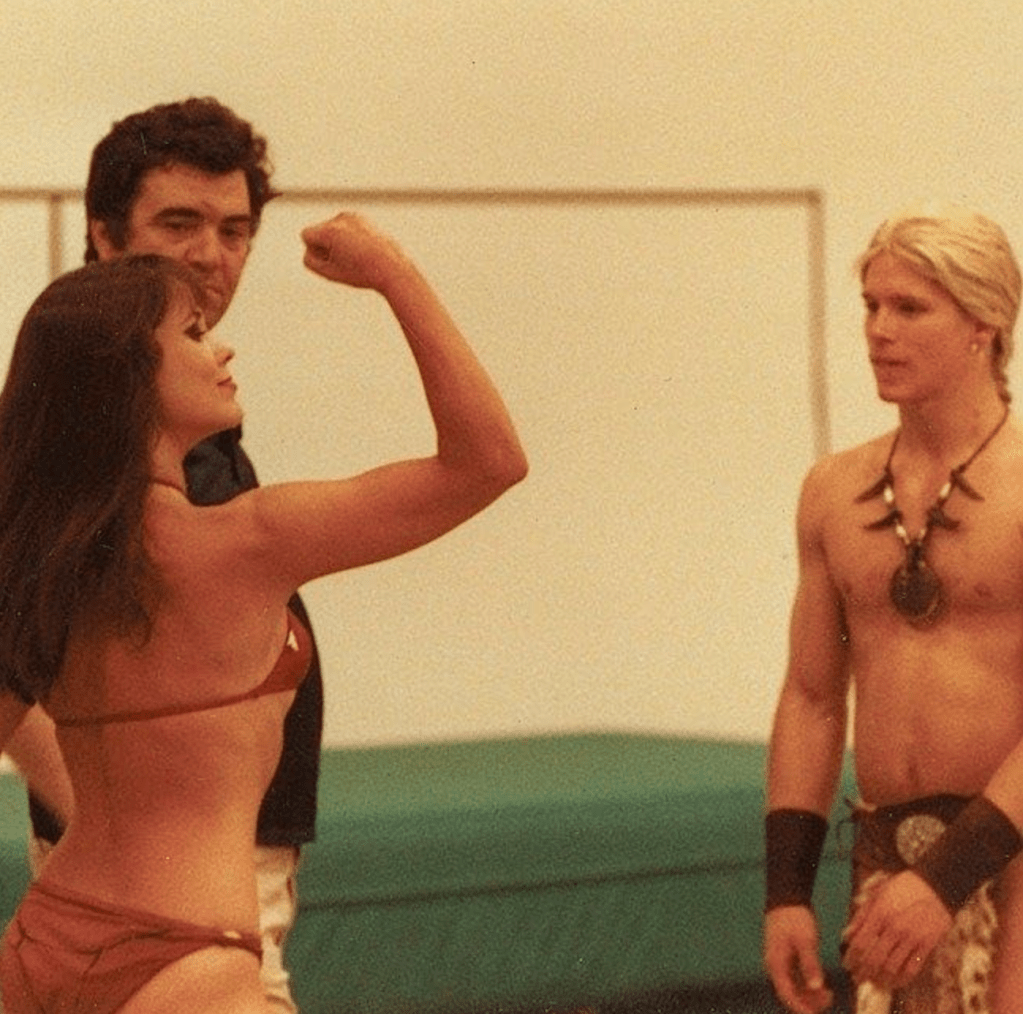
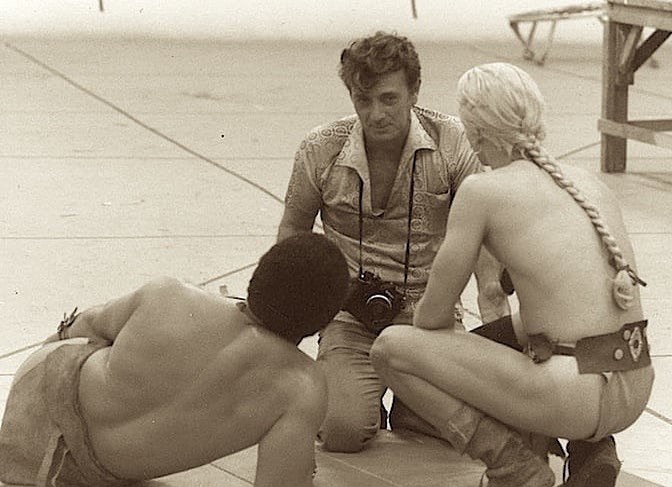
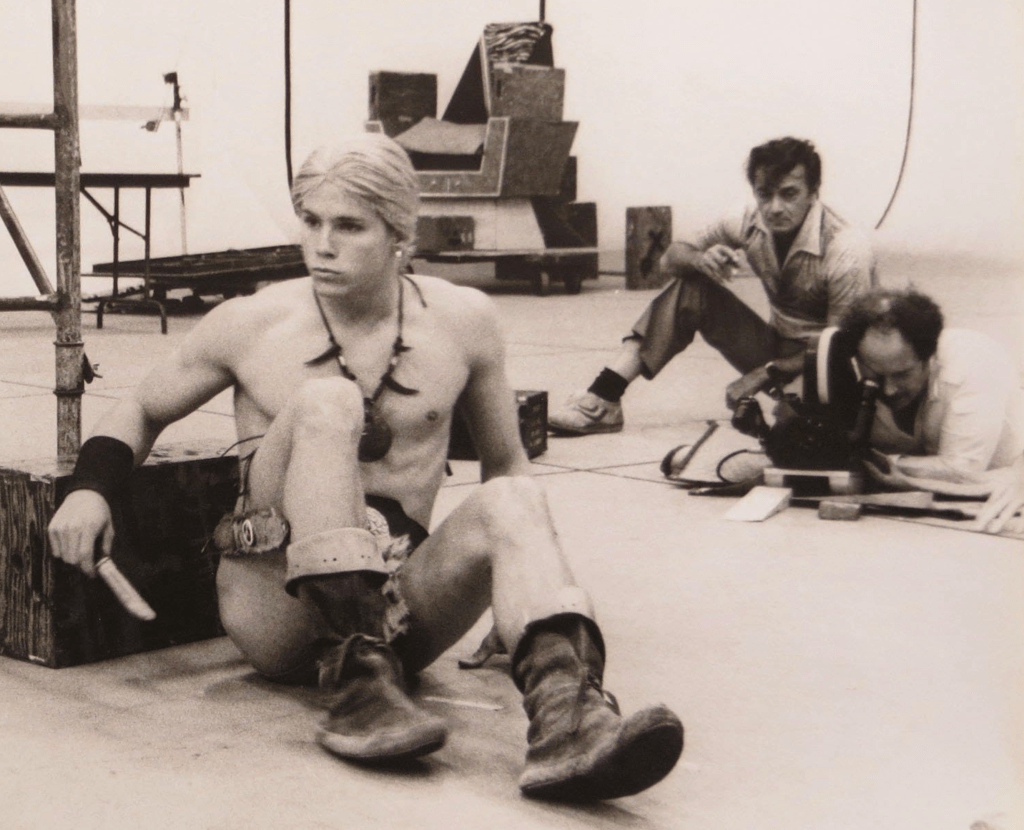
Here are behind the scenes shots showing the live action actors who were used as reference for the rotoscoping…
Above: three photos taken during the live action filming (Frank Frazetta can be seen in the bottom two pics and Ralph Bakshi is in the top shot)
Let’s end this post with one more look at the rampaging rotoscoped mayhem…
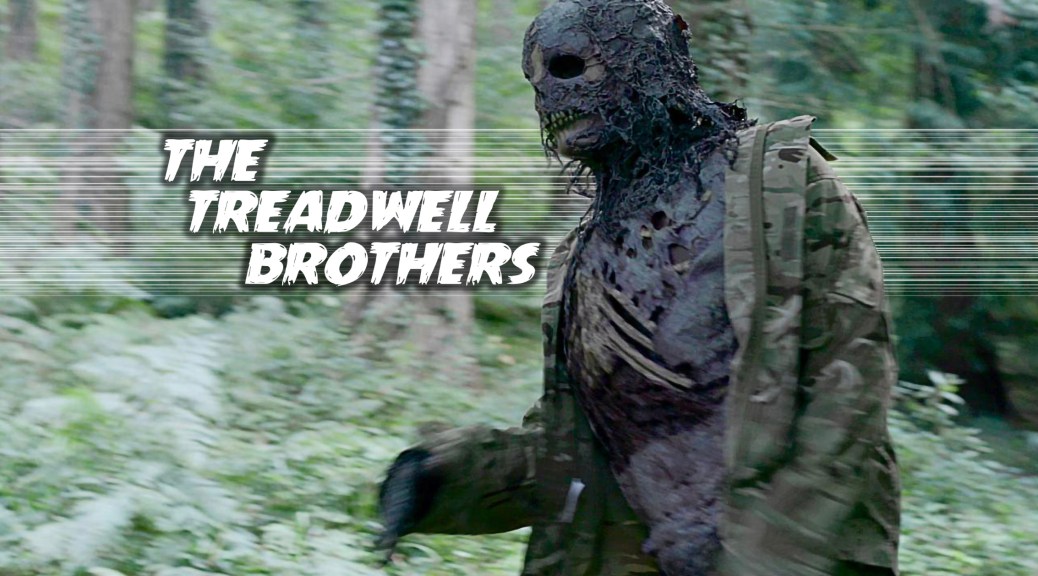
A sneak peek at a host of film zombies that are being created the old school way, which is just the way I like it!
A retro, practical-effects zombie! Woot!
THE TREADWELL BOTHERS is a low budget film that is in its preproduction stage and, hopefully, once finished it will find its way onto Amazon Prime. Maybe the movie will raise its rotting head on YouTube: I guess we’ll just have to wait and see. The two filmmakers behind this project, brothers David and Philip Fitzgerald, are currently trying out zombie makeup designs, doing lighting tests, and becoming accustomed to using their new camera – a Cannon Eos C300 mark II. Philip will be operating the camera and David will be making the zombies. Both brothers will be starring in the film, and Philip will be directing. David is the co-director and, though he is credited as David Fitzgerald for his makeup effects work, he will be using his stage name, William Fitzgerald, as his acting credit. Got all that? Cool, let’s move on…
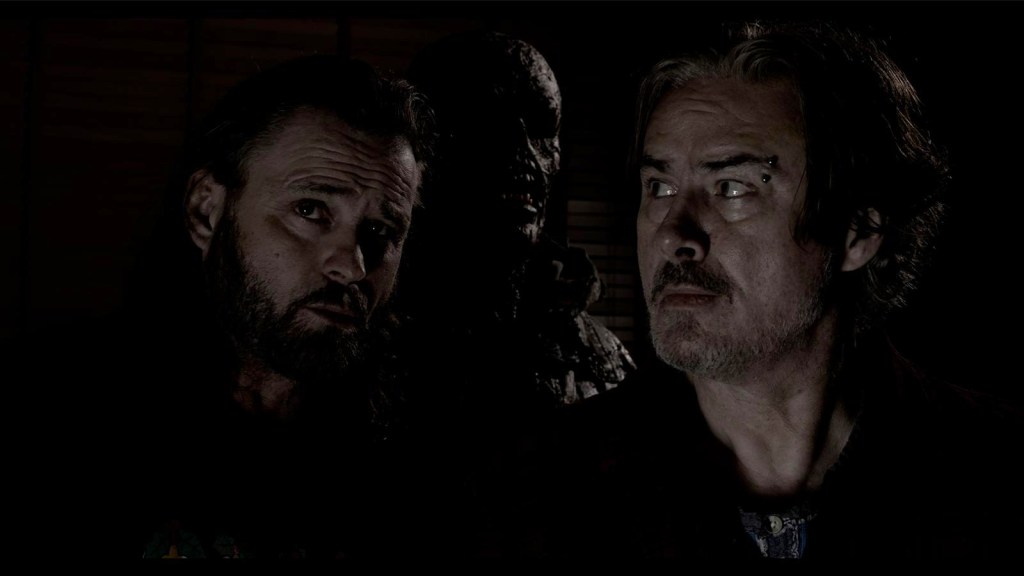
The Fitzgerald brothers will play the titular TREADWELL BROTHERS
The plot will focus on characters dealing with a world that has just about managed to contain a zombie apocalypse. Society has fragmented, with pockets of survivors living in disparate communities. The protagonists are the Treadwell Brothers (played by the Fitzgerald brothers), who were ‘Cleaners’ during the war with the zombies. These Cleaners were operatives set up by the military, and they persevered even after the military’s capabilities had been degraded. Now, in this post-war world, the Treadwell Brothers continue to ply their trade, being paid in kind to keep stray zombies out of towns and other human settlements.
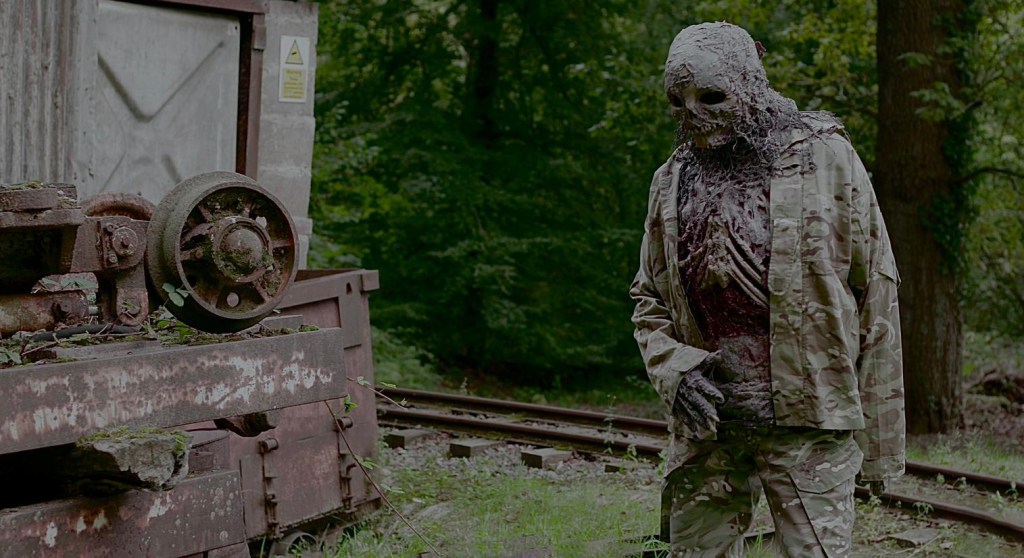
A shot from test footage taken of a zombie lurking near a disused railway
But there are other Cleaner teams out there, and one gang in particular has its own agenda. There’s also a twisted professor trying to create the perfect anti-zombie zombie, which he aims to use to destroy the other undead corpses… but the prof has begun tinkering with humans to perfect his super-zombie.
As the story progresses, the Brothers continue their debate regarding the origin of the zombie outbreak: one believes it’s some kind of biblical punishment, and the other says that it’s a man-made phenomena. Eventually, though, they will discover the outbreak’s true source…
But let’s focus on the zombie designs now, which are still in their preproduction stage…
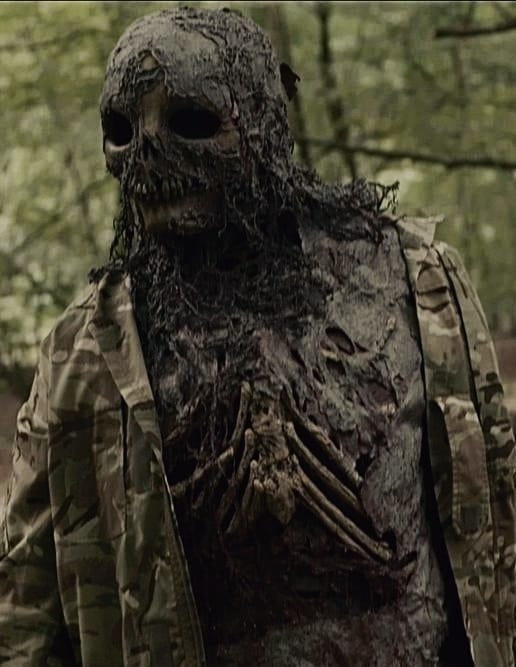
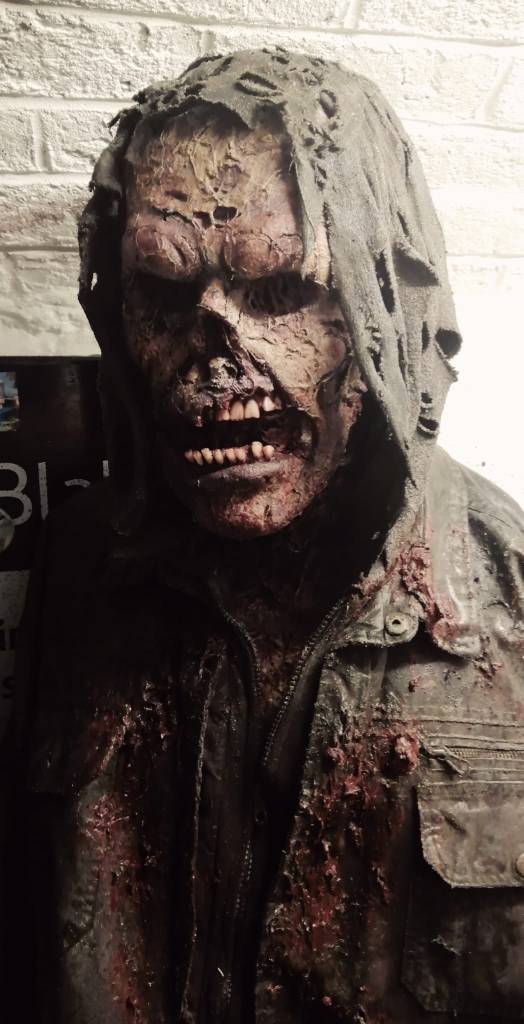
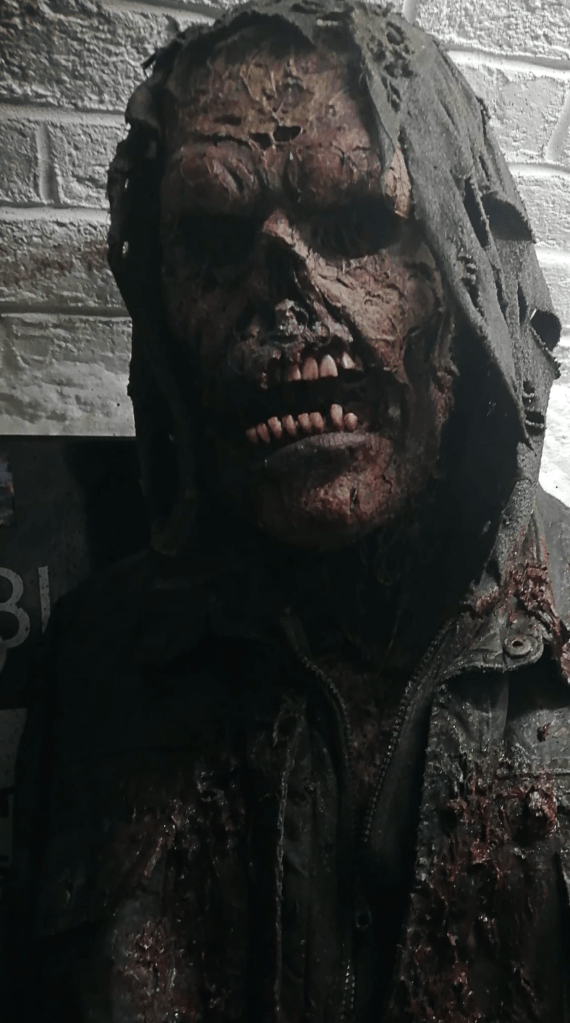
There will be various ‘character’ zombies, including: Oiler Zombie, Mother Zombie, Baghead Zombie, Soldier Zombie, Hoodie Zombie, and Black Eyes Zombie.
This is the Oiler Zombie prior to painting. The finished version will be burnt on one side
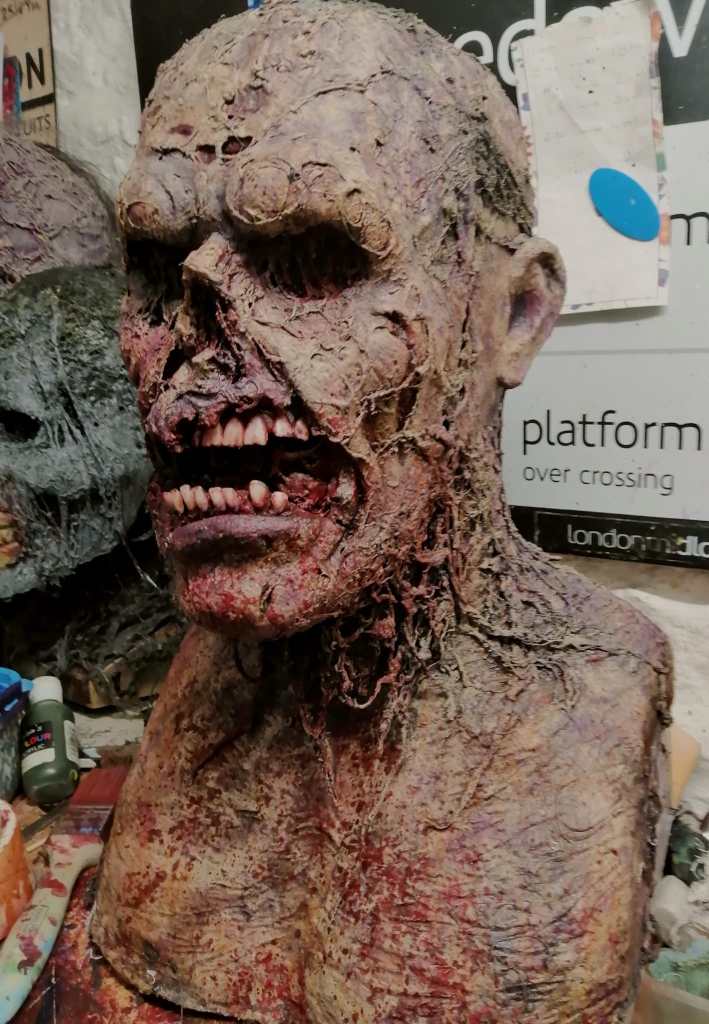
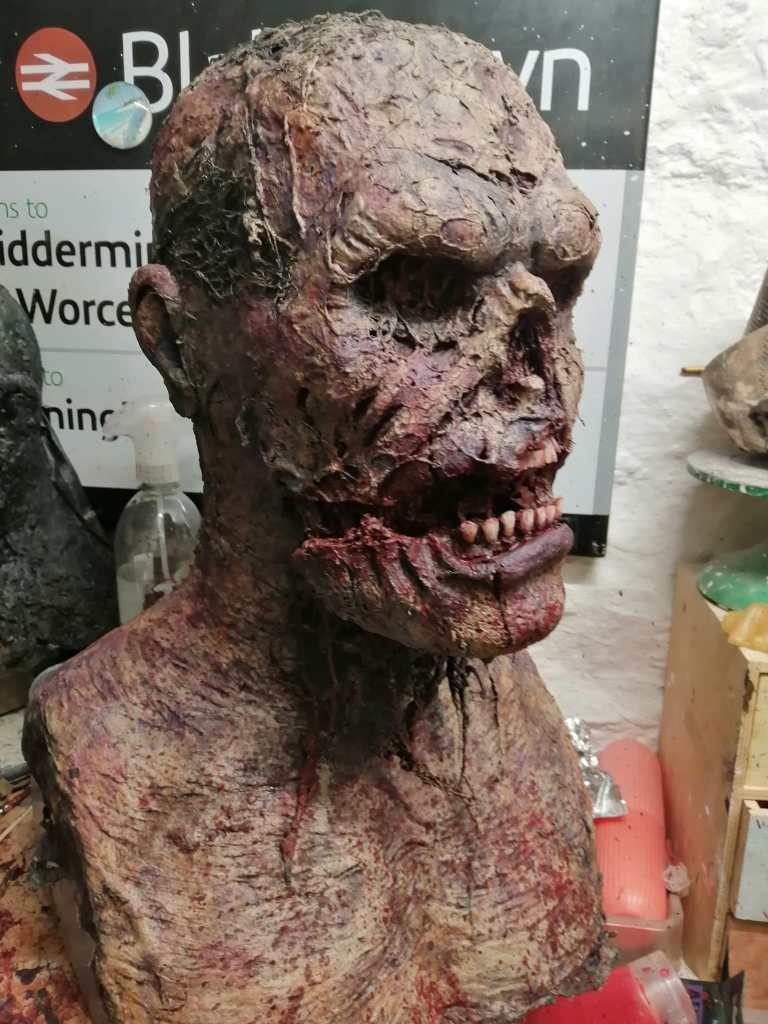
David, who created the ghostly, bandaged demon-dog creature in the short film SQUEAK AND I’LL RUN TO YOU (2021), is building the zombies using various old school, retro techniques, including the direct-build method. He has taken inspiration from such makeup effects legends as Roy (TALES FROM THE CRYPT, THE PLAGUE OF THE ZOMBIES) Ashton and Jack (DRACULA, FRANKENSTEIN, WHITE ZOMBIE) Pierce, using materials like cotton batting (absorbent cotton pressed into pads or layers) that is impregnated with liquid latex to create dead skin. David says that one of his movie touchstones for this project is Fulci’s ZOMBIE FLESH EATERS (1979), and his Hoodie Zombie is inspired by Amando de Ossorio’s BLIND DEAD movies. He hopes the practical zombie effects will imbue THE TREADWELL BROTHERS with an Amicus vibe too.
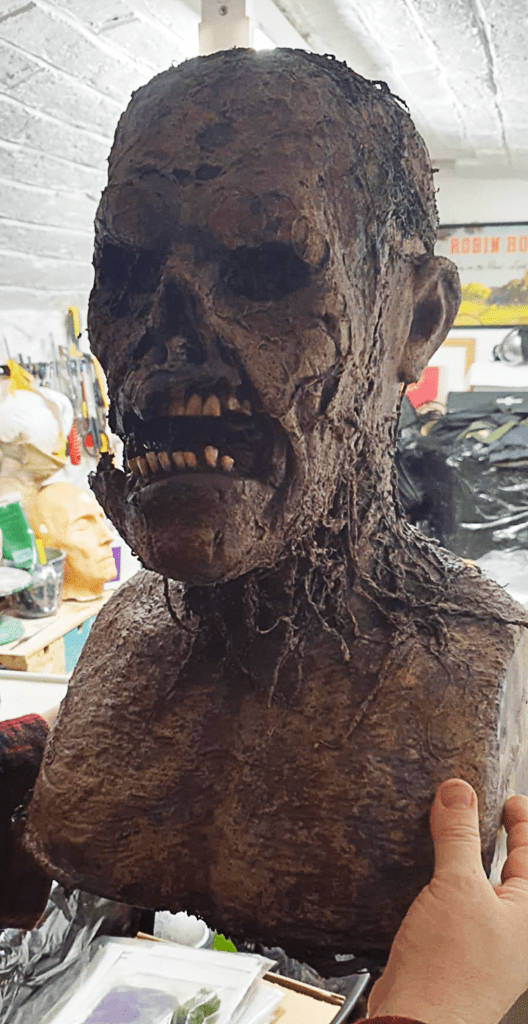
CGI zombies, like the ones in WORLD WAR Z (2013), can be okay, but I prefer guys in zombie makeup/latex masks/prosthetics, just like the undead dude above!
So let’s feast our eyes on some zombie-tastic designs now! (note: these are shots of in-progress creations, so the costumes haven’t been distressed and broken down yet, etc)
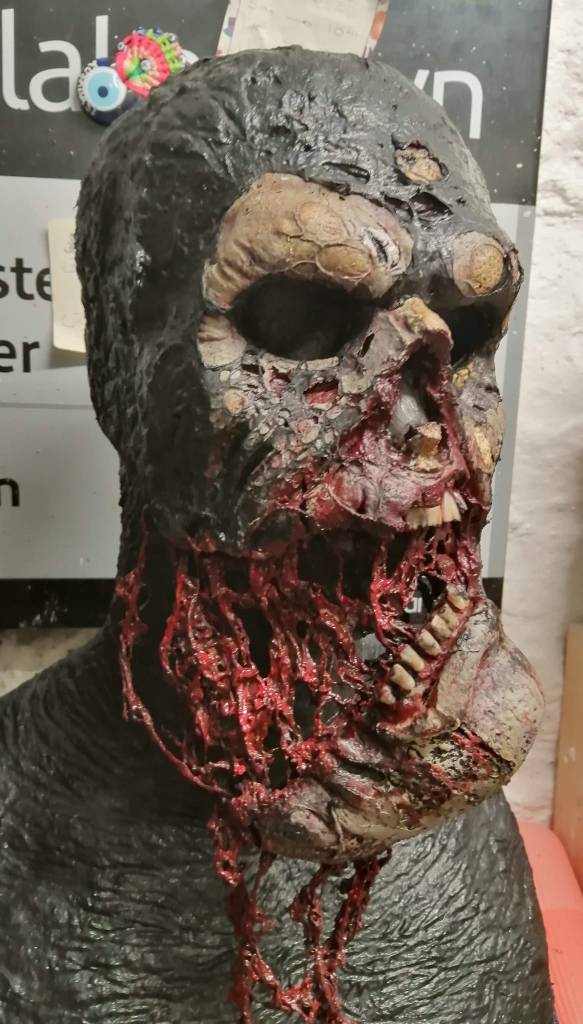
Early-stage Hoodie Zombie, when David was considering giving it a very distinct hanging jaw
Then David decided to make the detached jaw effect more subtle and less grisly
Above: two shots of the later version of the Hoodie Zombie
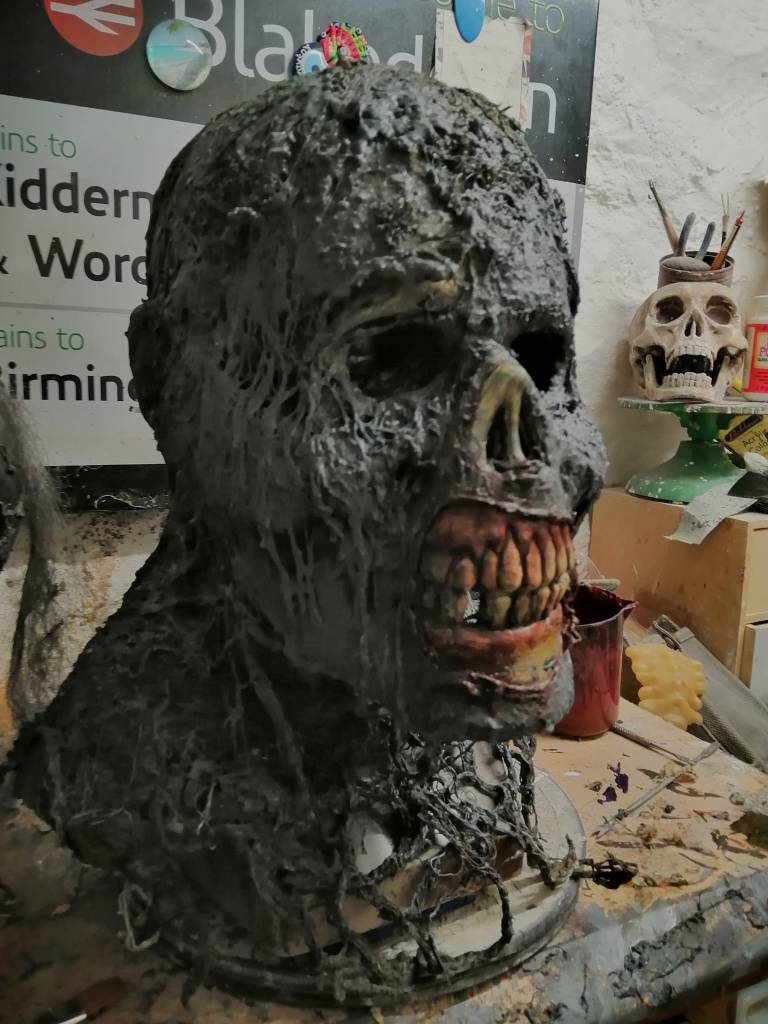
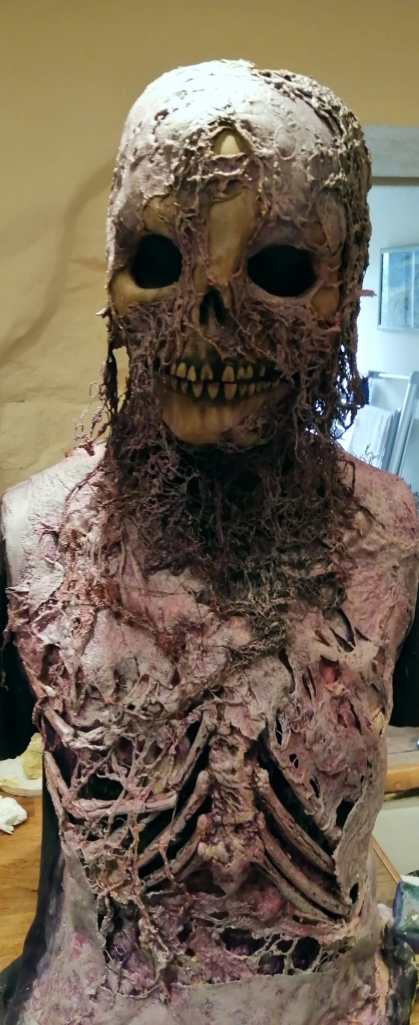
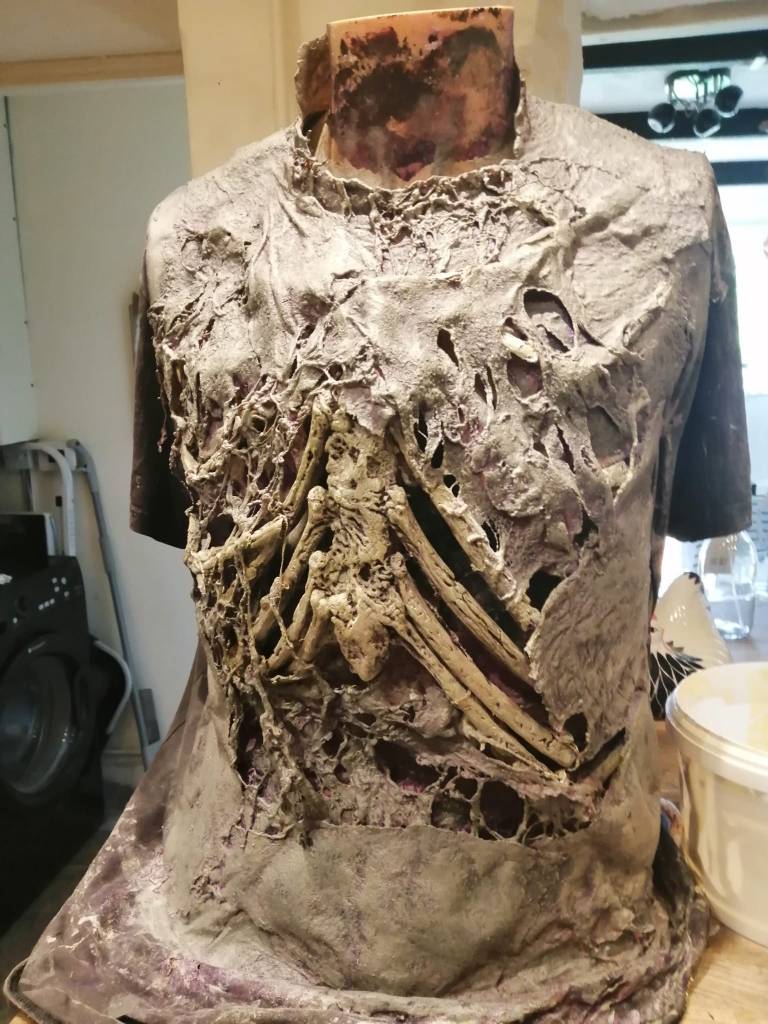
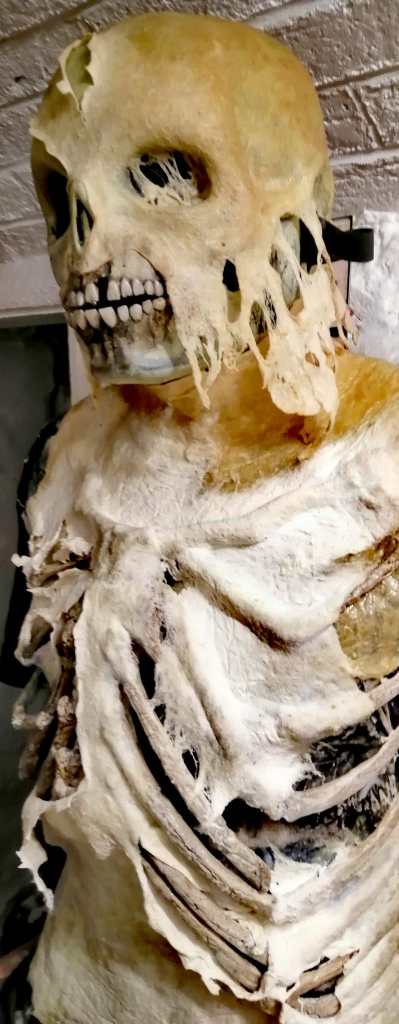
Chest and ribs detail of a zombie, prior to painting
Cotton batting, impregnated with liquid latex, is used to create the zombies’ dead skin
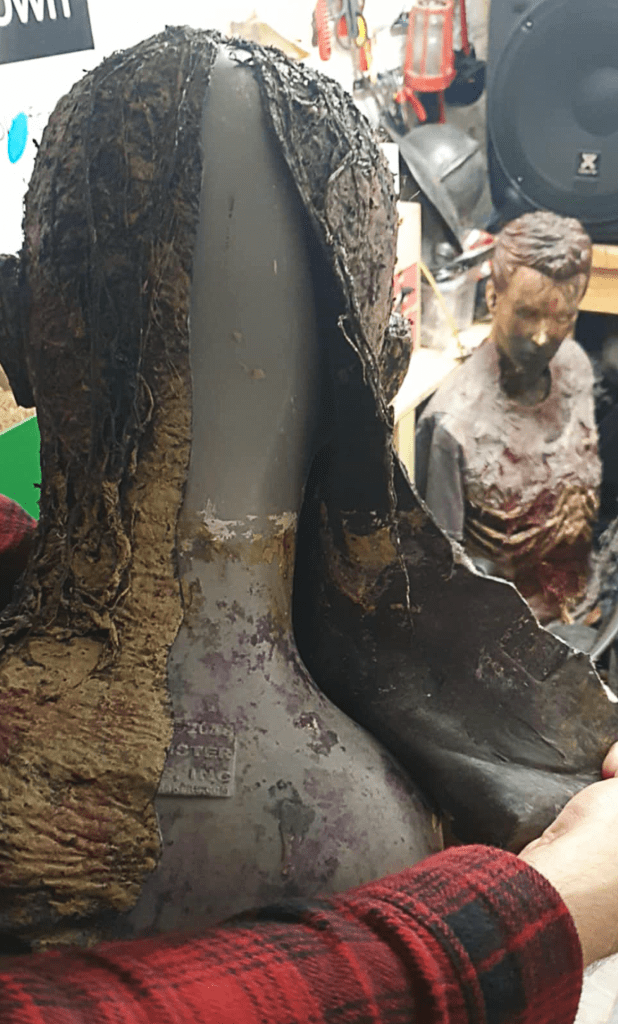
The Soldier Zombie’s skull-head was made from Carte Lana wool paper, then covered in rubber and cotton batting
Carte Lana wool paper can be made to look very skull-like. Note that these teeth haven’t been given aged detailing yet
Skin texture is sculpted into the cotton batting before it completely dries…
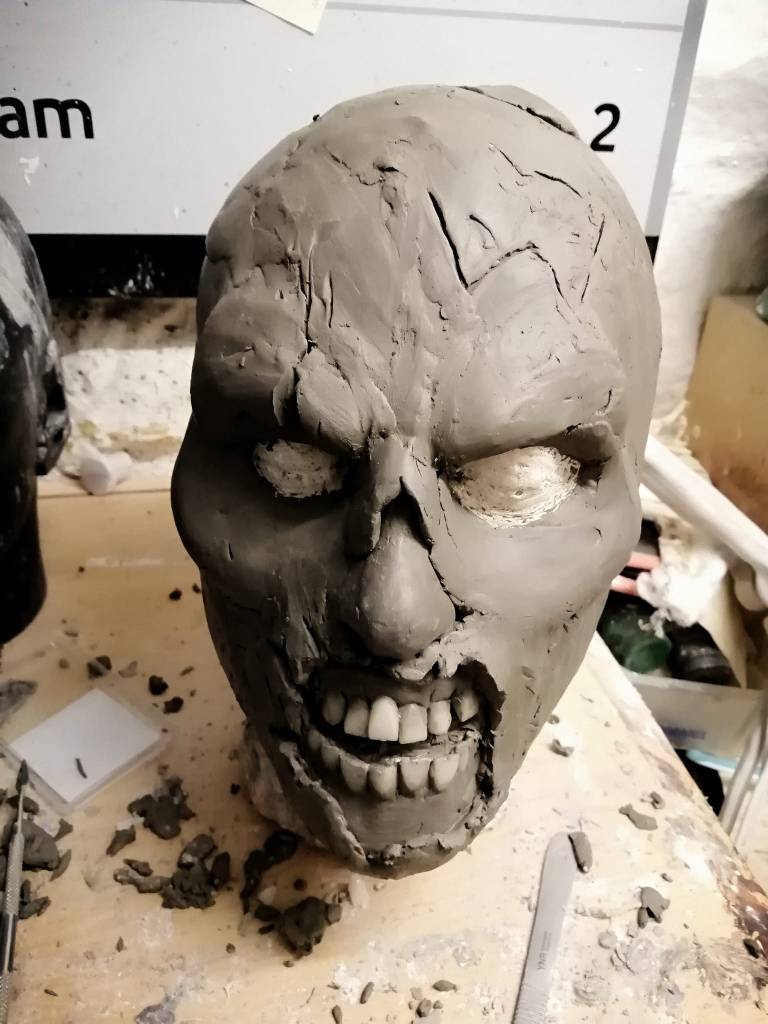
This is a rough, early-stage ‘clay sketch’ for a background zombie
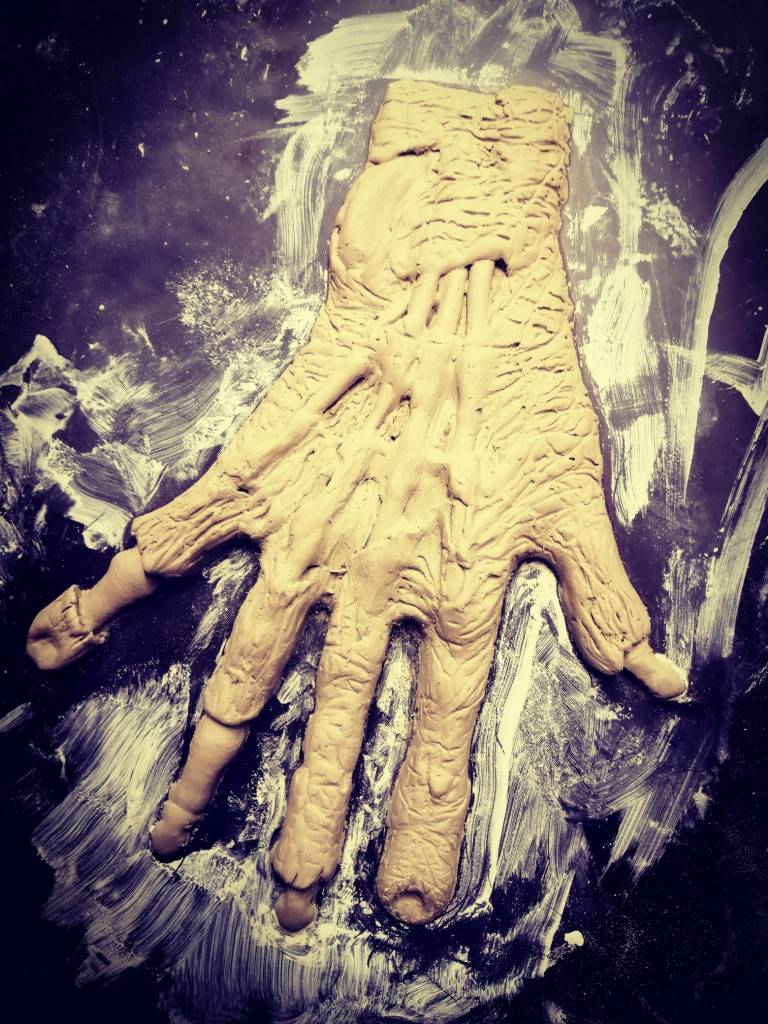
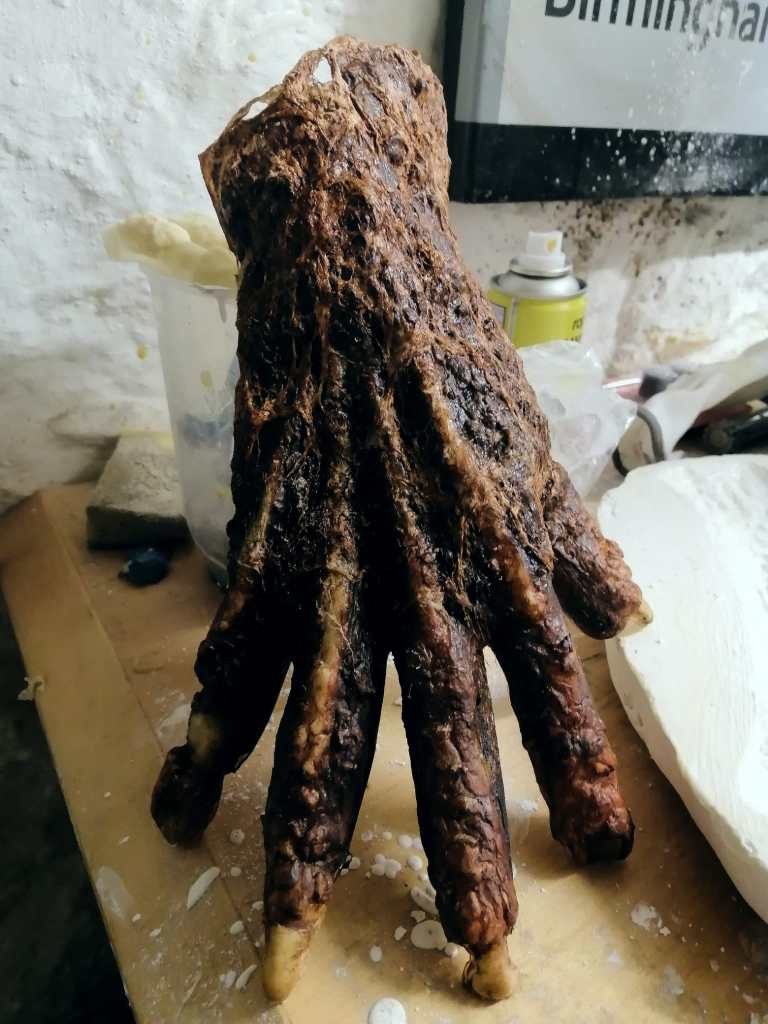
Sculpt of the Soldier Zombie’s gnarly hand
This very effective-looking zombie hand was created by gluing the latex moulding onto a glove!
A look at the liquid latex & cotton ‘skin’ used for the zombies
Above: two more shots of the Hoodie Zombie
So here’s hoping that the Fitzgerald brothers start filming their undead opus, so we’ll get a chance to watch their wonderfully old school zombies shambling across the screen!
A zombie on the loose: this looks like a job for THE TREADWELL BROTHERS!
Starring Sallie Harmsen, Alexandre Willaume, Anneke Blok, Fred Goessens, Noor van der Velden and Markoesa Hamer. Written by Nico van den Brink and Daan Bakker. Directed by Nico van den Brink. Produced by Sabine Brian and Dennis Cornelisse. NL Film/Vrijzinnig Protestantse Radio Omroep (VPRO)
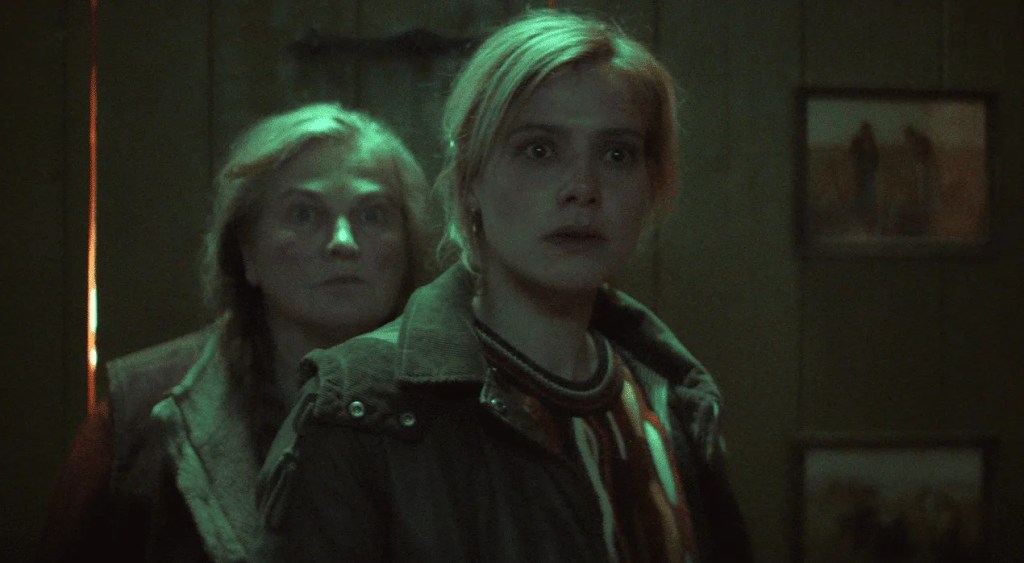
Betriek (Sallie Harmsen) and her mother become embroiled in supernatural events
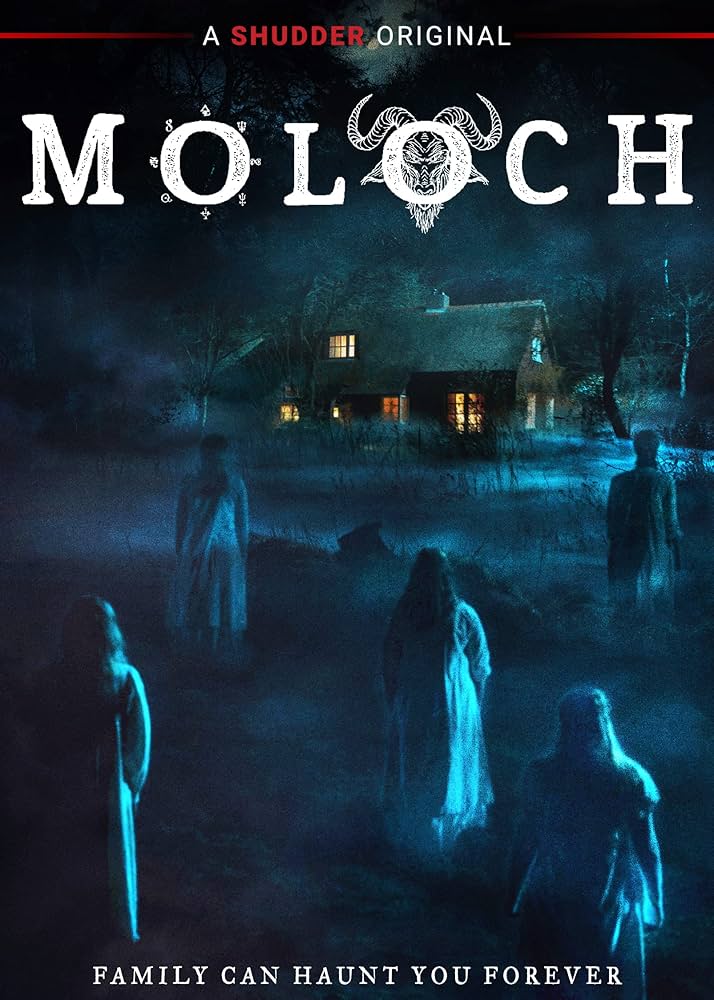
Betriek (Harmsen) lives in an area close to the edge of ancient bogland. Her family has suffered from a history of tragedies, and Betriek starts to suspect that the deaths of her relatives are somehow linked to the local legend concerning a wronged servant called Feike who made a pact with the demon Moloch – or maybe the preserved female corpses recently discovered in the nearby peat deposits are part of the puzzle…
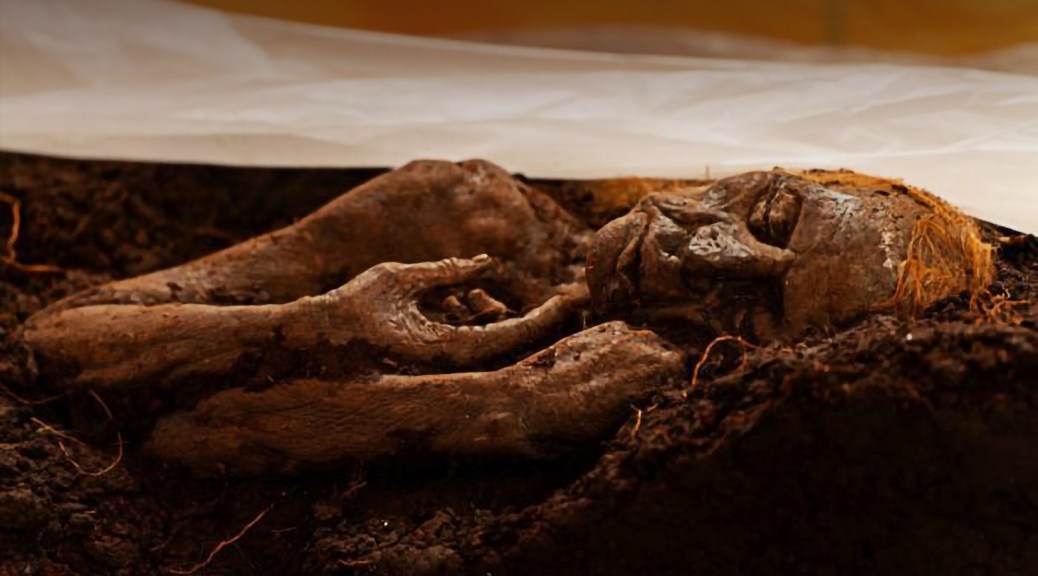
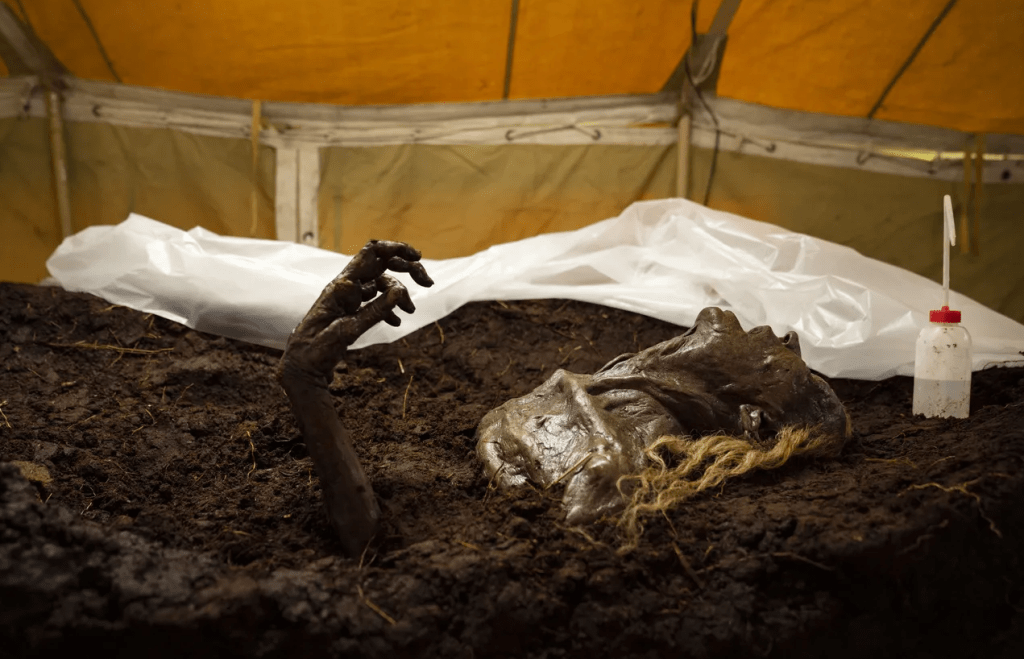
One of the cadavers found in the bog
This Dutch movie uses its often foggy and gloomy swampy locations effectively, and employs the archeological dig aspects of the plotline to inject extra mystery into the story.
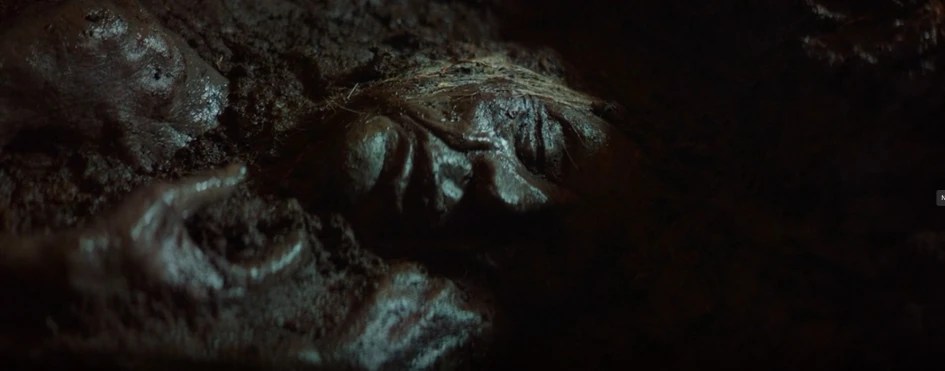
Another one of the bog bodies
Matters become more intriguing once various normal people are somehow compelled to become would-be killers, attacking Betriek and her mother in trance-like states.
Betriek’s mother is attacked by a possessed person
Creepy!
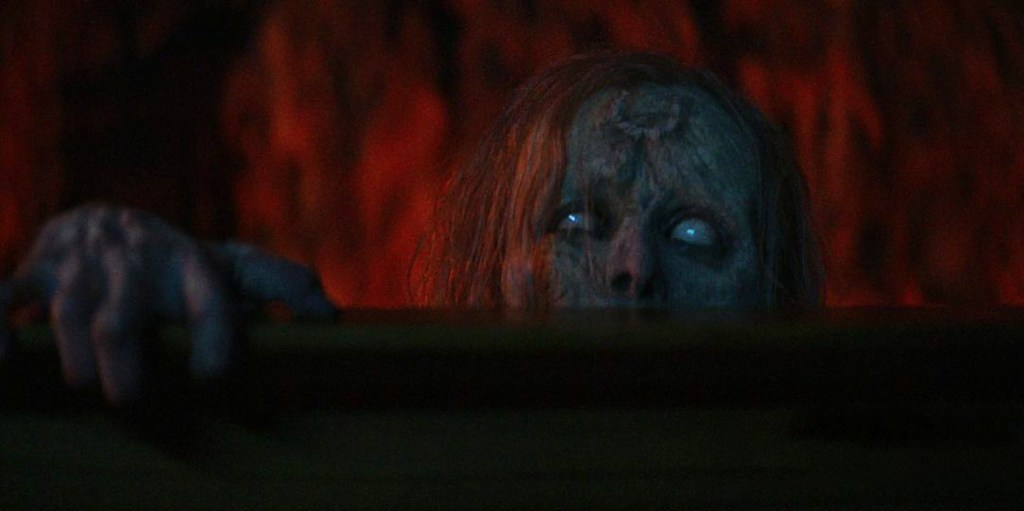
With mask-wearing cultists lurking about, and the spirits of murdered women emerging from the misty peat bog, the answer to the movie’s central enigma is finally revealed, and – even though it doesn’t properly explain the behaviours of the possessed would-be assassins or clarify if there is a causal link between the supernatural plot elements and the local pagan folks – the finale does give viewers a suitably striking set piece ending to remember.
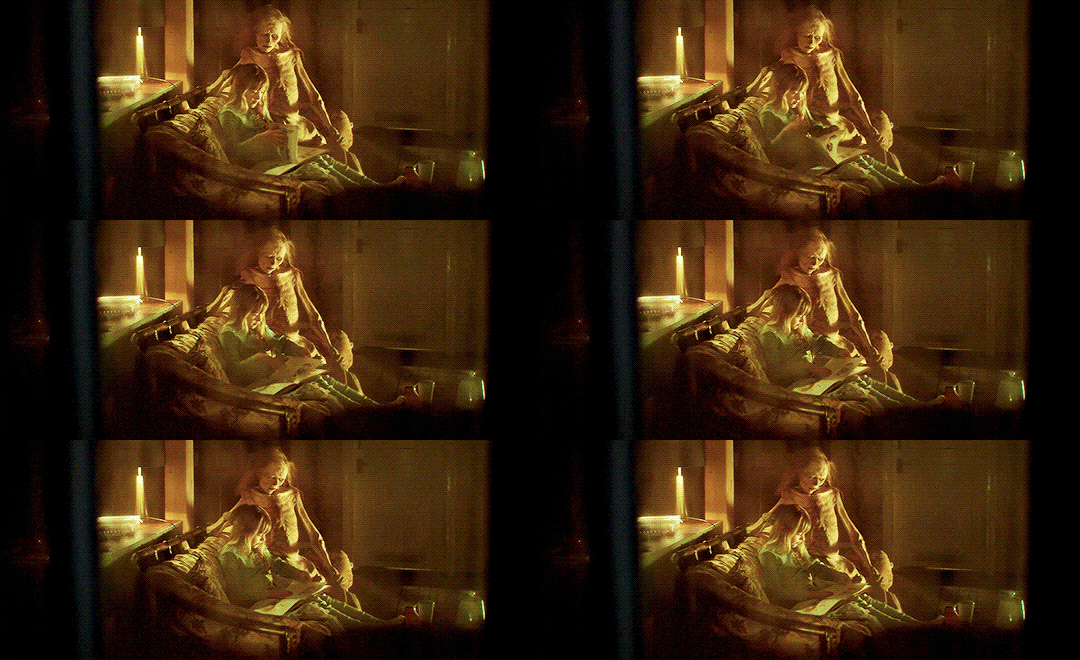
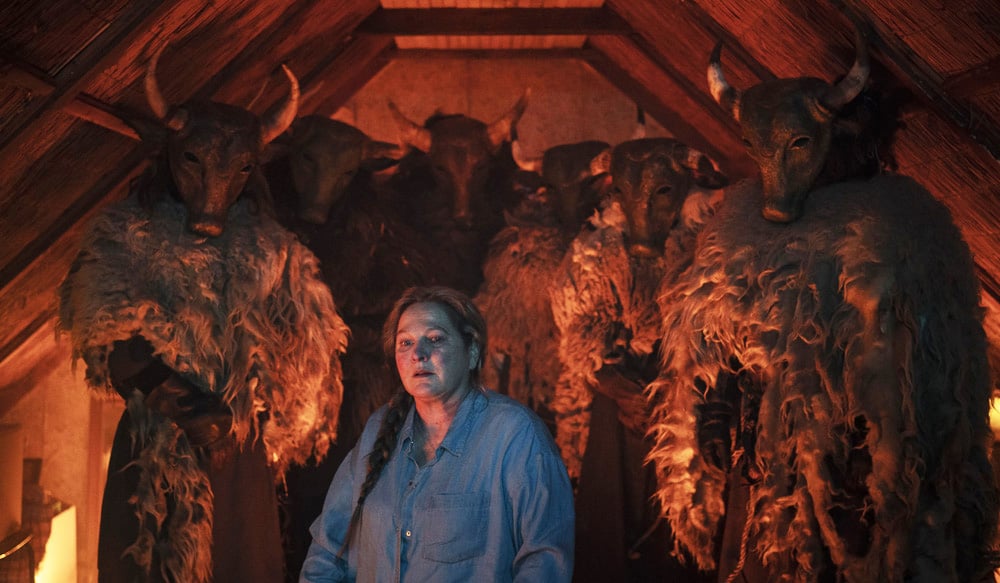
Above: three shots from the film
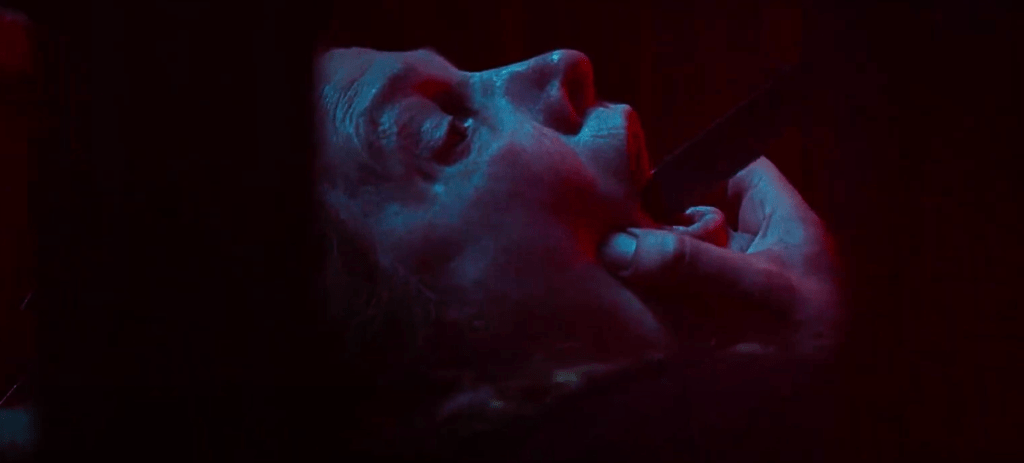
The acting is fine, the cinematography is good, the local cultists in their bull masks look cool, and the slit-throated sacrificial bog bodies provide the movie with some memorable imagery.
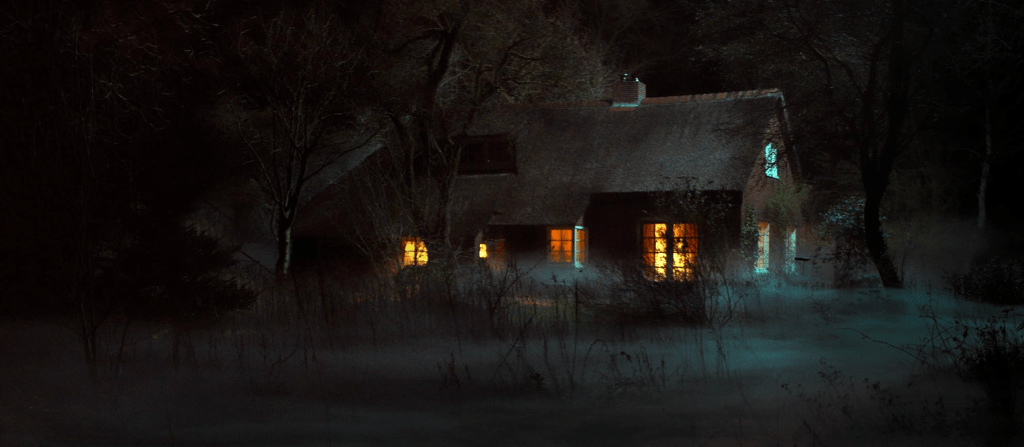
Above: two shots showing the atmospheric photography of the house in the film
You know, the more I think about it, the more I come to believe that any film featuring bog bodies is worth a watch!
Starring Juliet Mills, Richard Joseph Paul, Leon Russom, Walker Brandt, Tai Thai and Eric Steinberg. Written by David Allen and Randall William Cook. Directed by David Allen. Produced by Charles Band, Vlad Paunescu, Debra Dion, Albert Band, Danny Draven and Wendy Grossberg. Full Moon Features and Castel Film Romania.
After the body of a huge yeti is discovered and displayed at a university, a small team of scientists head to Nepal to learn more about this amazing creature. With the help of grizzled adventurer Rondo Montana, the group makes its way into an isolated, hidden, forested valley that is kept free of snow thanks to the ancient machinery of an alien race. Soon the protagonists discover that these aliens still exist…
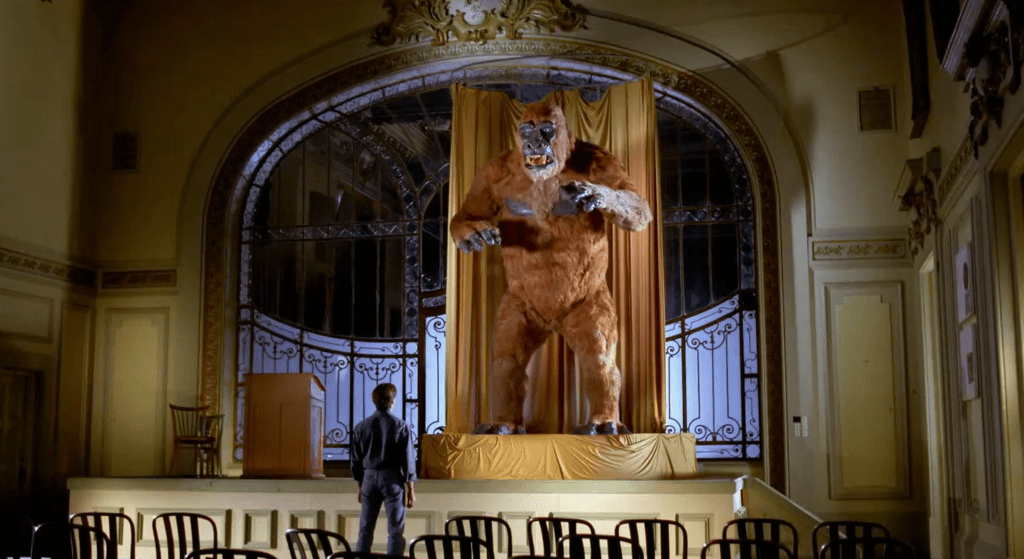
The yeti’s body is displayed at a university
I can’t believe THE PRIMEVALS has finally seen the light of day! This is a film project I have read about and followed the progress of for decades! It seemed destined to be one of those legendary projects that never got made.
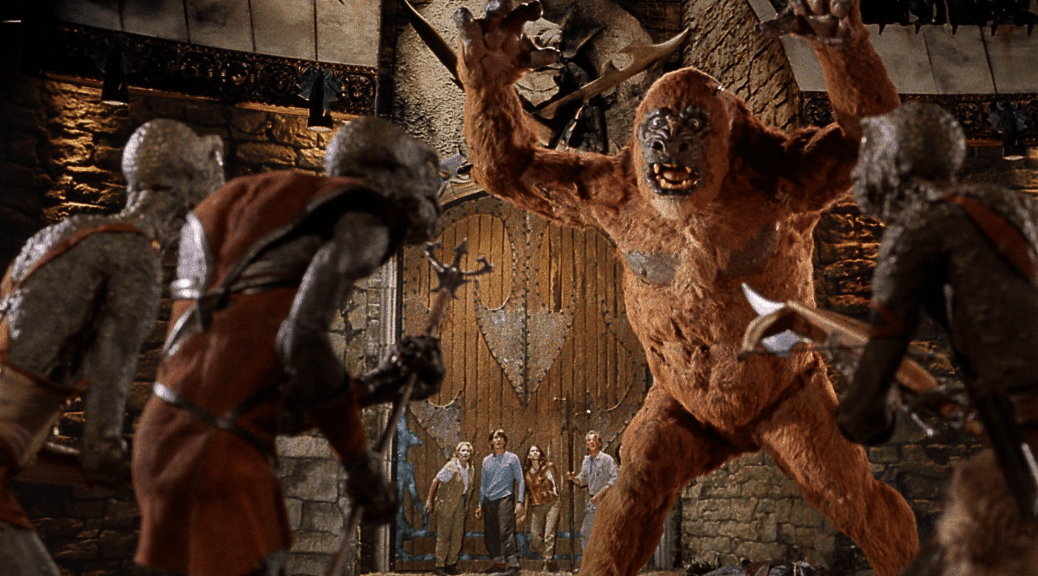
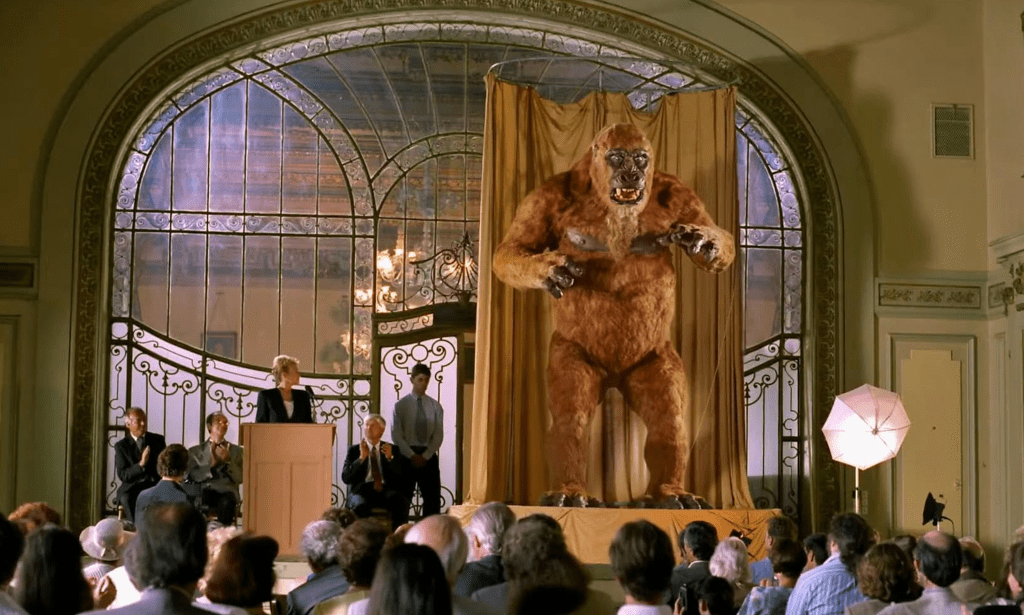
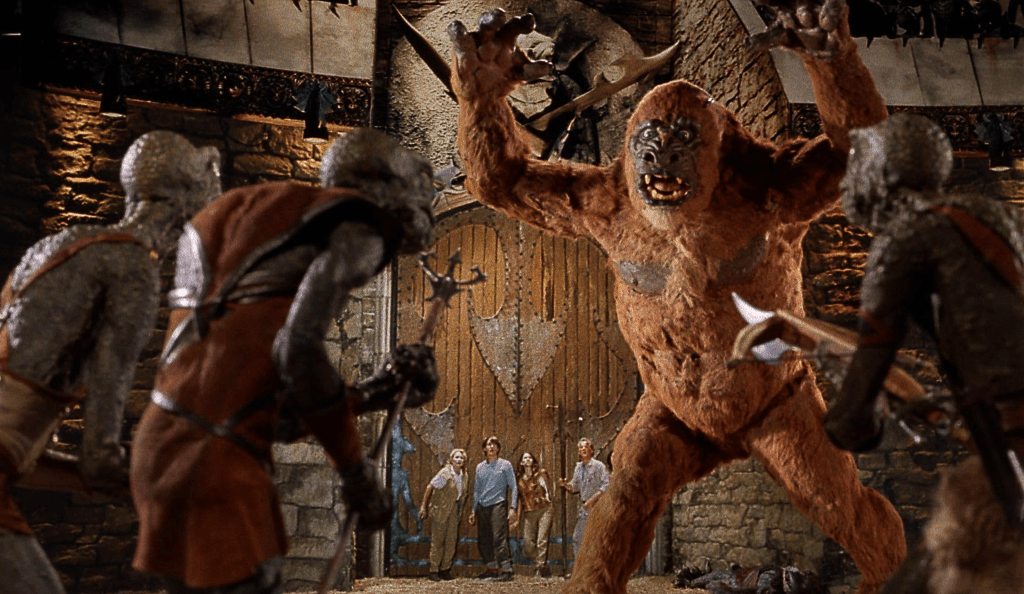
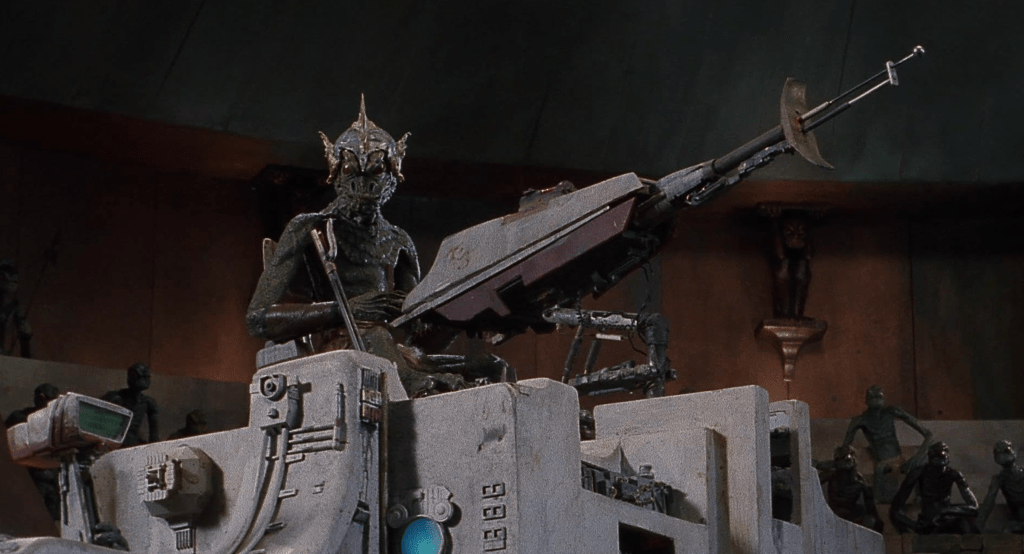
Alien lizard-men fight a giant yeti in an arena! Woot!
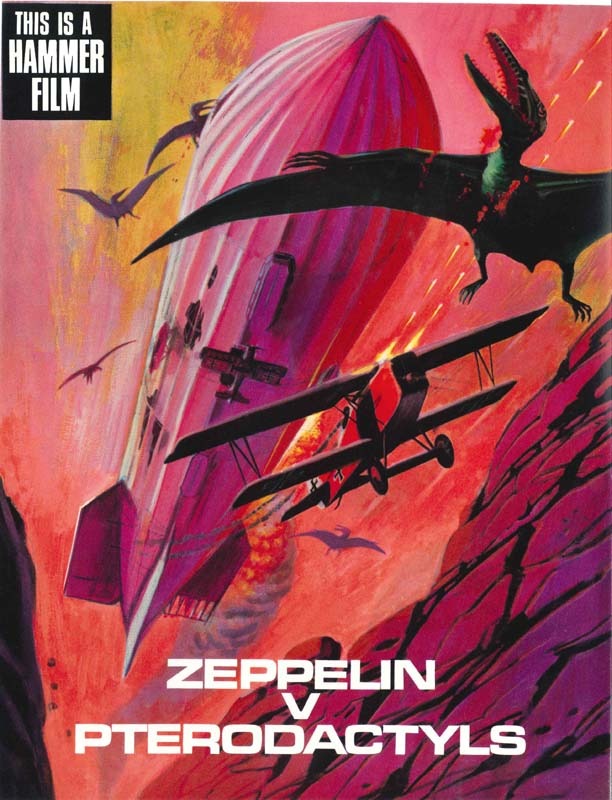
Back in the late 1960s David Allen (stop-motion animator on THE DAY TIME ENDED, THE CRATER LAKE MONSTER, Q: THE WINGED SERPENT and more) developed a fantasy film treatment called RAIDERS OF THE STONE RING. He then filmed a promo reel for it. Hammer Films eventually got to hear about it (at the time Jim Danforth and David Allen were working on WHEN DINOSAURS RULED THE EARTH), the idea momentarily morphed into a concept called ZEPPELIN VS PTERODACTYLS (now that’s a title!), and Hammer put out a ‘coming soon’ ad for the project that boasted a striking illustration by top Hammer artist Tom Chantrell. But funding wasn’t found and the project stalled.
Hammer Films would’ve added a zeppelin and pterodactyls into the mix!
David Allen continued to return to the project, hoping to expand on the treatment, and he finally co-wrote a screenplay with Mark McGee. The concept’s title continued to fluctuate, with it being called THE GLACIAL EMPIRE and, later on, PRIMORDIUM: THE ARCTIC WORLD. A new outline was written in the mid-70s by Allen, who now called it THE PRIMEVALS. Allen would then go on to write a script with Randall William Cook, who had a potential financial backer, but, yet again, the funding disappeared. The script for THE PRIMEVALS would continue to be tweaked, altered and updated over time, and it finally became the foundation for the film that was eventually made.
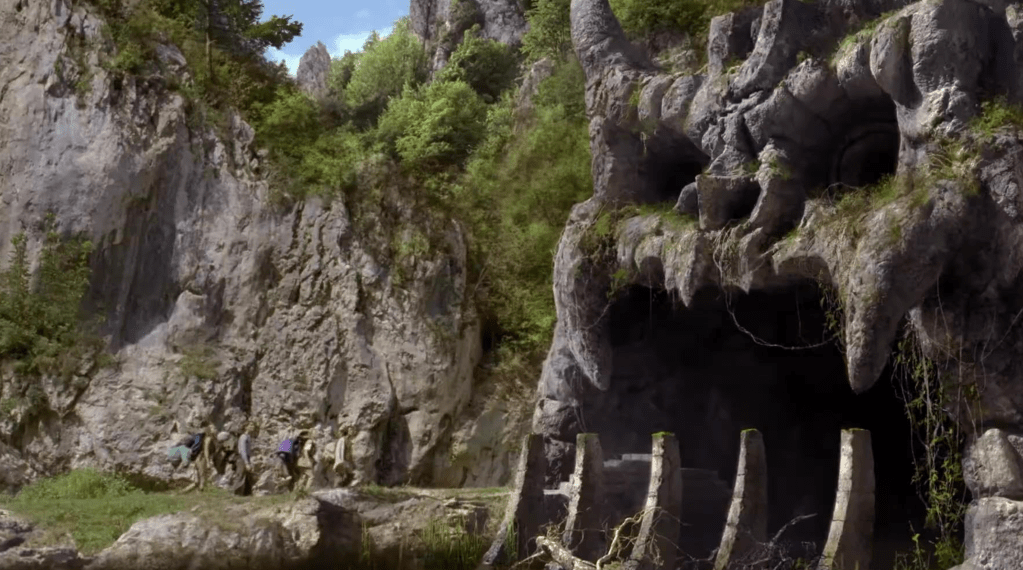
The explorers approach a skull-faced cave entrance in THE PRIMEVALS
Producer-director Charles Band was shown the promotional reel for the film and he agreed to fund the production through Charles Band Productions. But, once more, THE PRIMEVALS project ground to a halt after just a few months of preproduction. Then, in the early 1980s, the project was heavily advertised as part of Charles Band’s Empire Pictures slate of upcoming movies… but (you guessed it) THE PRIMEVALS failed to go beyond the preproduction stage at the studio. Damn it!
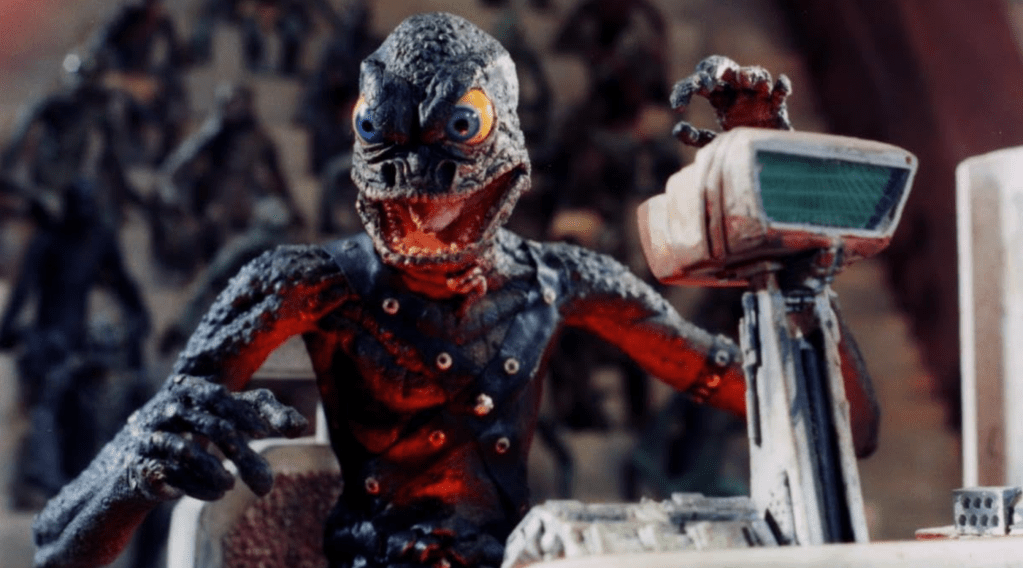
A stop-motion alien lizard-man with a ray gun, as seen in the finished film. What’s not to like?!
THE PRIMEVALS concept was revived again when Charles Band started Full Moon Entertainment. This time the project did move past the preproduction stage! In 1994 much of the principal photography was shot in Romania. Other footage was filmed in the Dolomites mountain range in Italy. But then (there always seems to be another ‘but’ in this story!)… Full Moon got into financial difficulties, which interfered with the completion of the production, though Allen did continue, between other projects, to work on the film at irregular intervals.
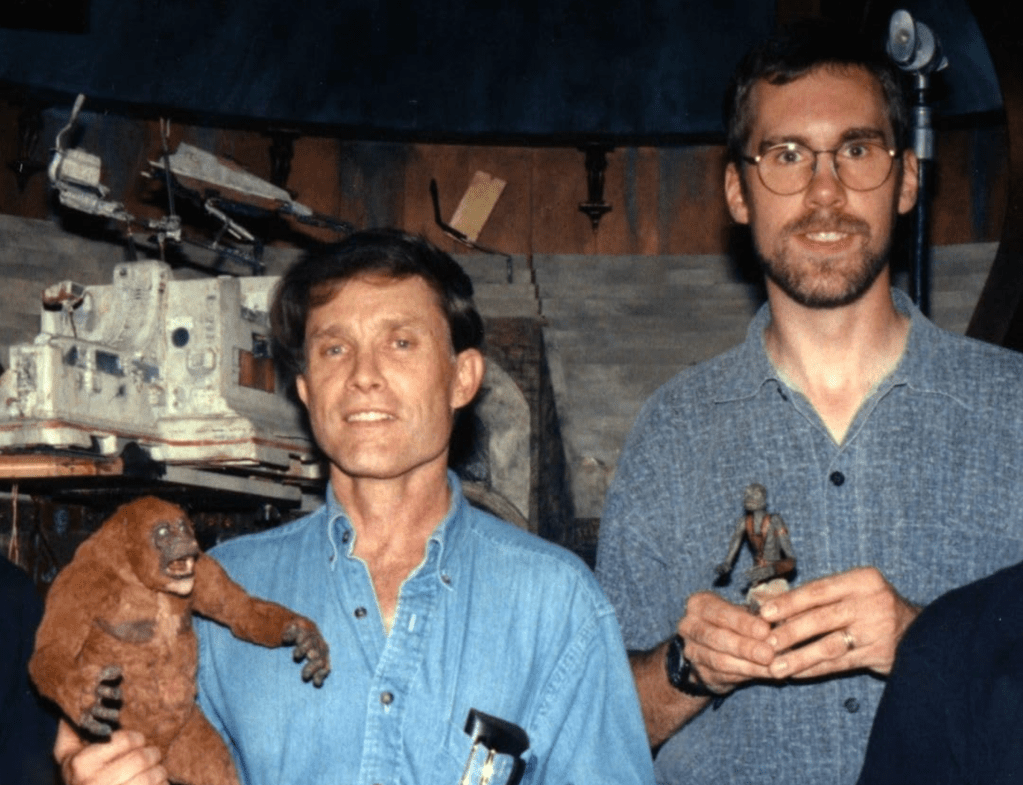
David Allen and Chris Endicott pose with stop-motion puppets
Then the ultimate tragedy occurred… when David Allen passed away, aged just 54, in 1999.
David Allen had left the film elements, stop motion puppets, the storyboards, and all of his equipment in the care of his colleague Chris Endicott. Finally, in 2018, Charles Band launched an Indiegogo crowdfunding campaign to obtain completion funds for THE PRIMEVALS, and this resulted in enough money being raised to allow Chris Endicott to team-up with stop-motion animator Kent Burton and other talented visual effects artists to work on getting David Allen’s passion project finally finished. In 2023 the completed film was premiered at the Fantasia festival and it is now available for us to watch.
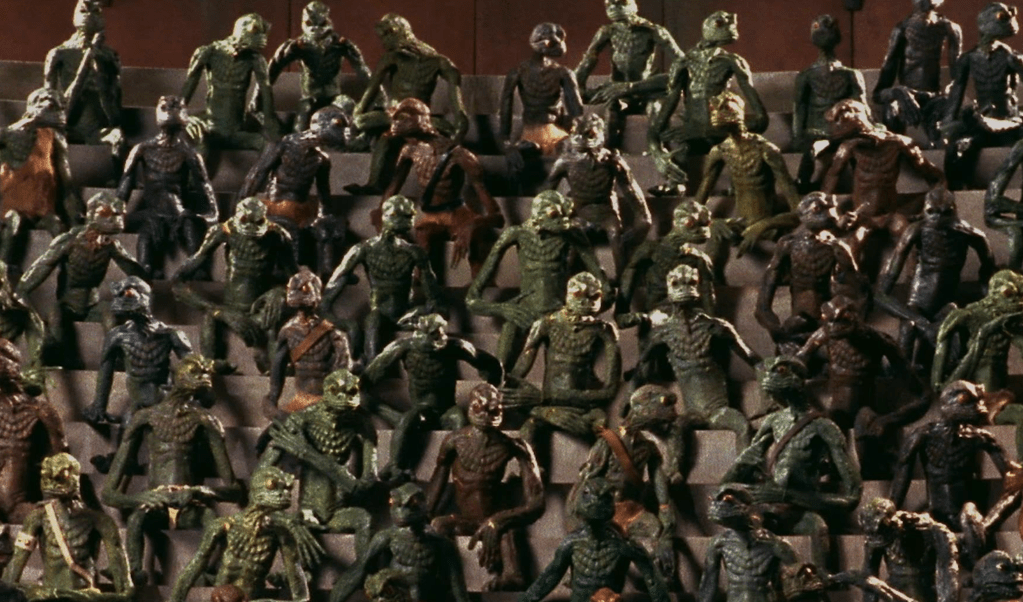
A crowd of reptile-aliens sit above the arena, watching the combat below
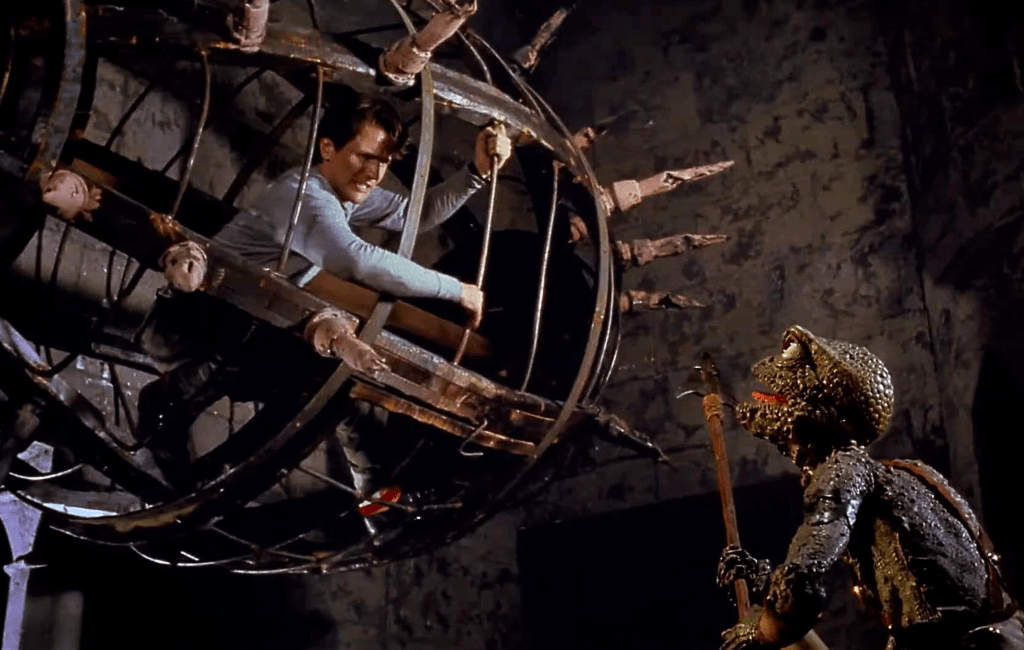
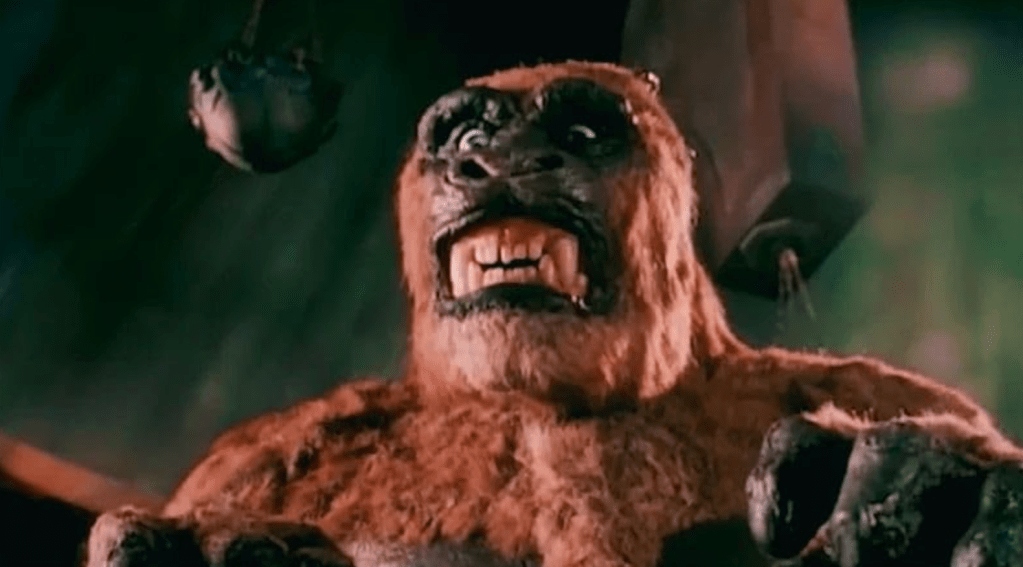
I must say I was over the moon when I eventually got to view THE PRIMEVALS and discovered I was about to be immediately treated to an opening mountain fight scene between sherpas and a big yeti. This is such a great stop-motion set piece! Honestly, this is as good as the creature sequences in Ray Harryhausen’s fantasy films. The yeti hominid creature is definitely a wonderful creation: it looks so good! In fact, this marvellous, massive yeti is so fine, the creature is a joy to look at even when it is displayed as an unmoving exhibit during the scenes at the university.
The amazing yeti roping scene that occurs at the start of the film!
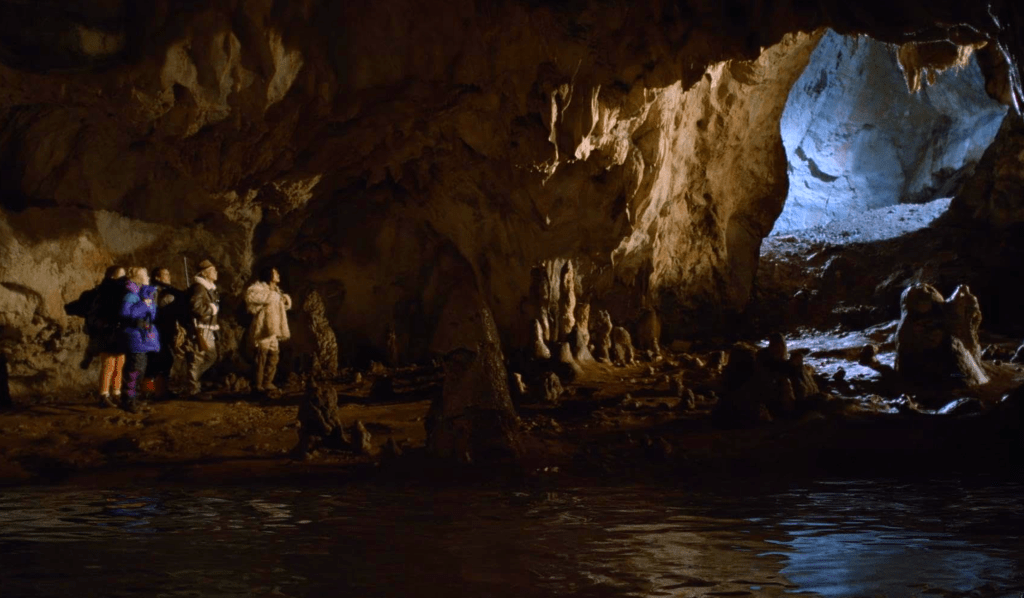
The film moves into explorers-on-a-quest mode next, as the protagonists trudge through cave systems and discover a lost valley. THE PRIMEVALS really exudes an old school adventure-fantasy vibe here, reminiscent of such productions as THE ISLAND AT THE TOP OF THE WORLD (1974) and JOURNEY TO THE CENTRE OF THE EARTH (1959).
I love scenes where characters explore caverns!
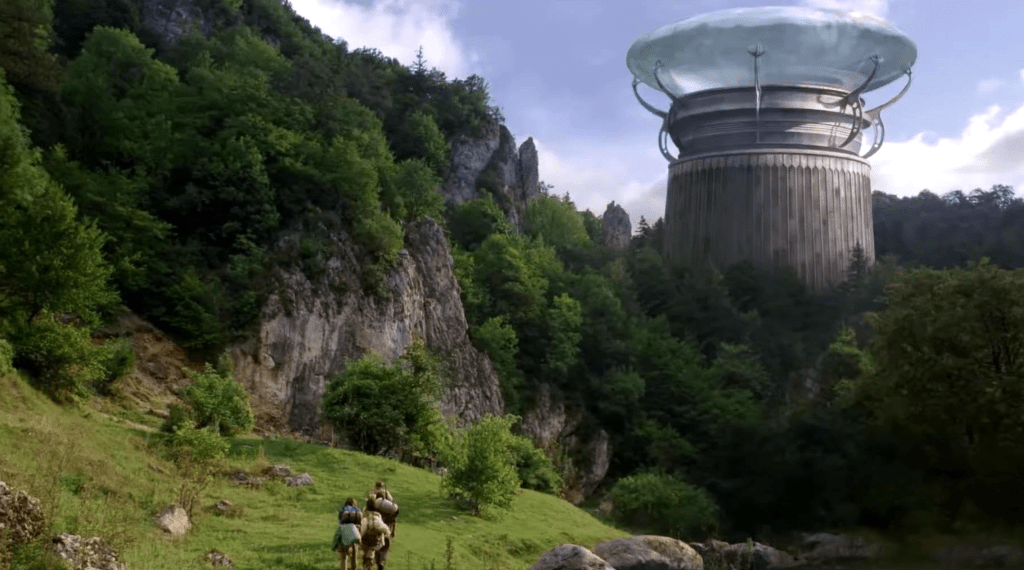
Once in the valley, through which a river runs, the group run across primitive hominid humans (actors in man-ape costumes) living in nicely-designed huts that are held aloft by stilt-like arrangements of branches. The scientists concur that the future-tech towers they’ve encountered must be part of a warming system that allows this hidden world to remain free of snow and harsh Himalayan weather.
The group approaches one of the alien towers
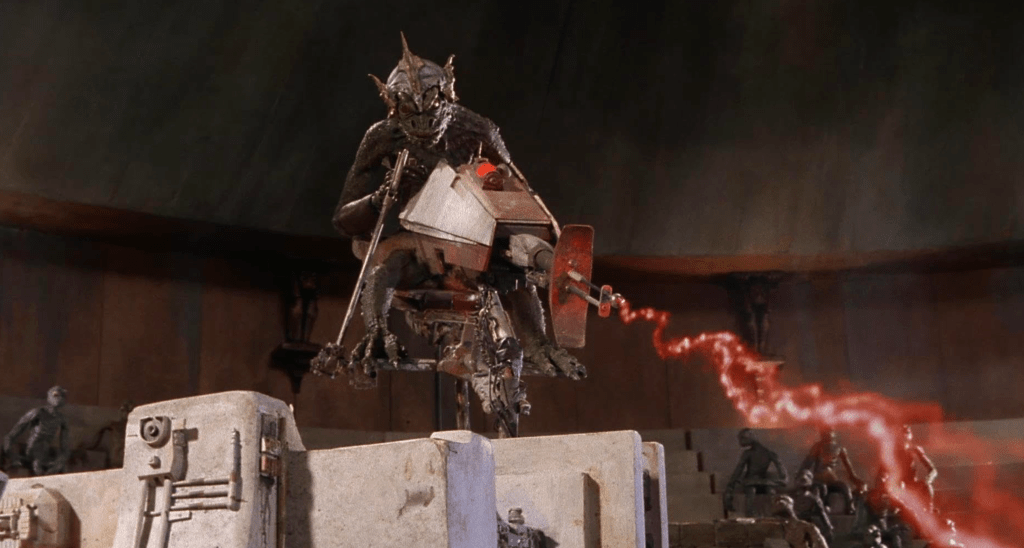
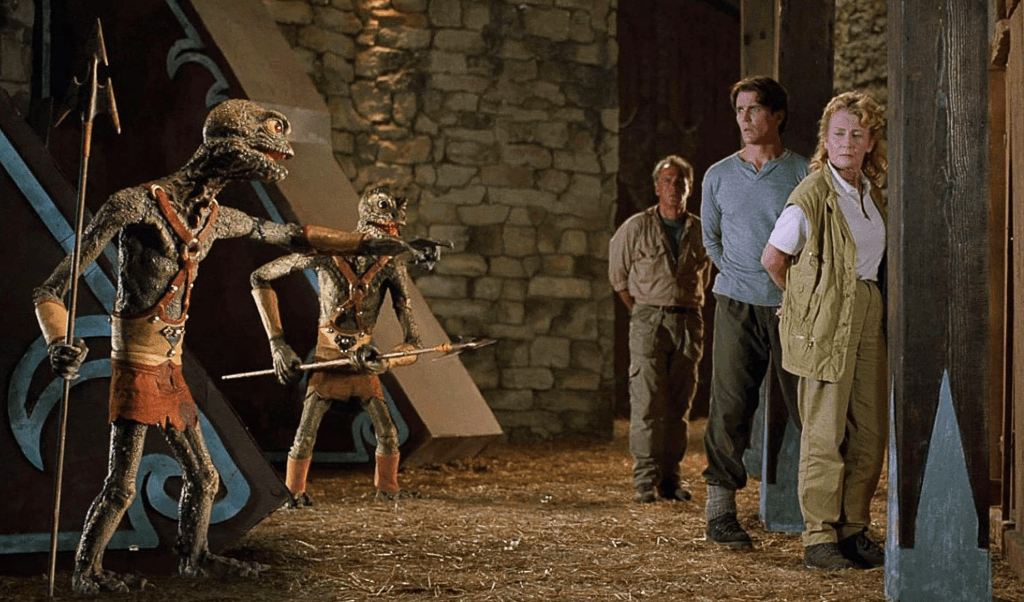
Soon our heroes discover a parked flying saucer, and this leads them to an encounter with alien reptile-people who live in a barbaric domain within the valley! The explorers are taken prisoner and placed in an arena, where they witness crowds of reptilian beings cheering on as a yeti is goaded (via fiendish implants) until it fights captured hominids! Can our heroes escape their predicament?!
A lizard-dude gunner zaps the yeti to make the creature fight in the arena
This film, for me, is like the cinematic equivalent of a well-made dish of comfort food: it has all the ingredients I adore, including characters journeying into a lost world, nice-looking stop-motion critters, a rousing orchestral score (by Richard Band), and a no-nonsense, pulpy adventure plot.
Another shot of the yeti on display in the university
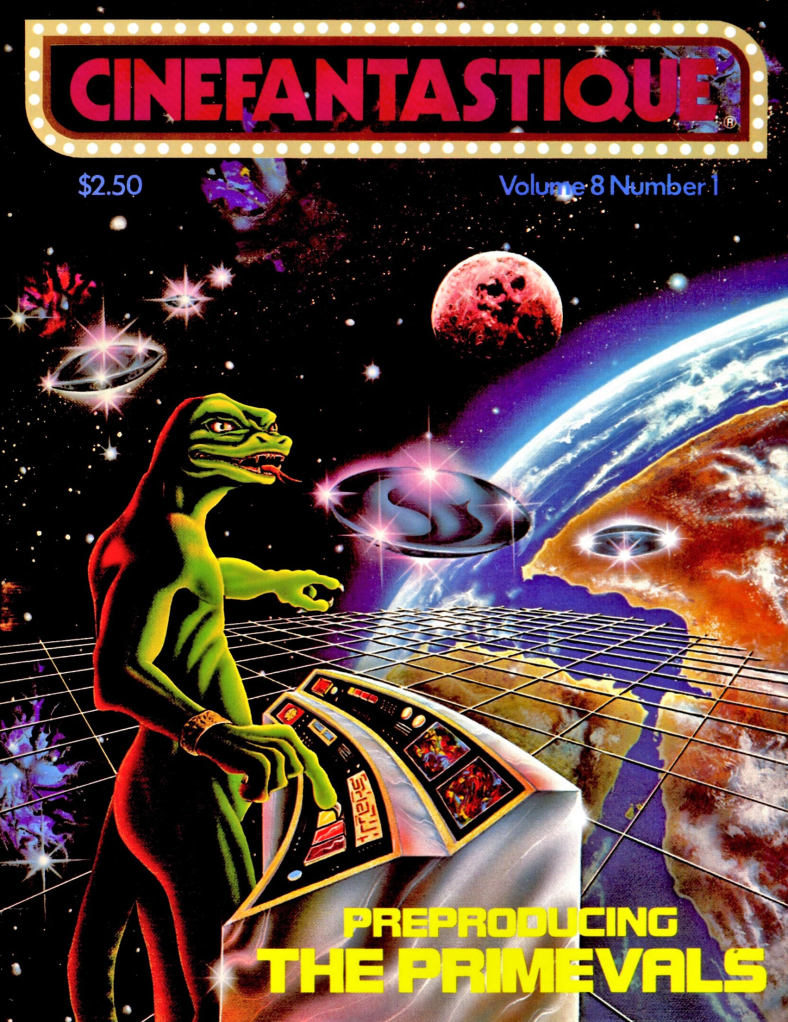
I would’ve liked to have seen at least one more stop-motion sequence in the mid-section of the film, but I understand that the filmmakers were constrained, needing to build on what was already shot and what they could achieve with the crowdfunding budget and the time that was available. There is one scene in the movie where characters talk about creatures they’ve spotted in the valley that are not normally-evolved animals, but we never see these beasts. So I assume this dialogue relates to scenes that were never completed. I remember seeing a concept drawing of a massive, horned River Lizard attacking a raft in an old issue of the magazine Cinefantasique, and this was definitely going to feature in the film, but, alas, the filmmakers were not able to complete the stop-motion for this part of the film. However, on the ‘David Allen Version’ disc (which is part of THE PRIMEVALS 3 Blu-ray Collection) the River Lizard sequence is presented with animatics based on Ron Lizorty’s design. (There’s more info on the River Lizard in a feature at the end of this review…)
The issue of Cinefantasique that featured the river lizard preproduction drawing
But, hey, I’m not here to quibble. I appreciate what everyone (including those who contributed to earlier iterations of the project) did to help get this David Allen love letter to fantasy-pulp-adventure yarns onto the screen.
One of the protagonists, Matt Connor (played by Richard Joseph Paul), is held prisoner by the alien reptile folk
The main selling point of THE PRIMEVALS is obviously the effects: the stop-motion animation, plus the miniatures, the optical effects, the props, the makeup effects, the hominid body suits and the matte paintings. They all help make this such an entertaining film. The creative people (who toiled on the final revival production and others who were part of the 1978 crew) include David Allen (of course), Chris Endicott, Kent Burton, Kim Blanchette, Mark Sullivan, Trey Thomas, Wes Caefer, Ken Ralston, Paul Mandell, Dave Carson, Jena Holman, Brett White, Dennis Gordon, Phil Tippett, Randy Cook, Jim Danforth (who was a VFX production consultant), Kevin O’Neill, Doug Beswick, Andrea Von Sholly, Peter Kermode, Steve Neill, Dave Matherly and many more talented folks. Thank you all!
An angry lizard alien
The stop-motion animation in THE PRIMEVALS is such a delight!
The long-armed lizard-men aliens are varied in their looks, wearing different bits of clothing, headgear and armour – and all of them have big-eyed, mean, scowling expressions. Their animation is wonderfully smooth, and the puppets are exquisitely detailed. They’re meant to be the cruel, savage descendants of the original reptile alien visitors, and the animators manage to convey the leering lizard-folks’ spiteful natures well.
The reptile-men always look a bit pissed off!
The yetis are simply awesome. I presume the same puppet was used for the different yetis, and it is a stunning model. The yetis in THE PRIMEVALS are so fine-looking and impressive they will definitely become top fan-favourites with many stop-motion animation aficionados.
I love the yetis!
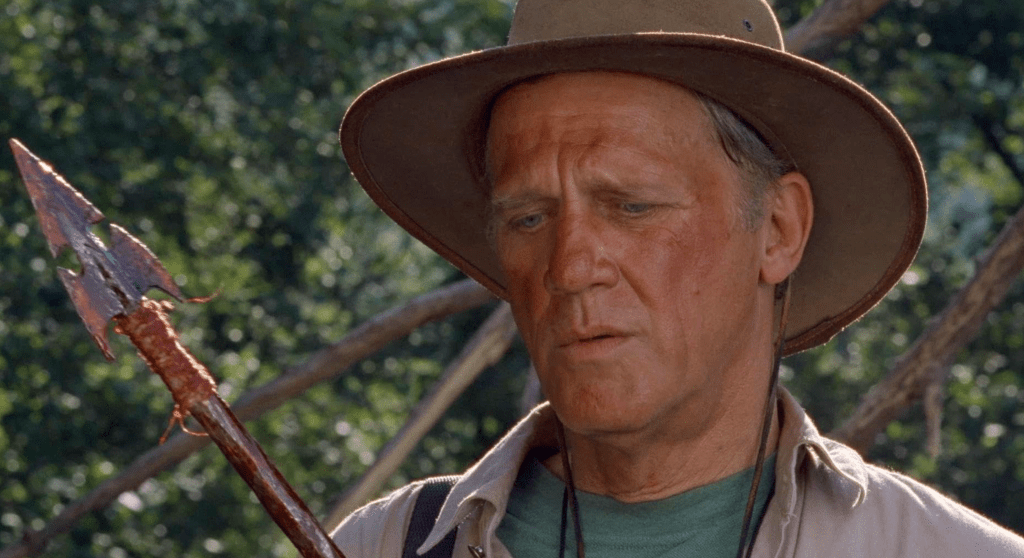
The cast, including Juliet Mills, is good, though Richard Joseph Paul, playing Matt Connor (the student who predicted the existence of yetis), tends to have an open-mouthed expression that unfortunately makes him look a little vacant some of the time! Leon Russom, however, is great as the magnificently-named Rondo Montana, contributing an old school, manly presence to the movie.
Leon Russom plays Rondo Montana
But as I’ve said already, I’m not here to complain: if you want to watch a movie with they-don’t-make-them-like-that-anymore vibes, that boasts extremely professional stop-motion animation, apemen suits, skull-faced cave entrances, retro sci-fi tech, stone arenas and medieval weaponry… then this is definitely the film for you!
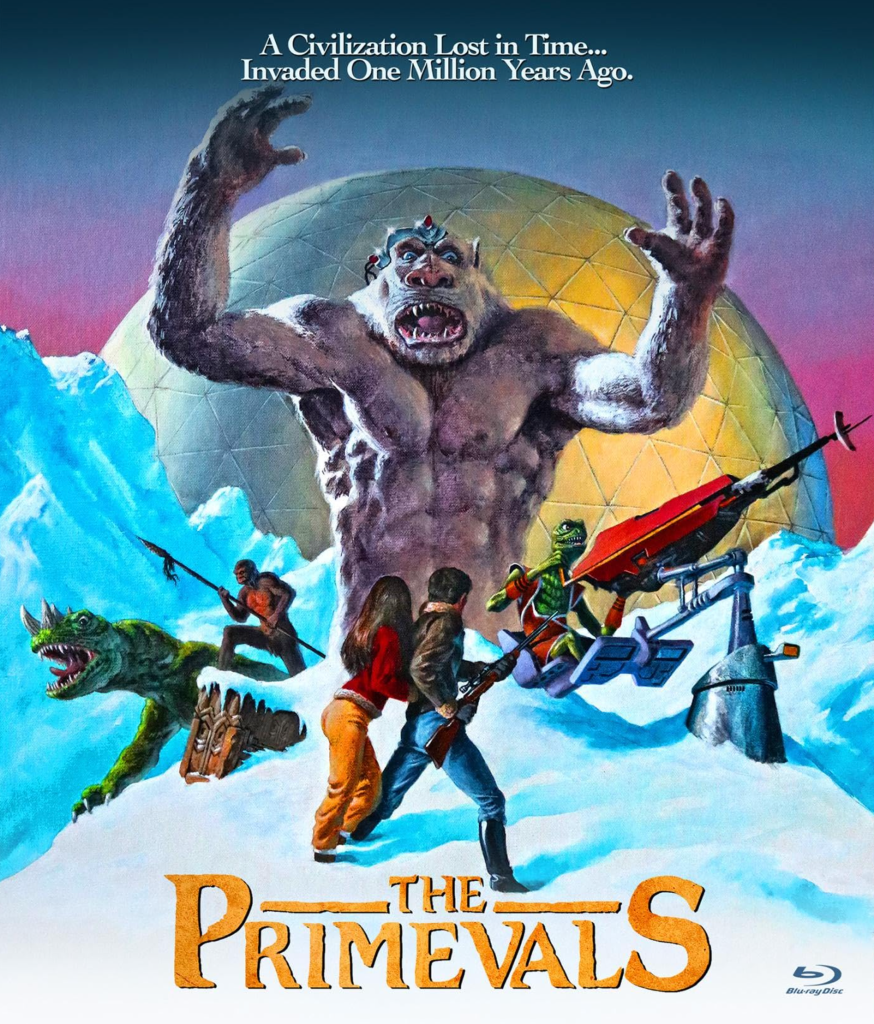
‘A civilization lost in time… invaded one million years ago.’
THE RIVER LIZARD
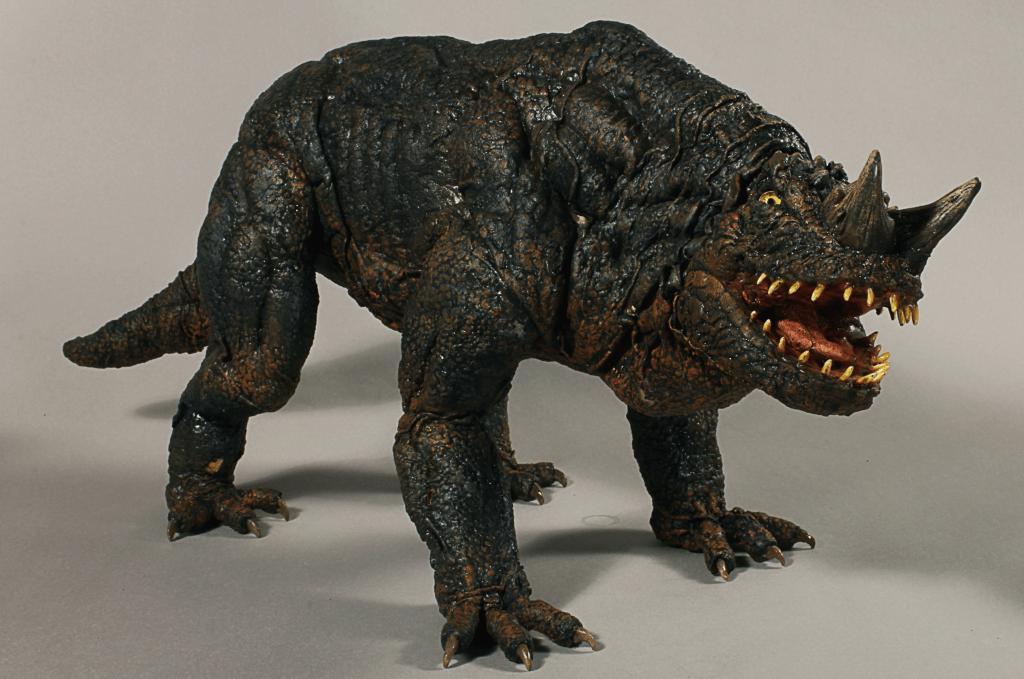
Ron Lizorty, Production Designer on THE PRIMEVALS, put lots of work into redesigning the original River Lizard, because David Allen had never cared for some of the anatomy choices on the earlier, original version of the reptile (made for RAIDERS OF THE STONE RING). Lizorty co-designed the armature with Allen, did most of the armature tooling, then did the build-up of the beast with a detailed skin he sculpted and stretched over the muscles, using a puppet-building approach similar to the techniques sculptor and model-maker Marcel (KING KONG) Delgado utilised on his films. Lizorty’s model was truly magnificent-looking, and it would’ve been an astounding stop-motion addition to the movie, that is for sure.
The wonderful River Lizard stop-motion puppet!
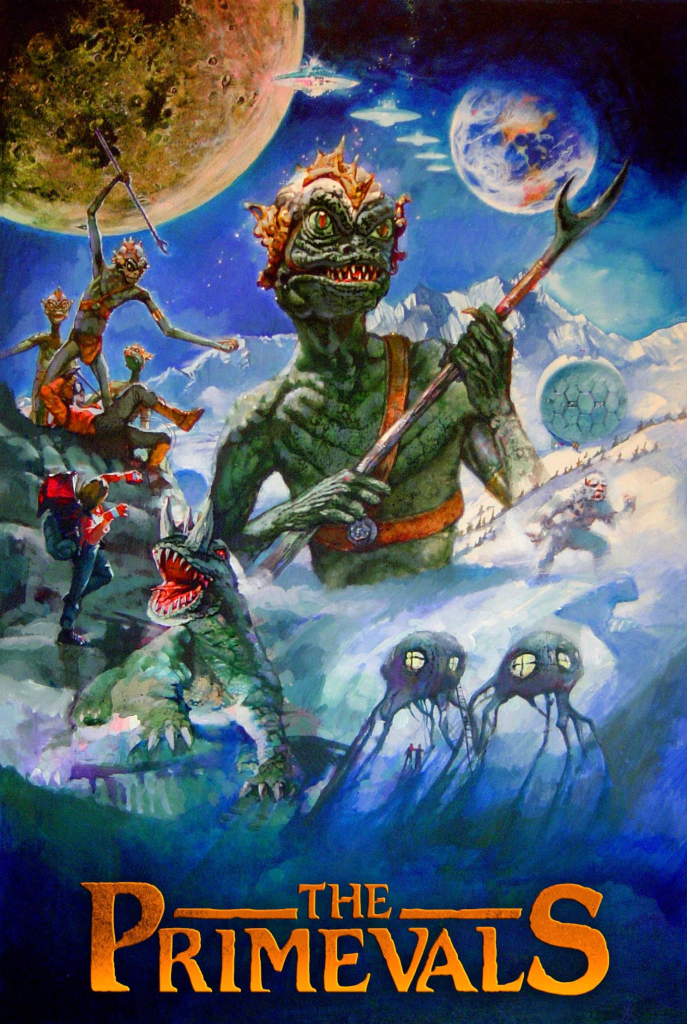
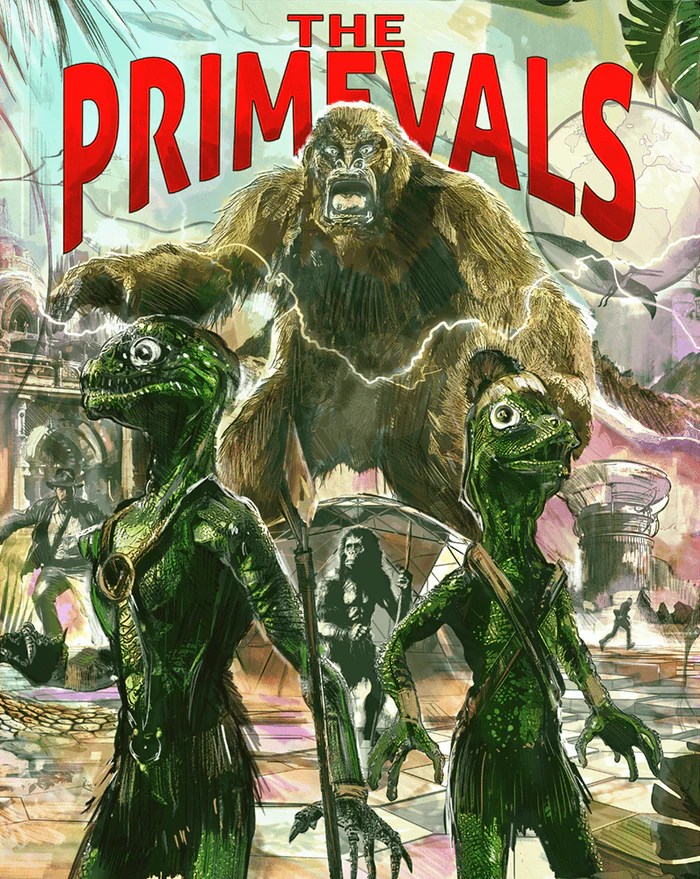
Chris Endicott confirmed that this horned lizard was definitely intended to be in David’s finished film, but, for various reasons (the original camera negative for most of that sequence was lost by Full Moon, and Full Moon was never prepared to allocate the money nor the time to complete the film entirely, and so compromises had to be made), the reptile wasn’t included in the released movie. However, because Full Moon had created all the promotional artwork for THE PRIMEVALS long before the film was released, the River Lizard does feature in much of the promo art…
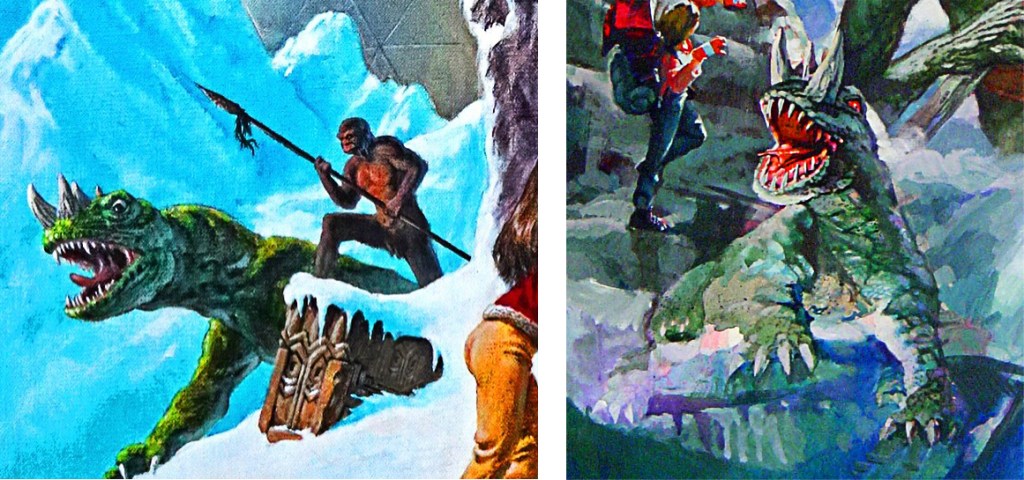
Details from two promo illustrations, showing the horned River Lizard, even though the beautiful brute never made it into the film. Shame!
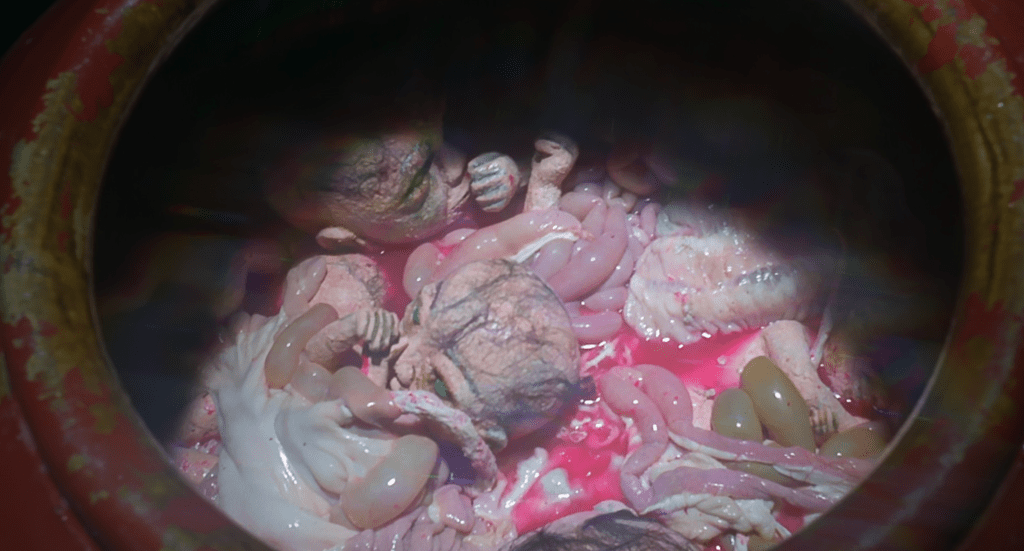
…including a scene where an evil spell-caster scoops a bowlful of blood from an urn that’s full of dead babies, viscera, and fluids!
Starring Ai Fei, Huang Chin-Shen, Lily Chan Lee-Lee, Fanny, and Hussein Hassan. Written by Sze-To On. Directed by Kuei Chih-Hung. Produced by Mona Fong. A Shaw Brothers production.
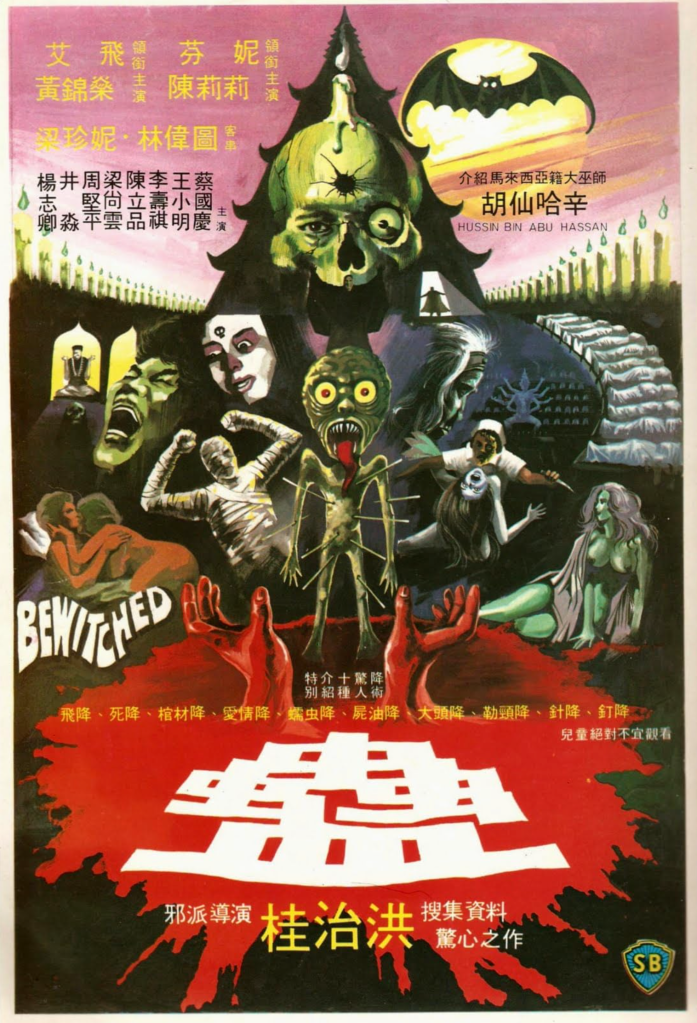
Cool poster!
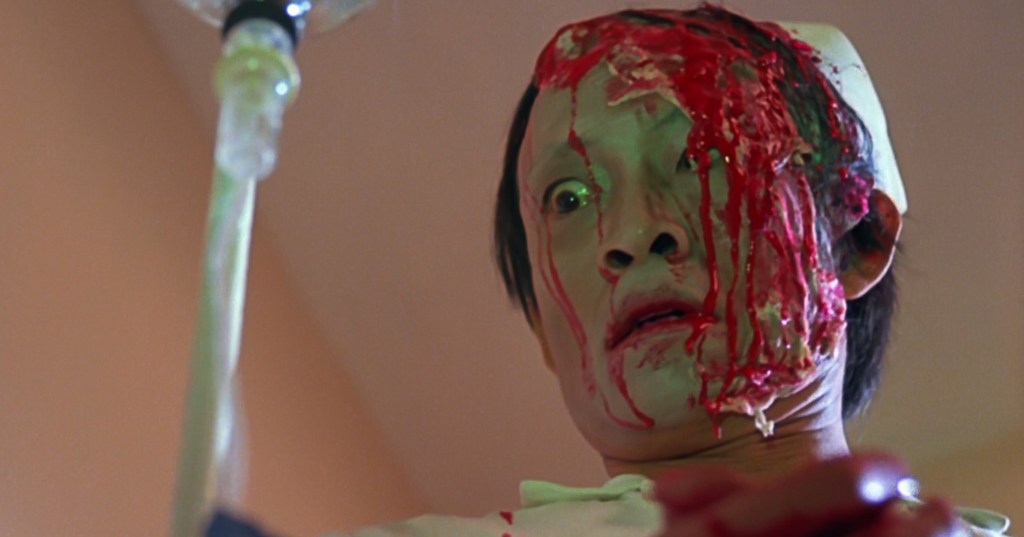
A possessed nurse!
Stephen Lam (Fei) is arrested for the murder of his daughter, admits to driving a nine-inch nail through her head, is found guilty, and afterwards asks Bobby (Chin-Shen), the policeman overseeing the case, to listen to his story, swearing that it was Thai witchcraft that compelled him to do what he did. Intrigued, Bobby looks into these claims and is soon the target of black magic rituals himself.
Above: five shots from the film
An extended flashback reveals how Stephen went on holiday to Thailand, had relations with a local woman called Bon Brown (Lee-Lee), returned to Hong Kong and promptly disregarded his promise to return to her, prompting the woman to seek supernatural revenge via Magusu, an evil spell-caster (Hassan).
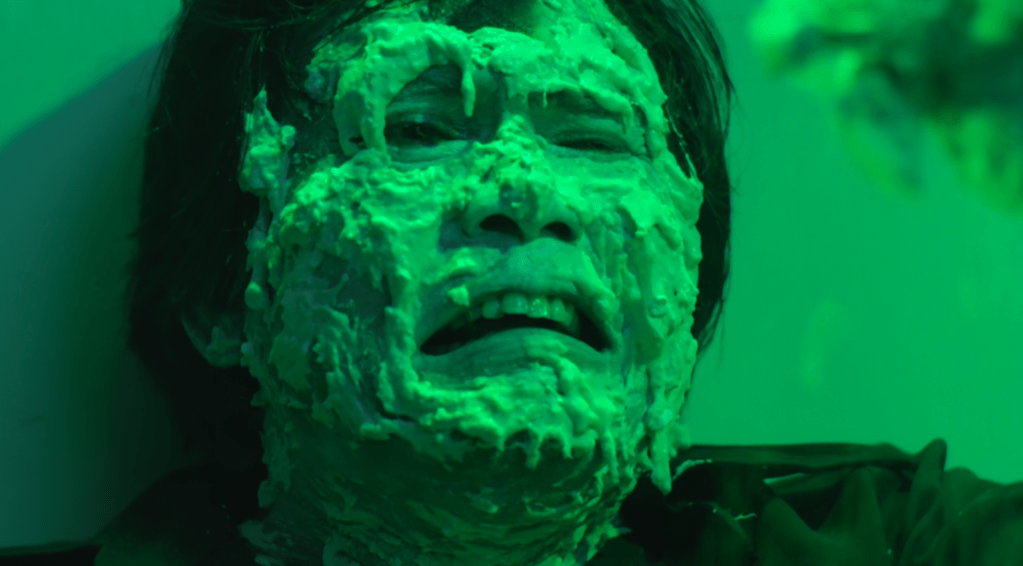
At one point green fluid spurts from evil Magusu’s face
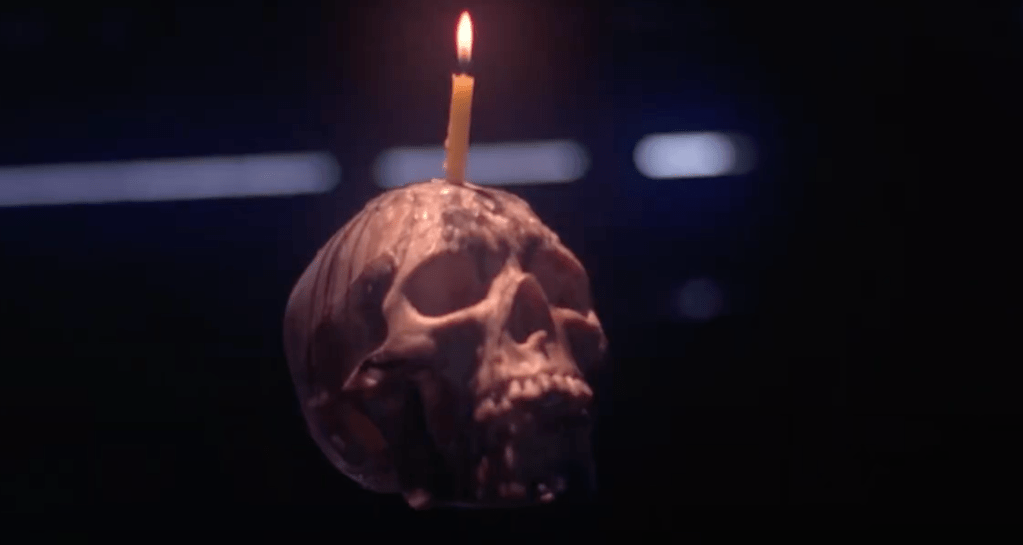
We’re soon witnessing various rituals, including a ceremony invoking a Vegetable Basket Spirit, which is enacted in silence and stillness, helping the scene to stand out when compared to the usual hectic, noisy rituals seen in most Hong Kong horror films. There’s also a grisly sequence in a temple mortuary, where the chanting Magusu sticks a spike into the foot of a dead pregnant woman to make her sit up, then uses a candle to make oil drip from the fake-but-grotesque corpse’s nostrils. Yet another novel instance of weird witchcraft involves the dark sorcerer burying a needle-transfixed lemon under the tarmac of a street: every time a pedestrian steps on the buried object it triggers stabbing pains in Bobby’s chest!
Magusu burns the face of a dead pregnant corpse so that dark oil will drip from the corpse’s nostrils
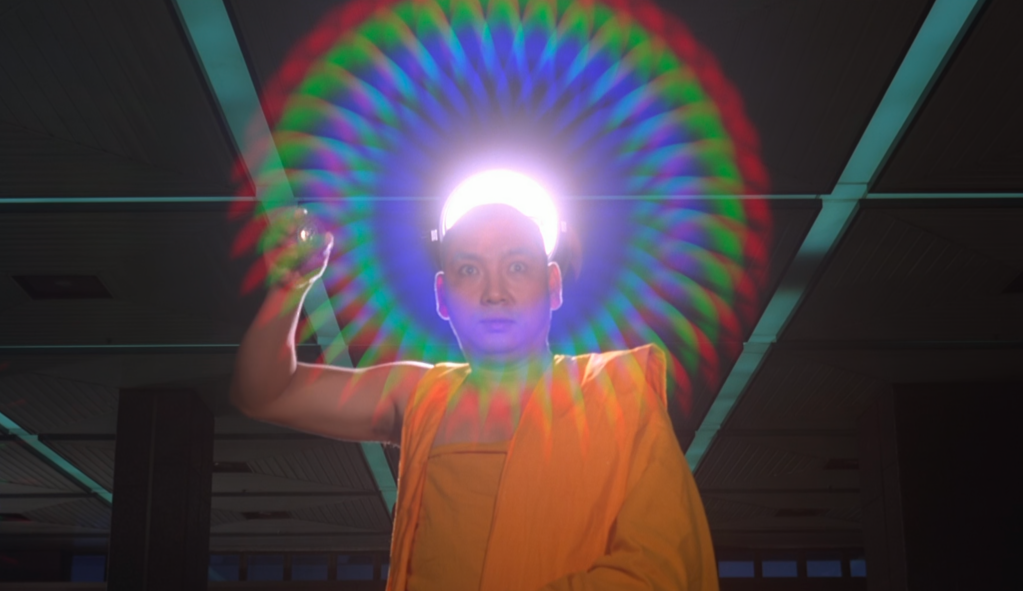
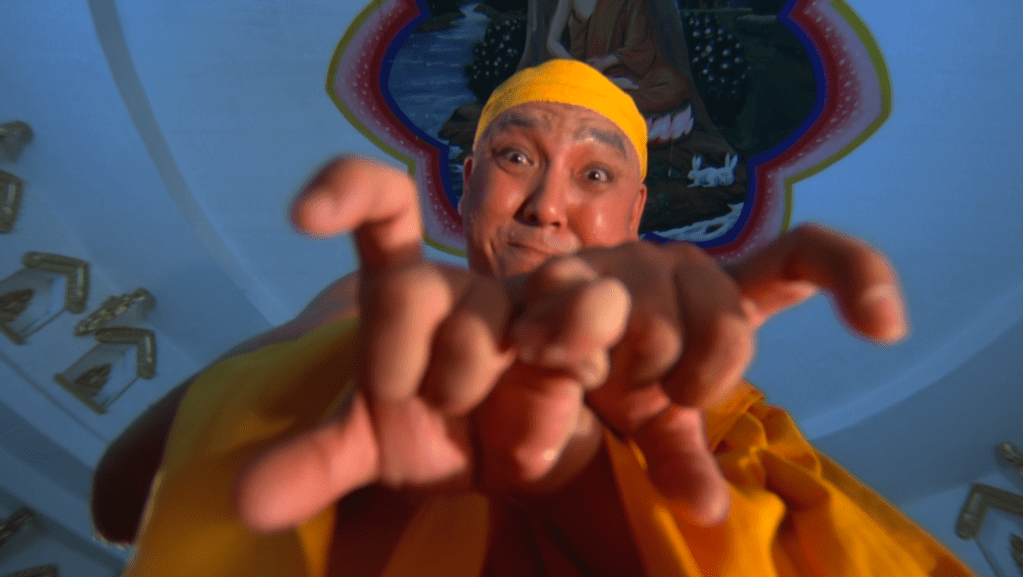
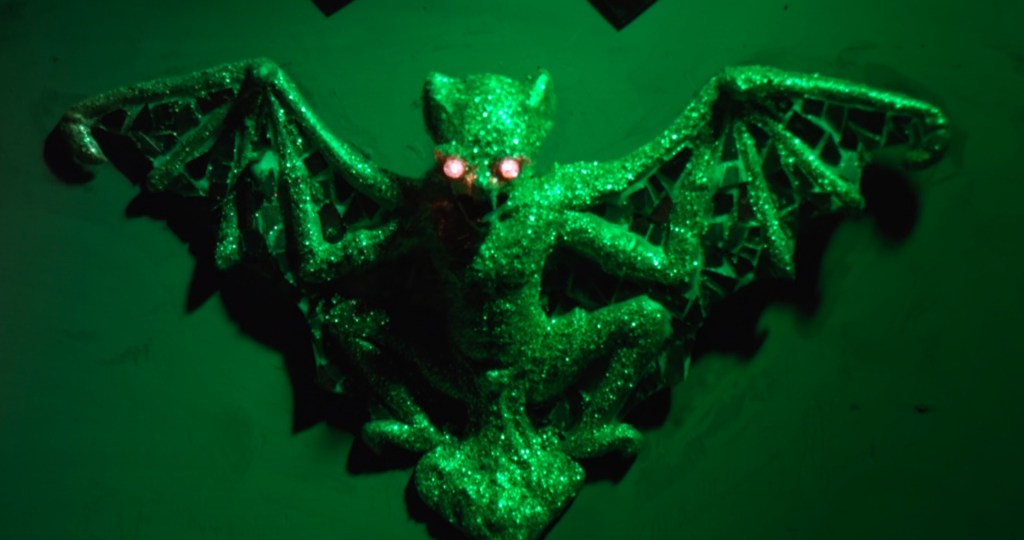
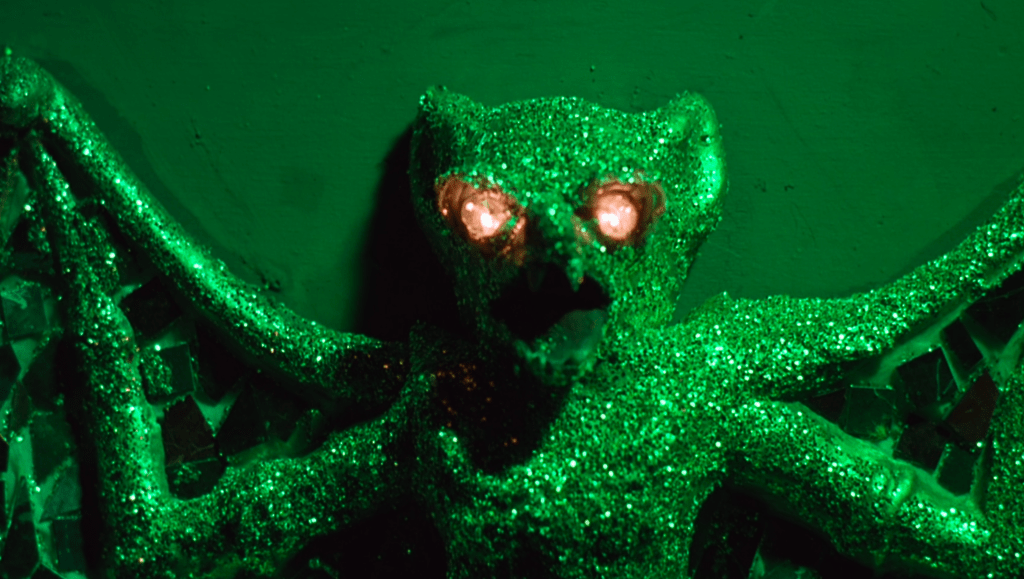
The standout supernatural sequence, however, is the remotely-fought confrontation between Magusu and a Buddhist monk. Director Chi-Hung nicely contrasts the bright, clean, expansive look of the monk’s Thai temple with the sorcerer’s dimly-lit, shuttered shrine room, as the two men utilise different arcane methods to counteract each other’s mystical might. With Magusu’s veins filling with green gunk, the black magician prays to a bat effigy on the wall, which becomes a ‘real’ bat creature that flies off and kamikazes into the monk’s ceremonial fan to wreck his ritual! This whole duel of mystic men is really well-handled.
The moving bat sculpture, before it becomes a ‘real’ bat!
A close-up of the glowing-eyed bat ornament that somehow comes alive
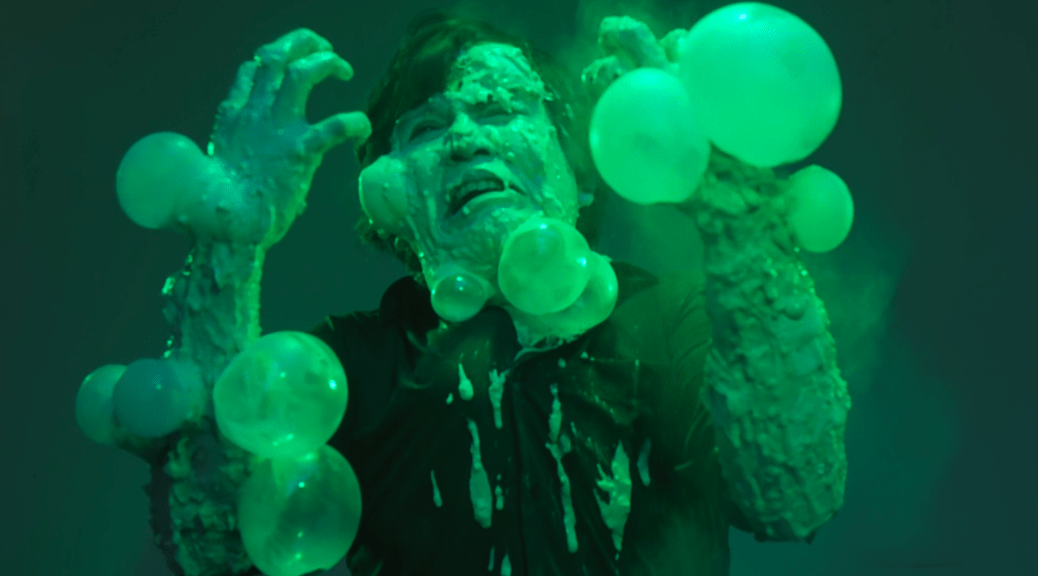
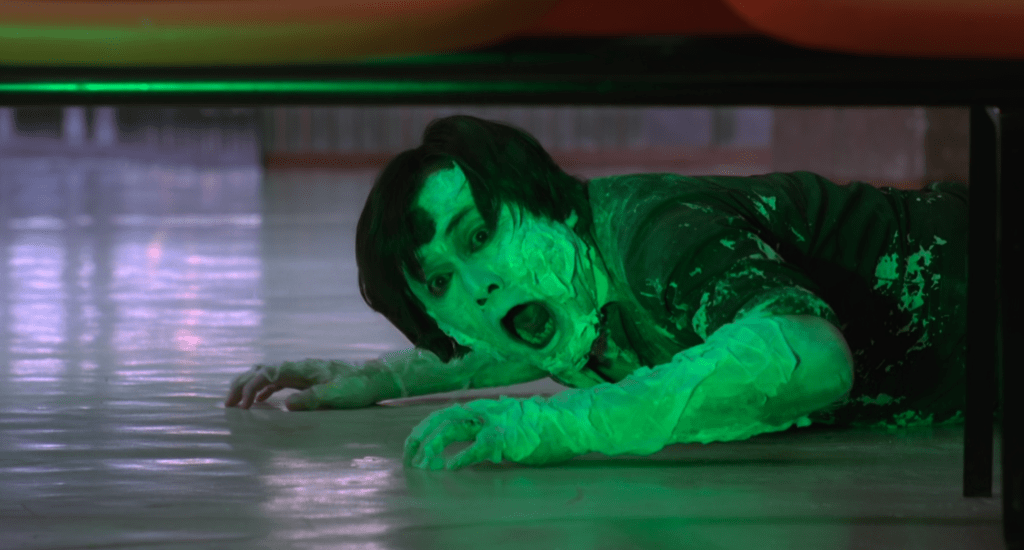
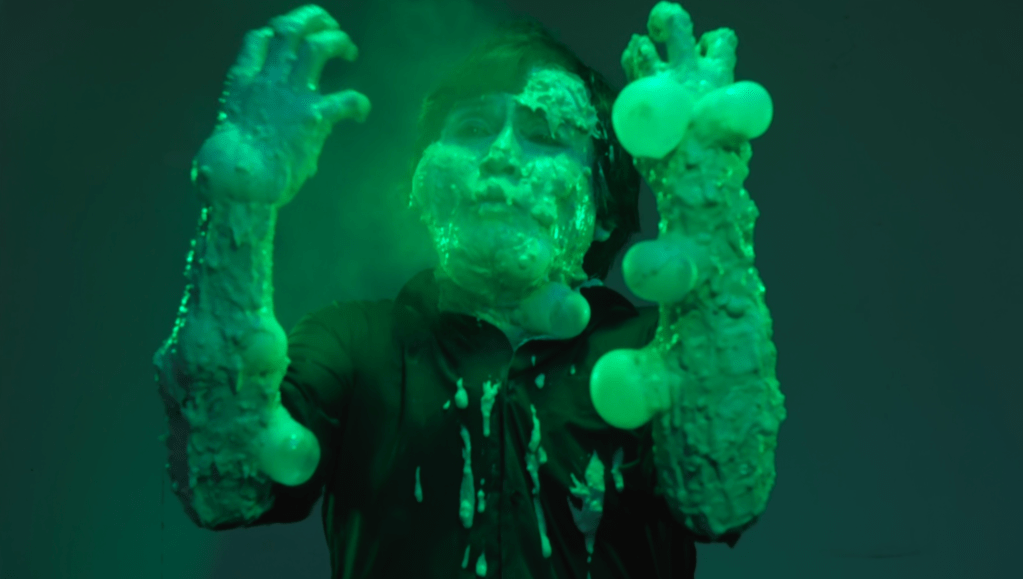
When the film’s finale comes, it is reliant on the sudden, handy intervention of the monk at an airport. The monk causes Magusu to become all slimy and develop blisters, which inflate like balloons and pop…
Above: three shots of Magusu falling victim to a monk, who makes the evil magician’s skin blister and melt!
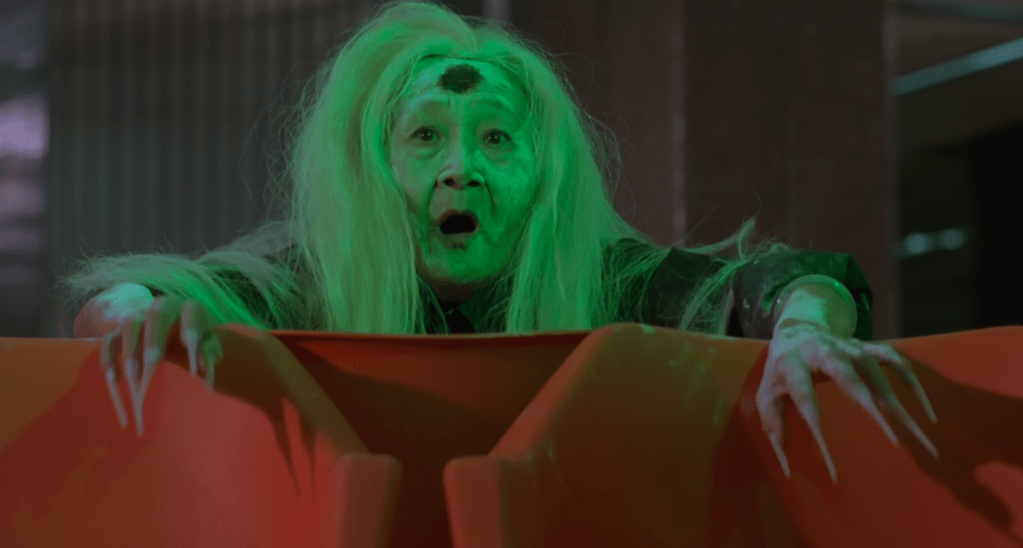
…and then, somehow, the monk makes Magusu transform into an old woman…
Magusu, for some reason, turns into an old hag!
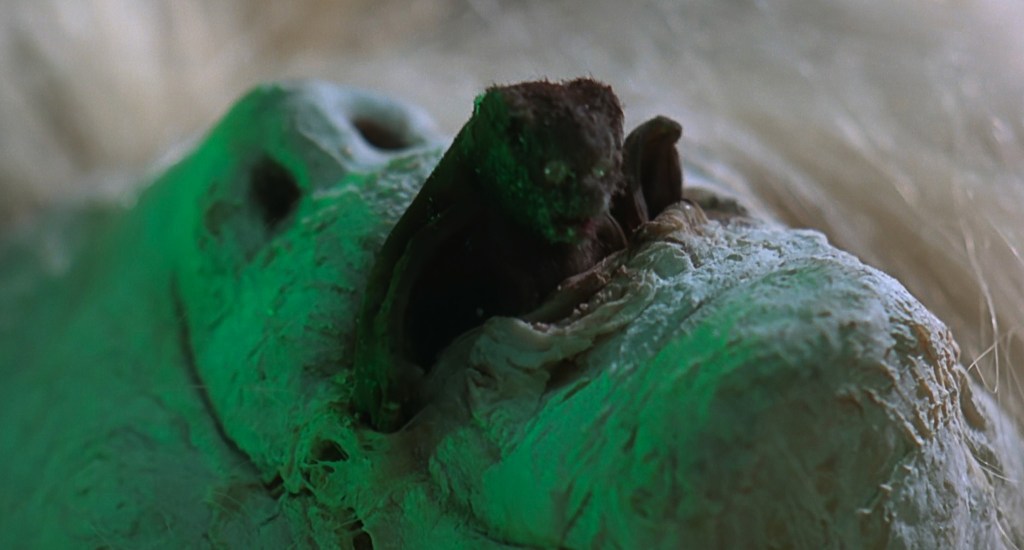
…and then… a bat-creature puppet crawls from the old crone’s mouth!
The bat-thing pushes itself out of the hag’s mouth!
The monk proceeds to pick up the (rather sweet-looking) bat and slip the lil’ critter into his pocket. End of story! This is a brilliantly bizarre finish to the film, utilising garishly fun, lo-fi effects, that drives home the fact that BEWITCHED is a continually diverting, enjoyable, and colourful Shaw Brothers horror yarn.
Devoted to every kind of movie and TV monster, from King Kong to Godzilla, from the Blob to Alien. Plus monsters from other media too, including books and comics.







 Monster Zone