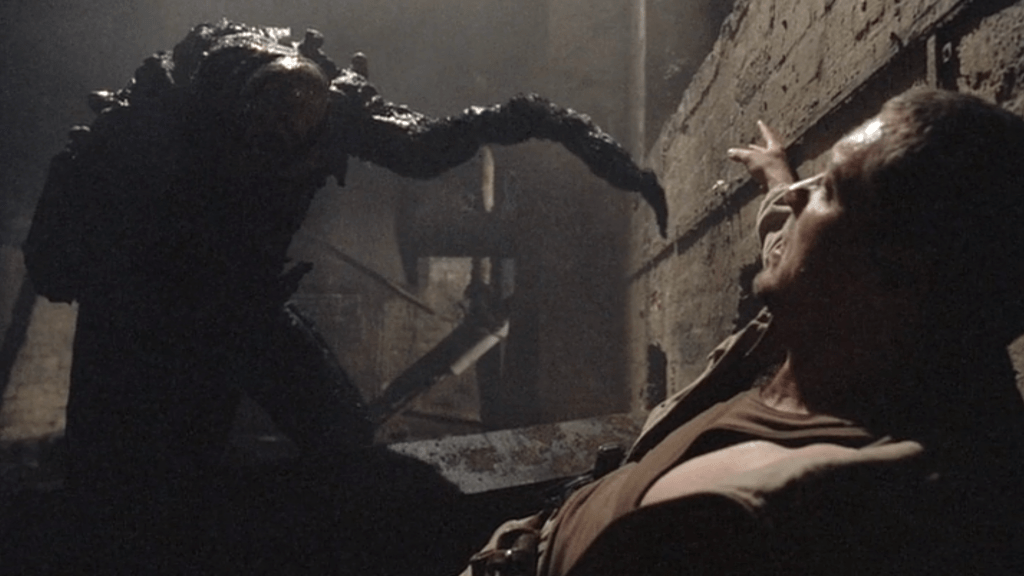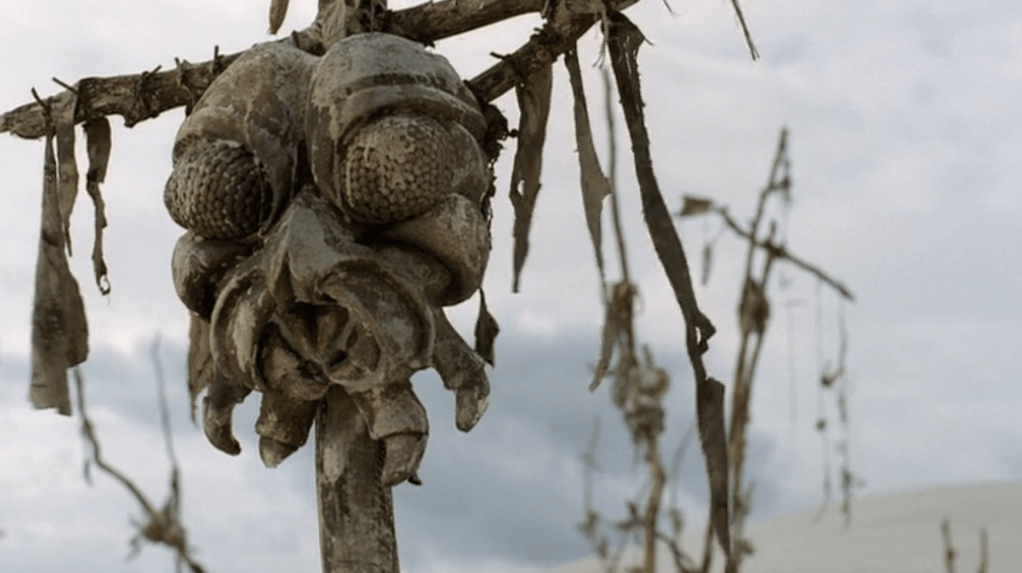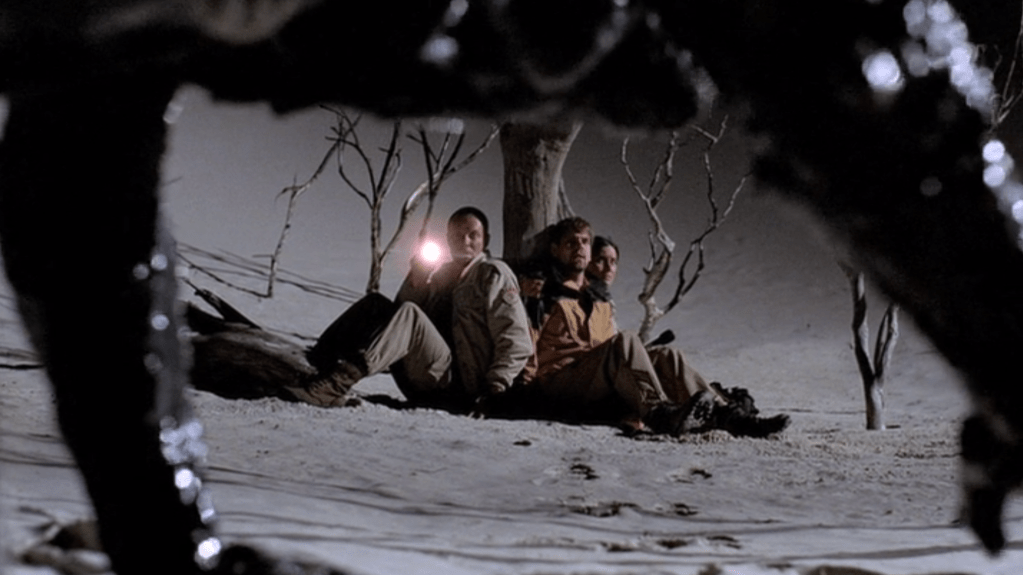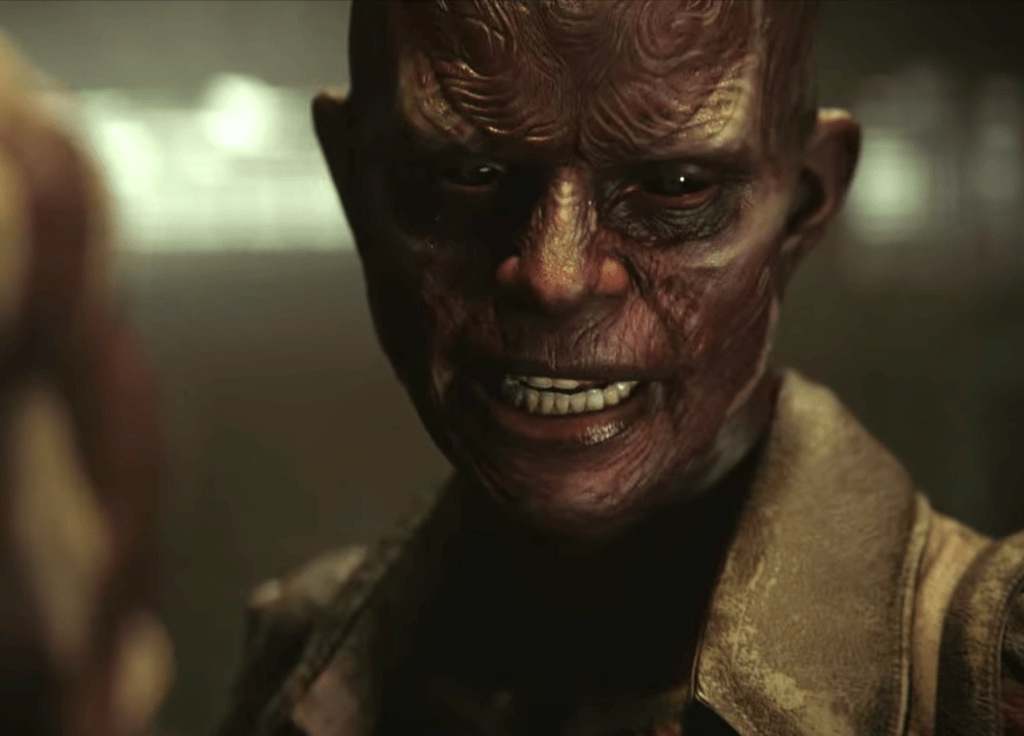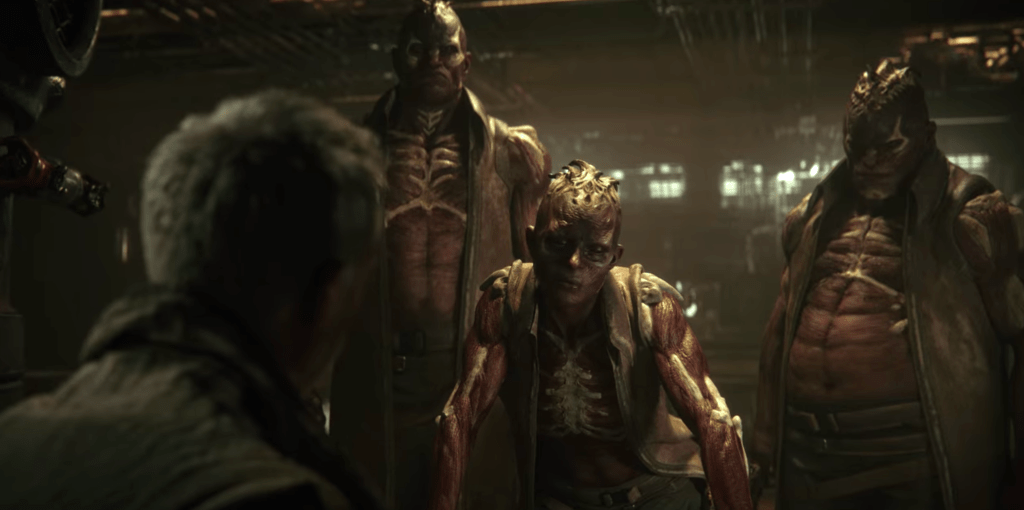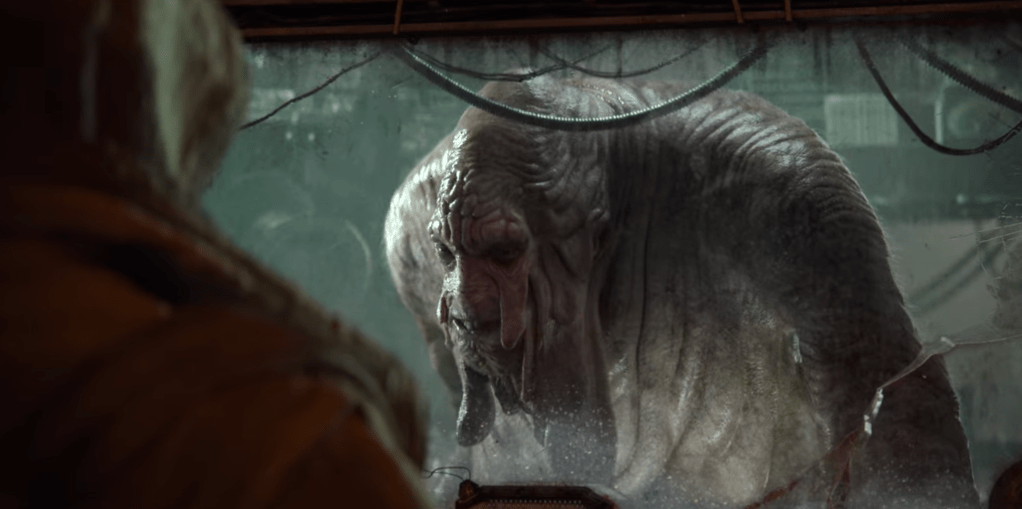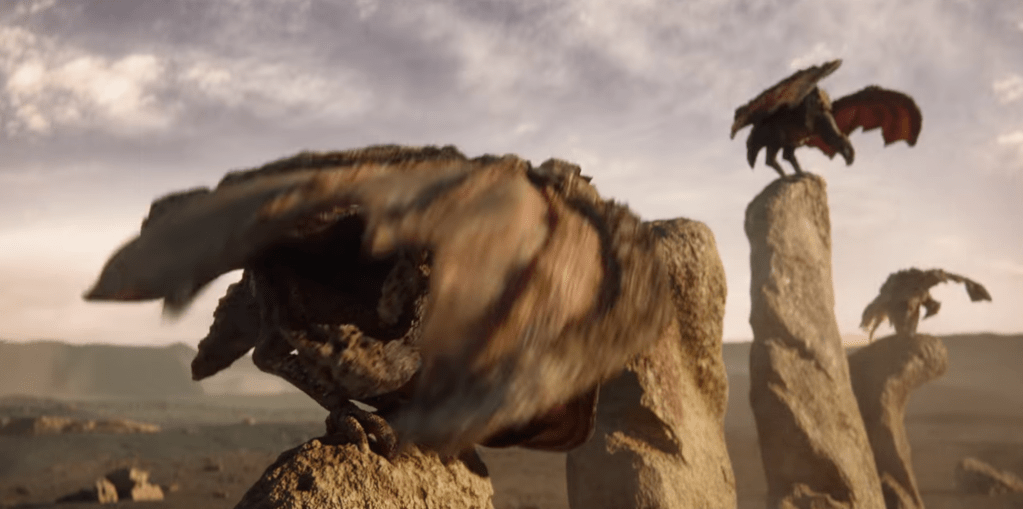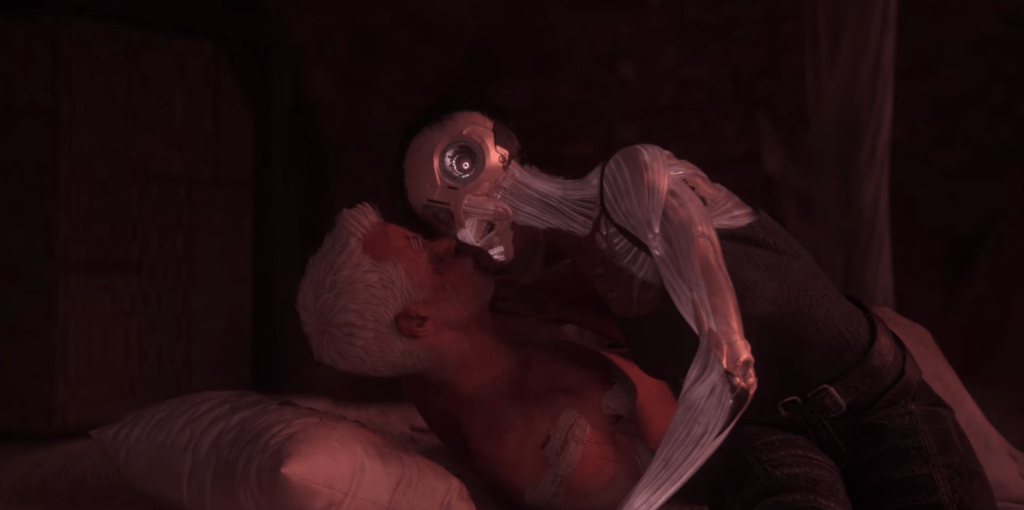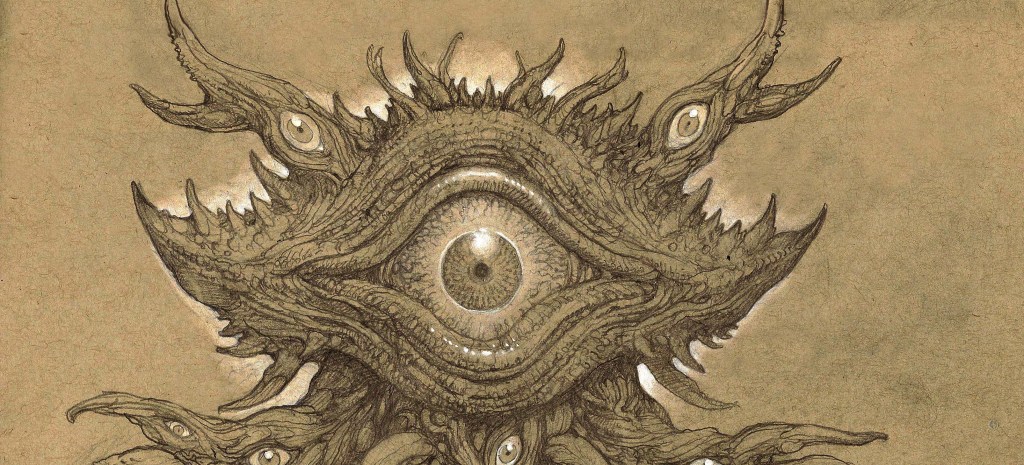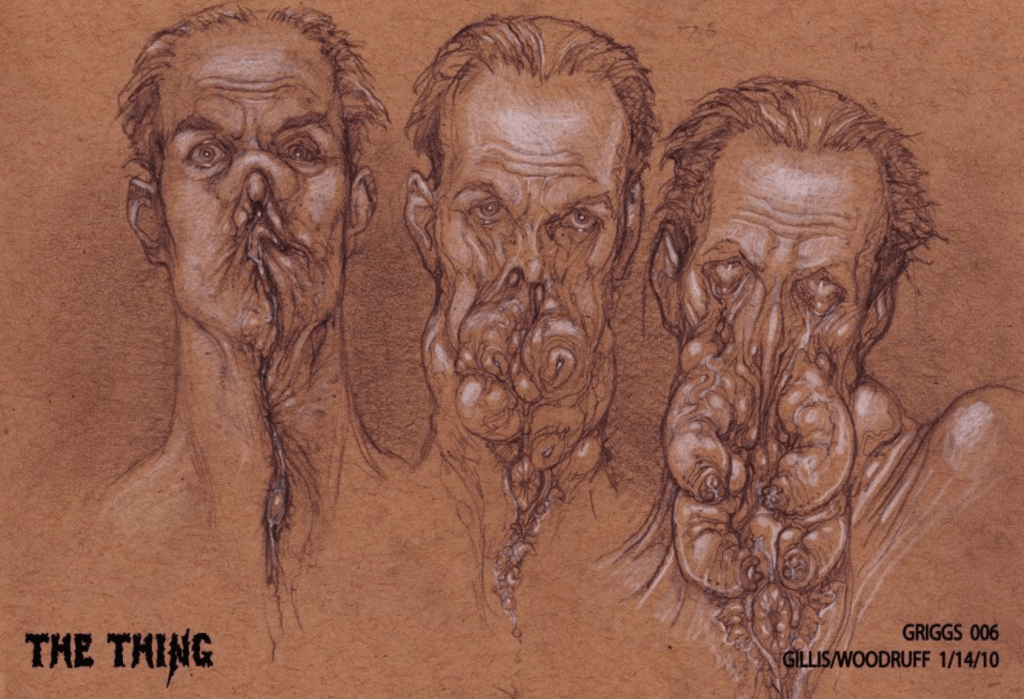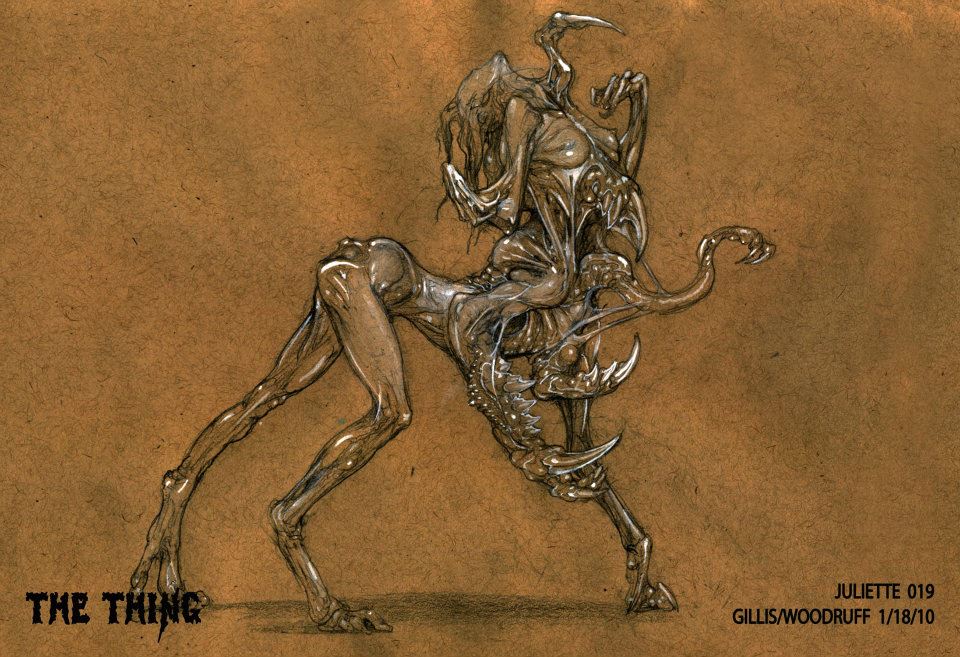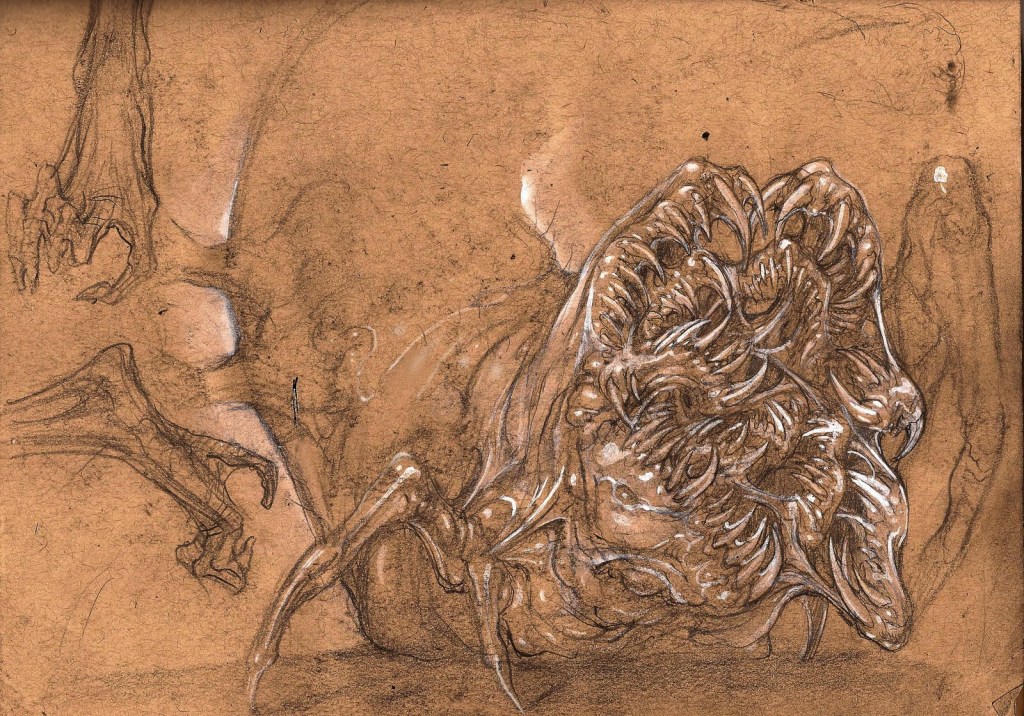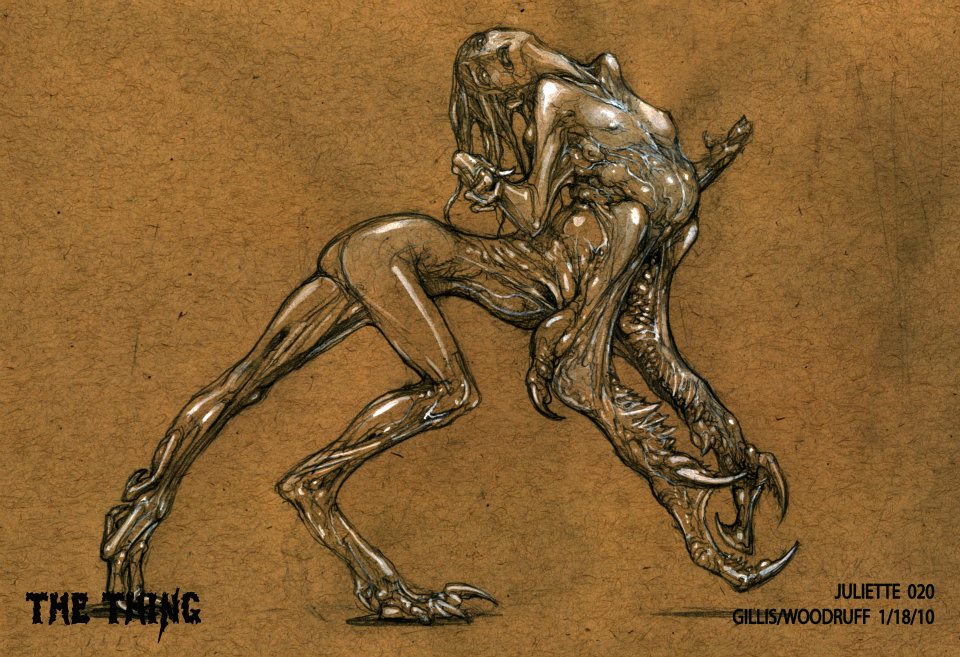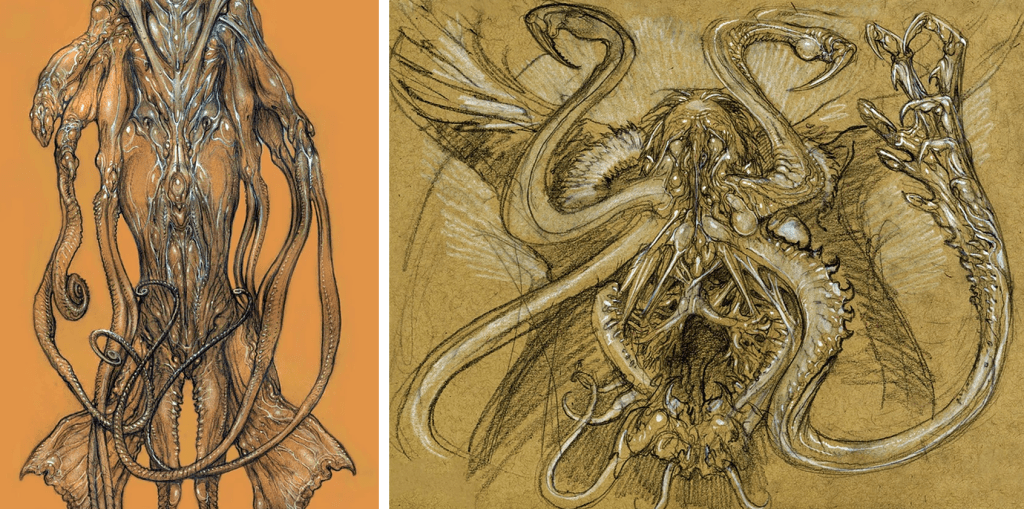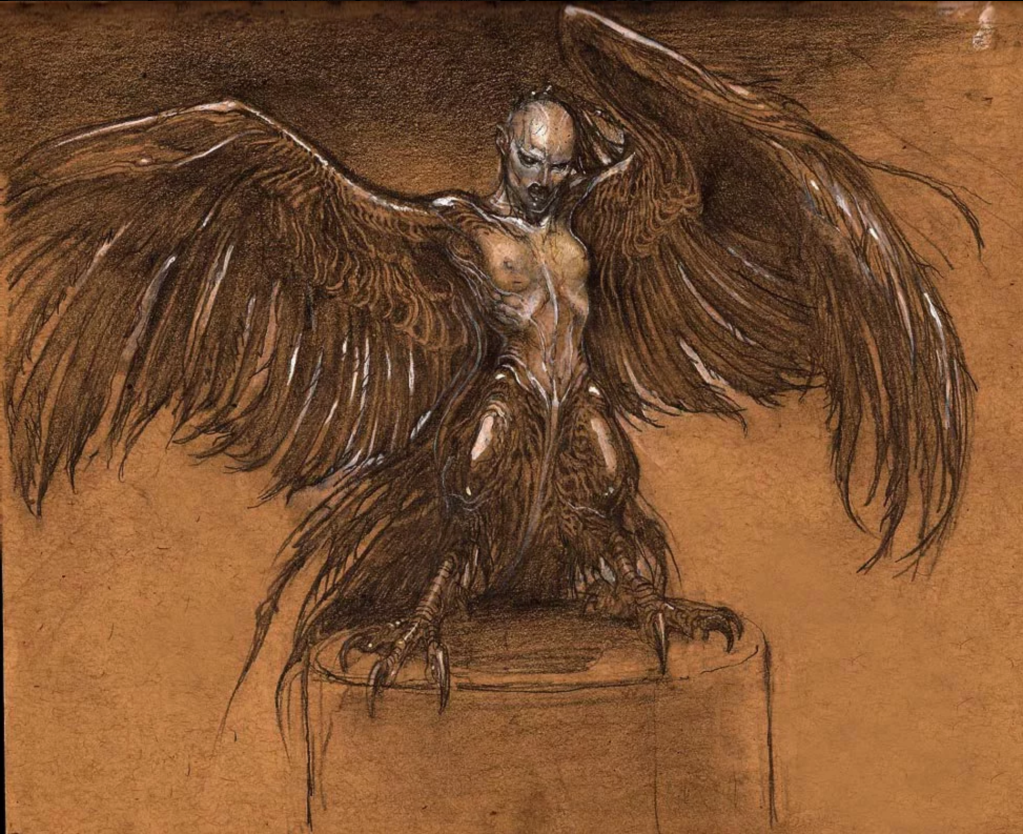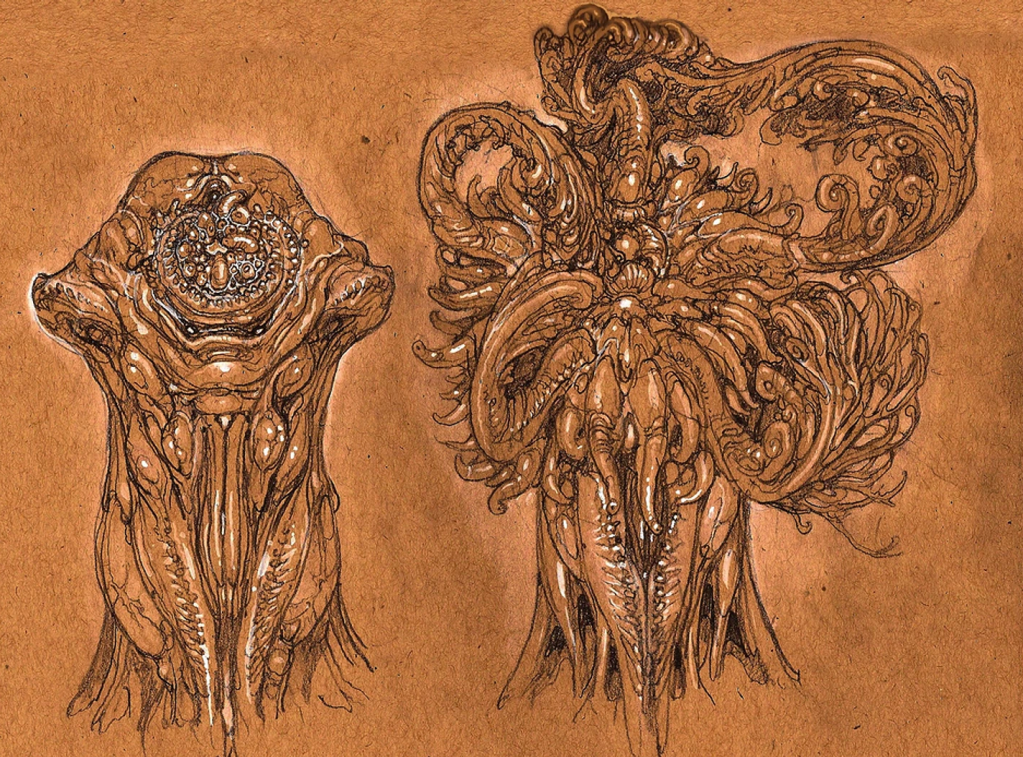
There’s no mistaking Paul’s gorgeous drawing style
Over the years I’ve seen a lot of Paul’s concept work posted online either by himself or featured on various sites. He is a sculptor, fine artist, illustrator, resin kit designer and movie concept artist.

Anyway, I thought I’d post a selection of his concept designs here as I love the look of his illustrations, which very often almost have the feel of classic Leonardo da Vinci drawings.
Enjoy…
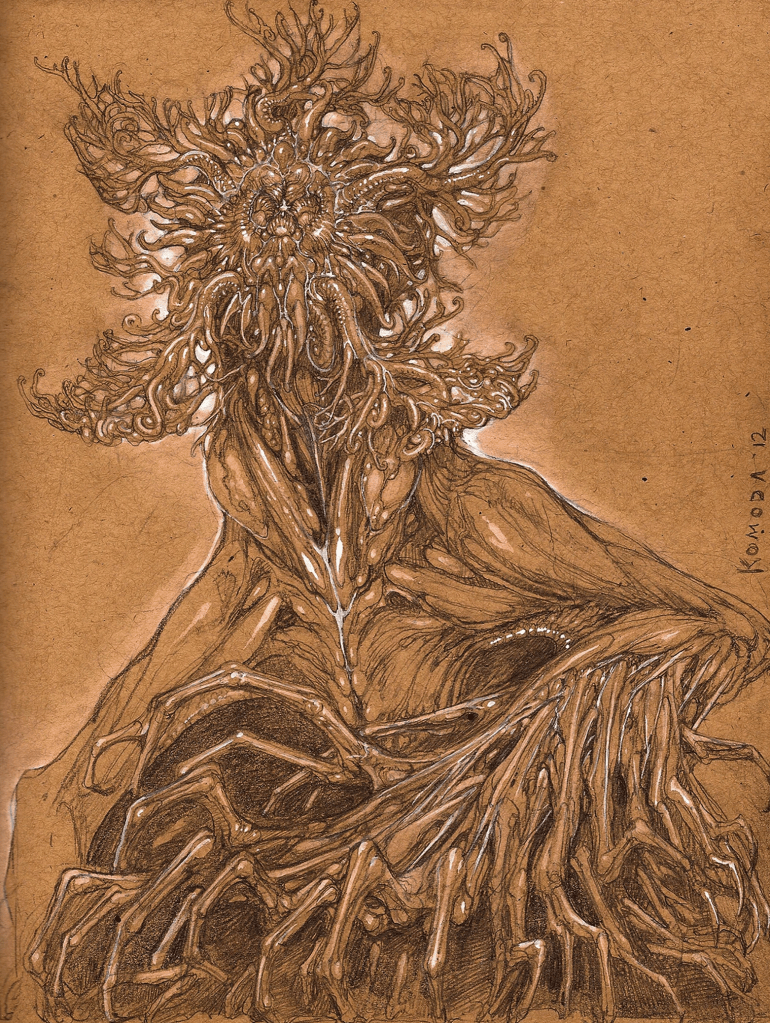
The Thing (2011)
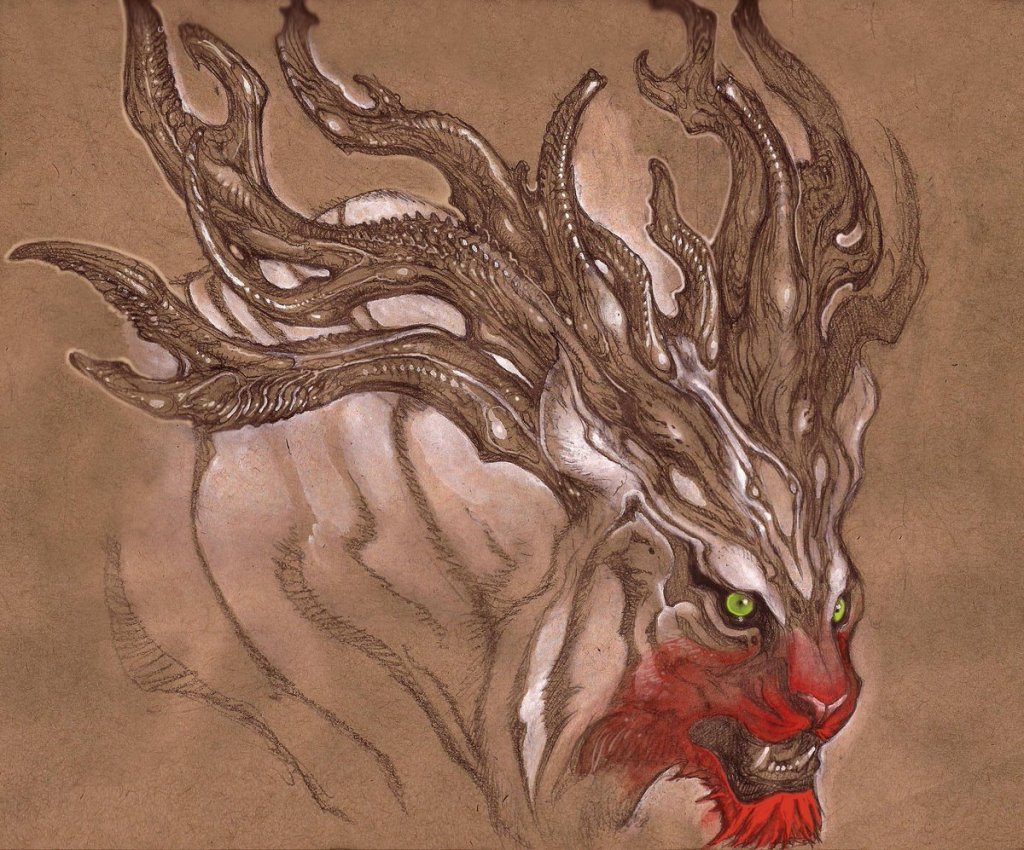
The Thing (2011)The Thing (2011)The Thing (2011)The Thing (2011)The Thing (2011)Harpy concept for The Tempest (2010)After Earth (2013)After Earth (2013)Horned wolf concept for Kong: Skull Island (2017)Unused horned tiger creature design for Kong: Skull Island (2017)
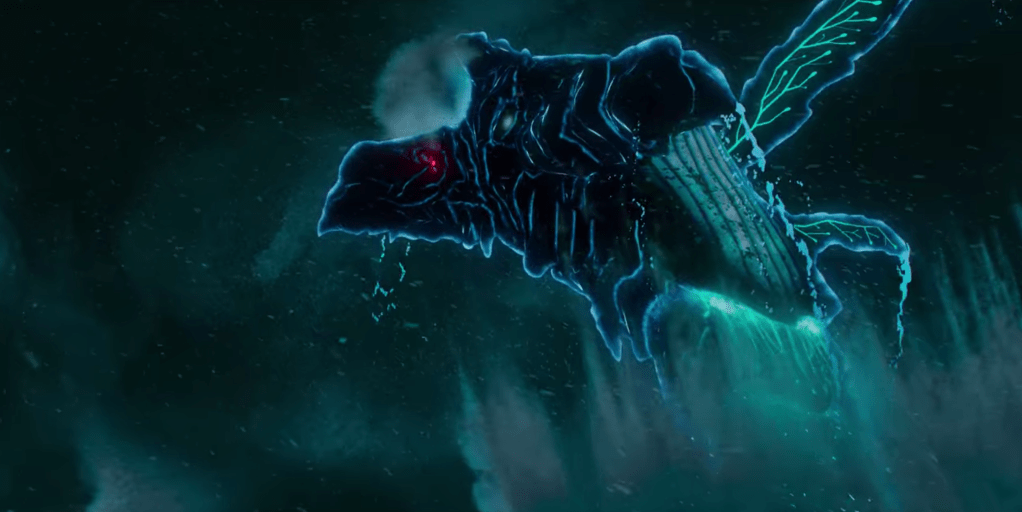
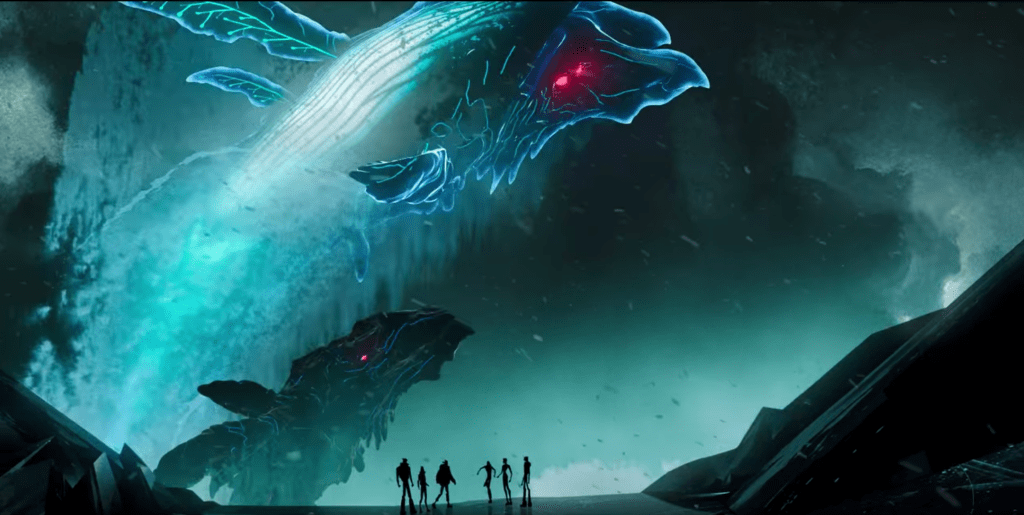
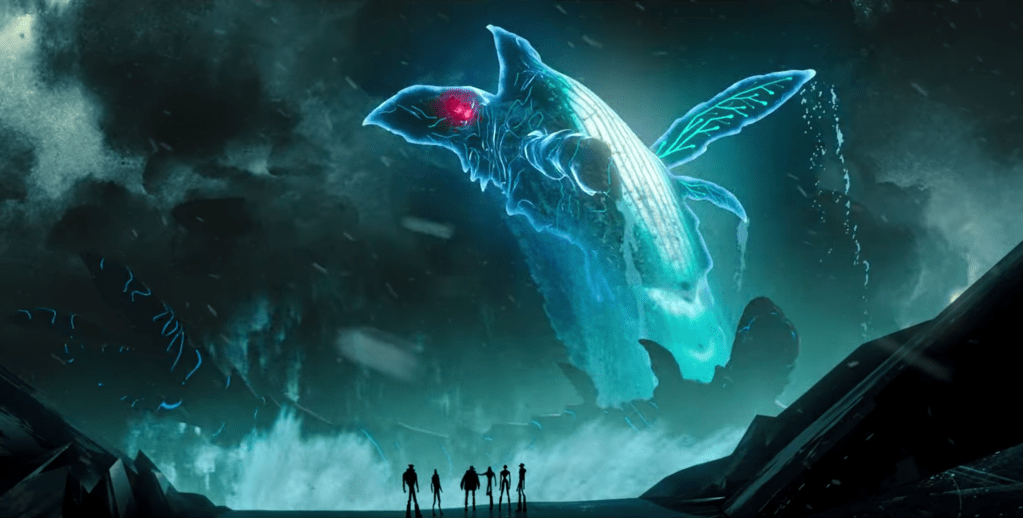
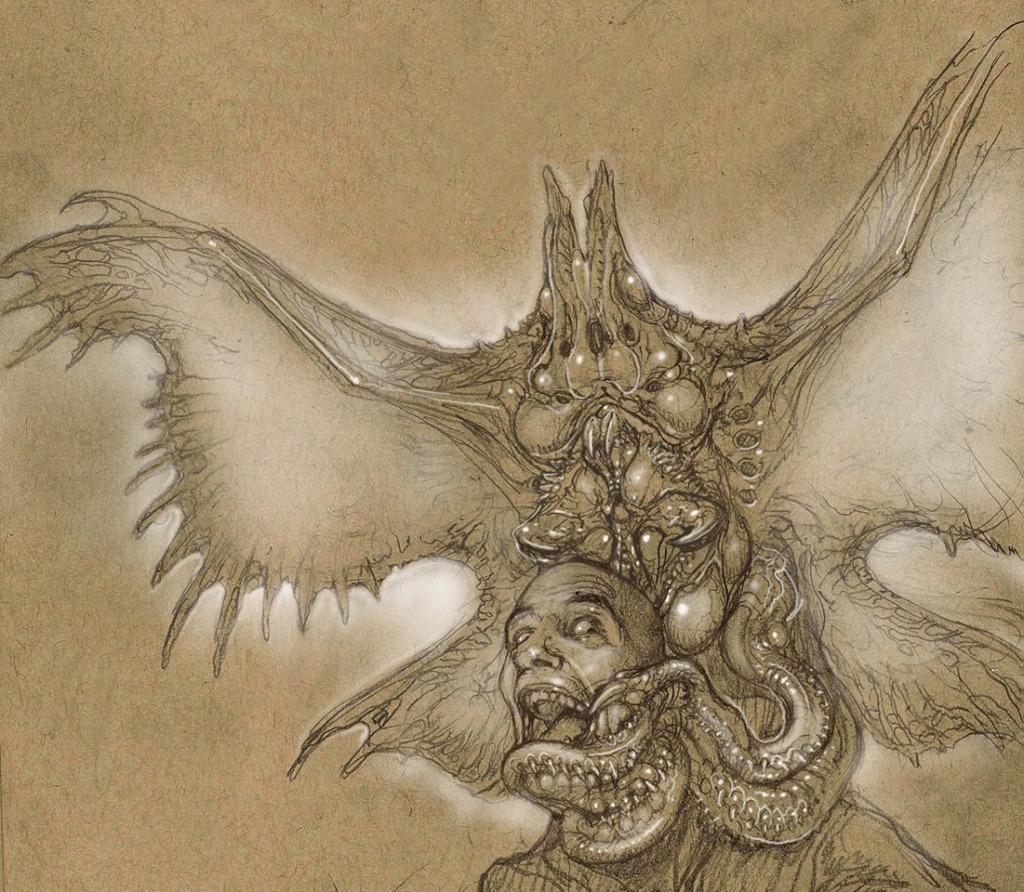
Unused flying creature design for Kong: Skull Island (2017)
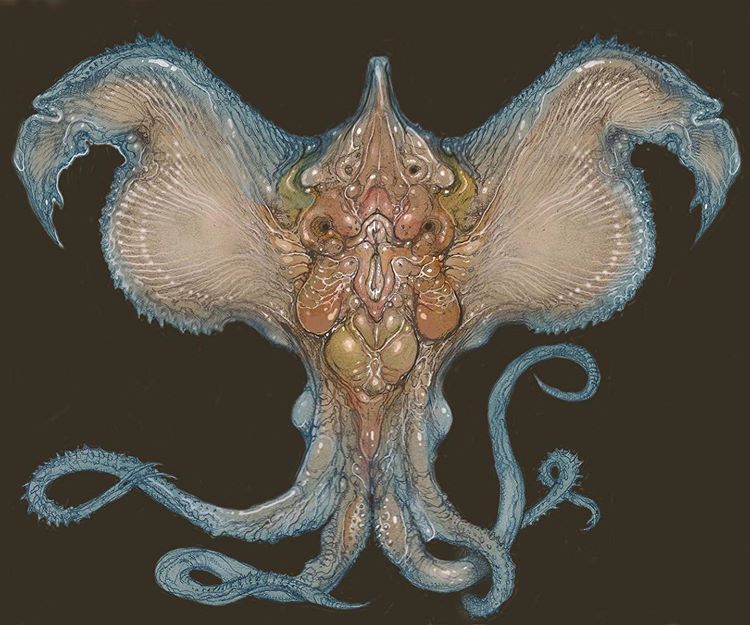
Paul’s concepts for the flying creatures in KONG: SKULL ISLAND were pretty otherworldly. It’s a shame these didn’t find their way into the film as they’re very striking.
Another of Paul’s flying creature designs for Kong: Skull Island
I Am Legend (2007)
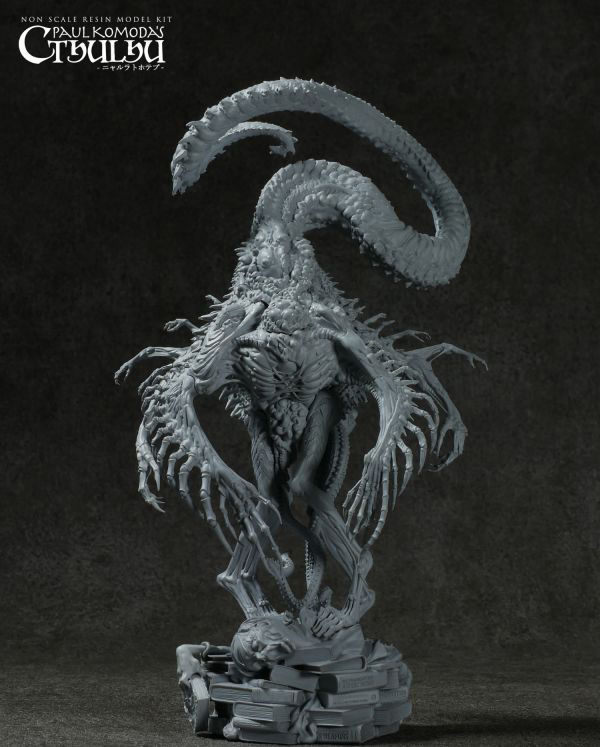
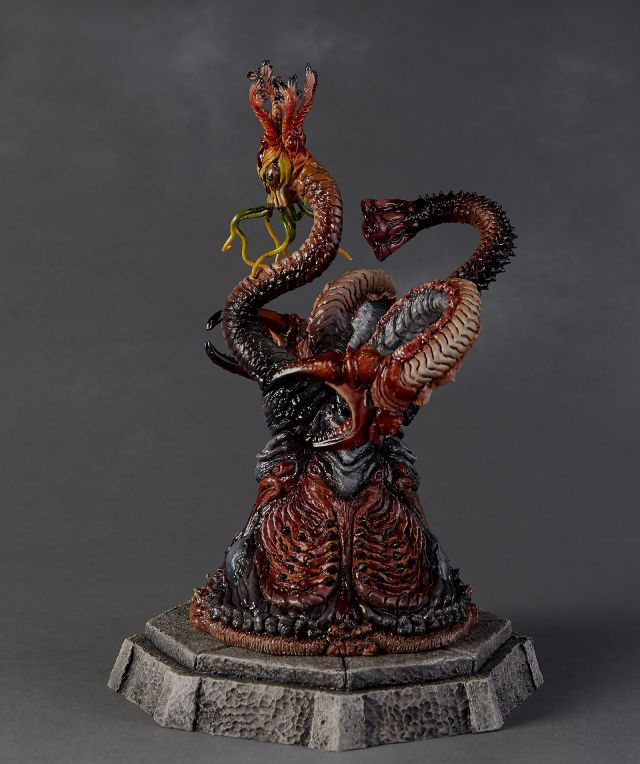
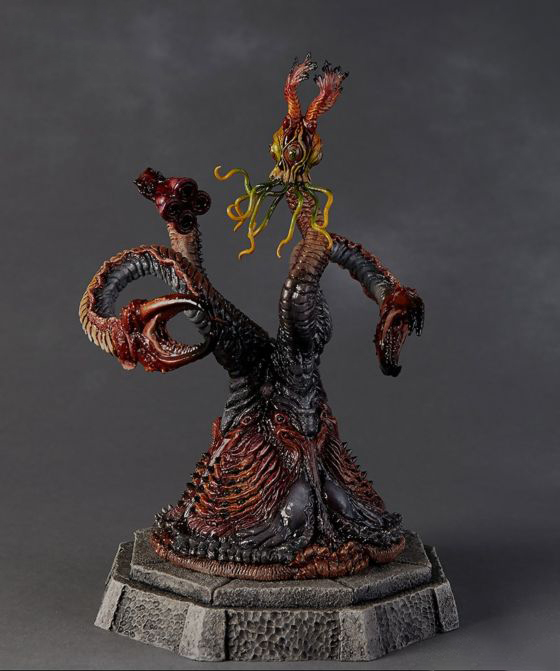
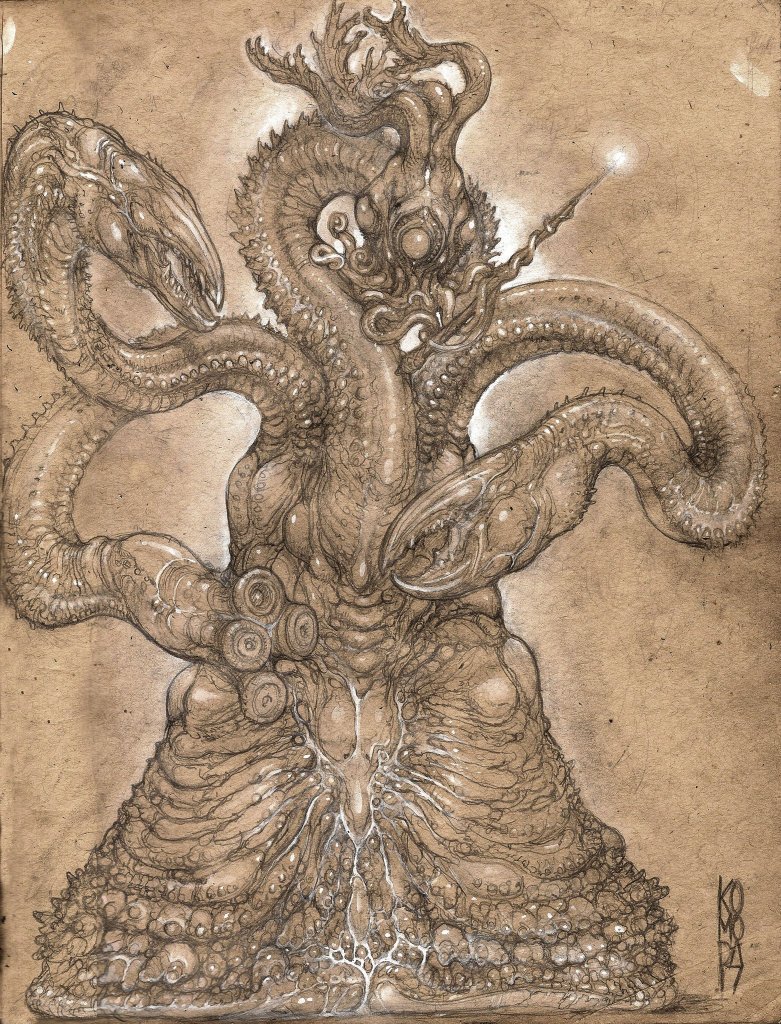
Below is a drawing Paul did for a resin model kit of Nyarlathotep: an Outer God in the Cthulhu Mythos…
Nyarlathotep resin model kit design
Daisuke Manno sculpted the Gecco garage kit that was based on Paul’s design…
The finished Nyarlathotep resin model kit
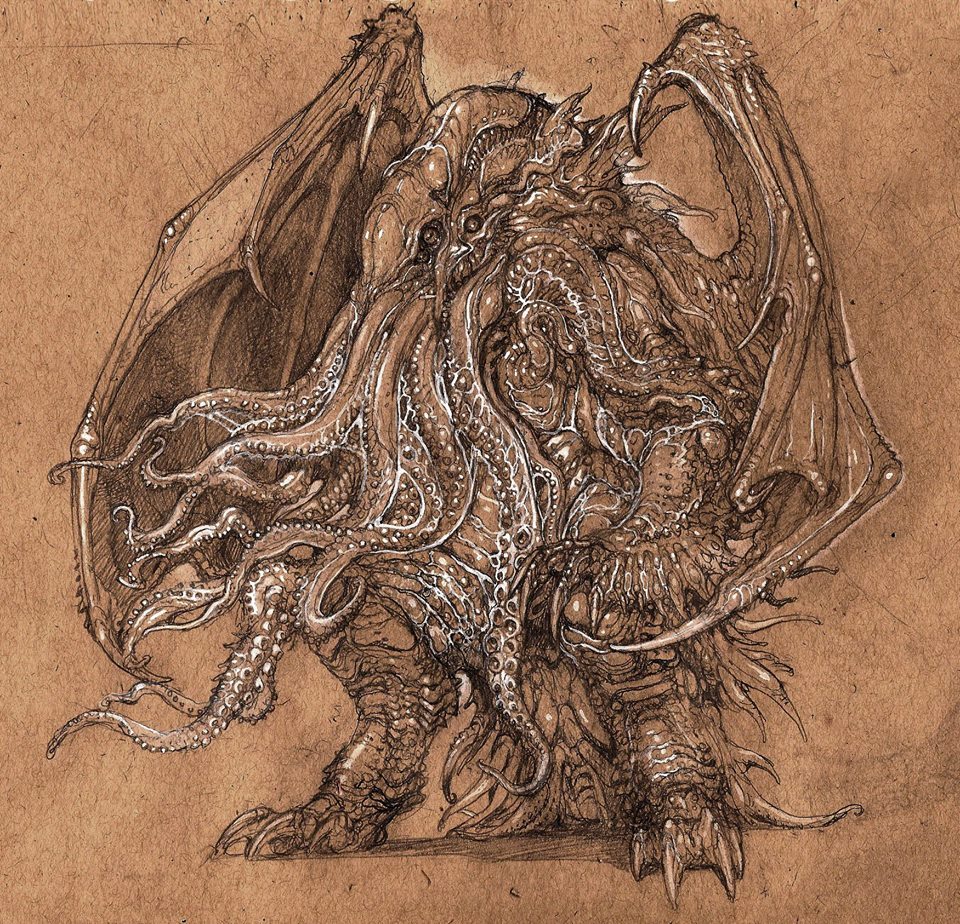
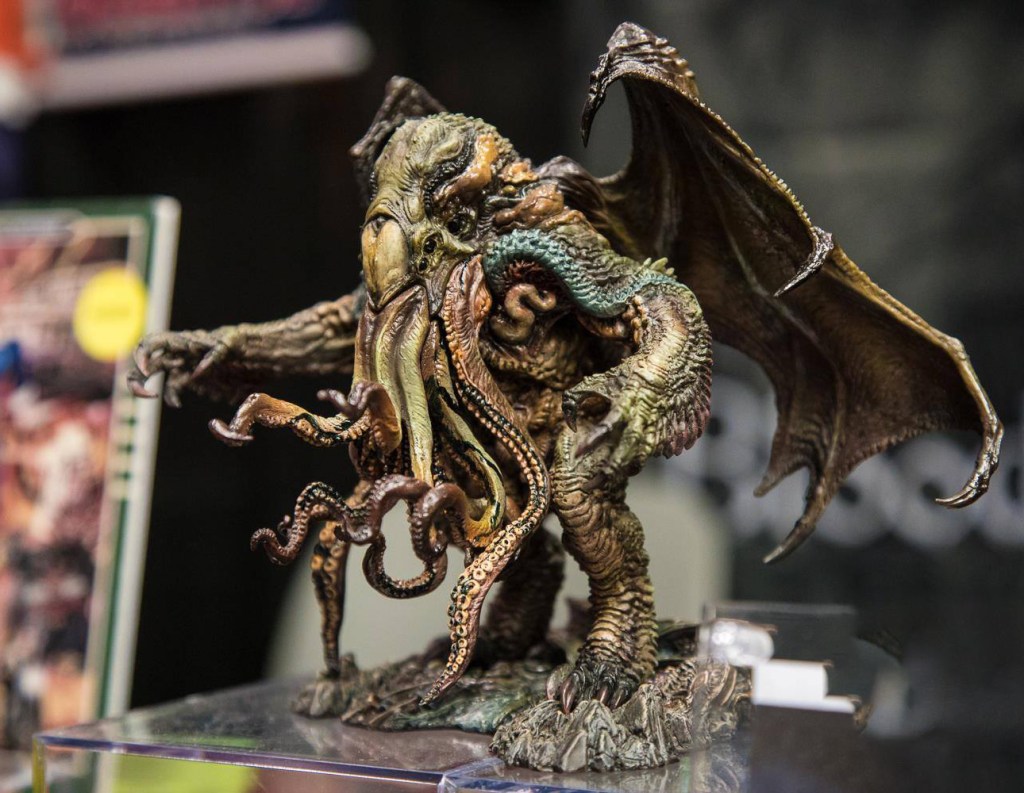
Here’s a glorious Cthulhu illustration Paul did for another Gecco model kit design…
Tentacle-tastic!
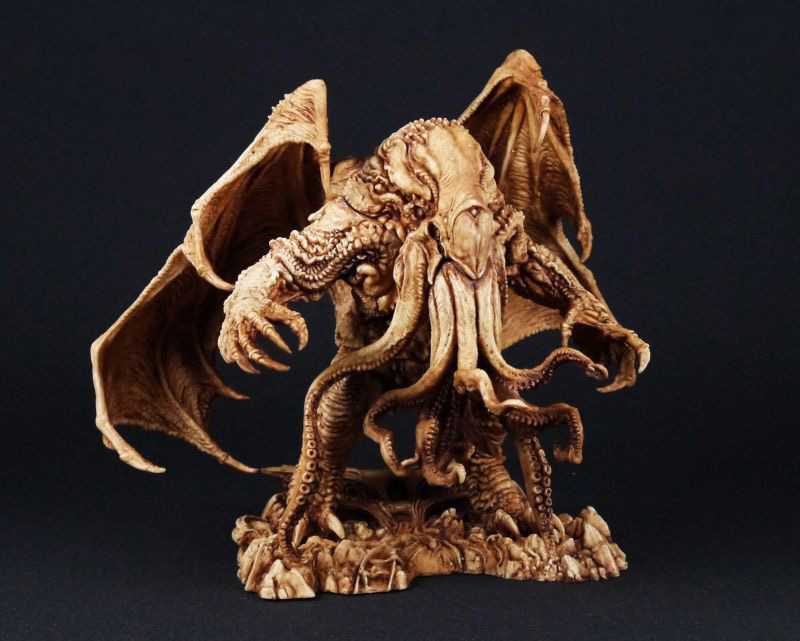
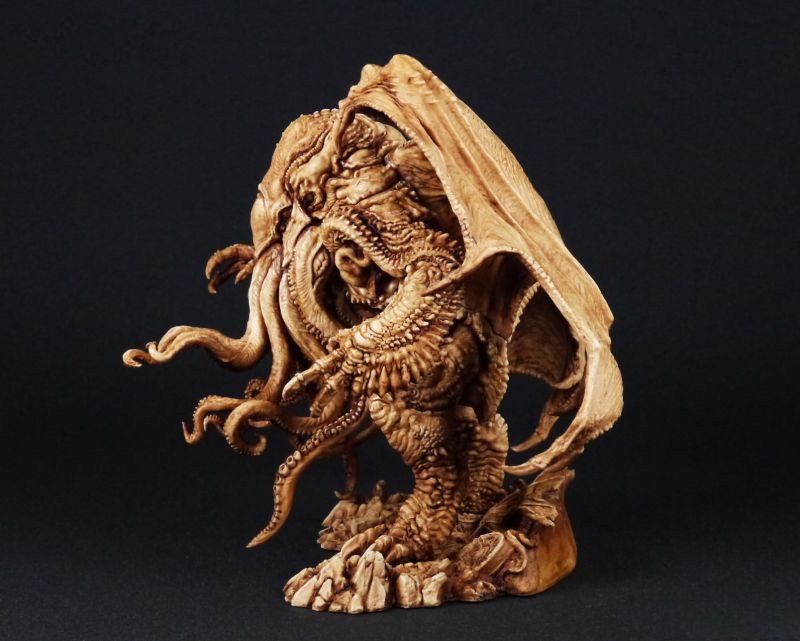
Some shots of Paul’s Cthulhu resin model kit…
Cthulhu resin model kit, sculpted by PaulSide view of the Cthulhu resin model kitHere’s a painted version of Paul’s awesome Cthulhu creation on display at a NY Comic Con
Paul designed this Great Race of Yith creature, which was then sculpted by RYO (nendoseizin) and painted by David Dill…
Great Race of Yith prepainted statue – side view
Great Race of Yith prepainted statue – front view
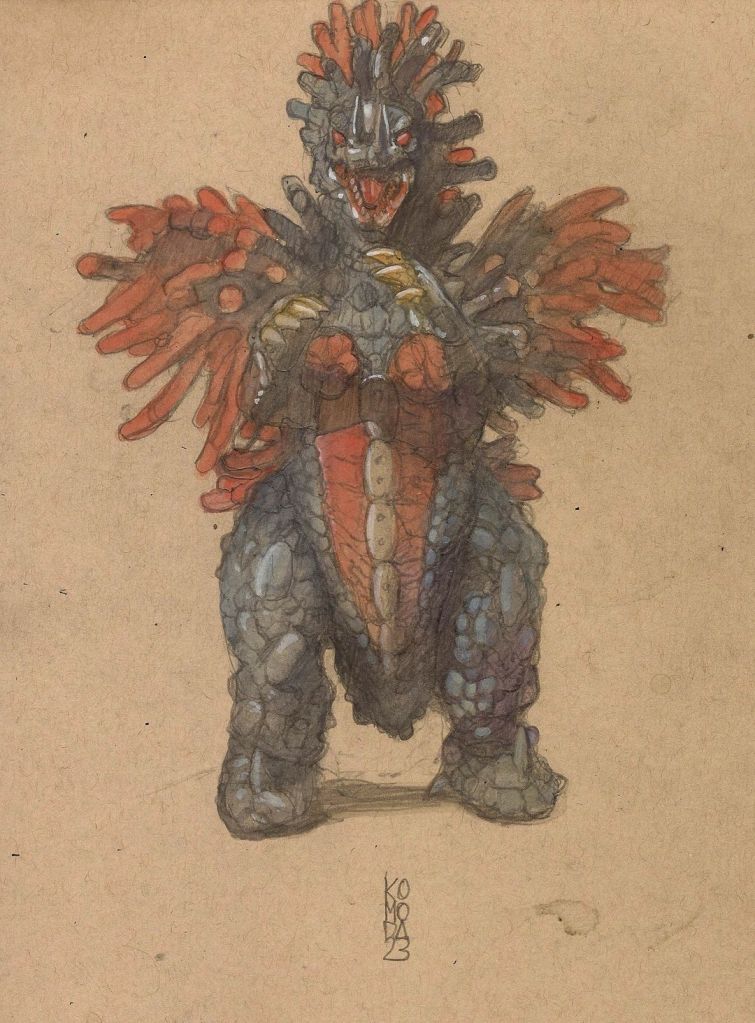
Here’s a great illustration Paul did for ACRO Co. Ltd, showing his design suggestion for Gan-Q (a Kaiju that first appeared in Ultraman Gaia)…
Design for Gan-Q model
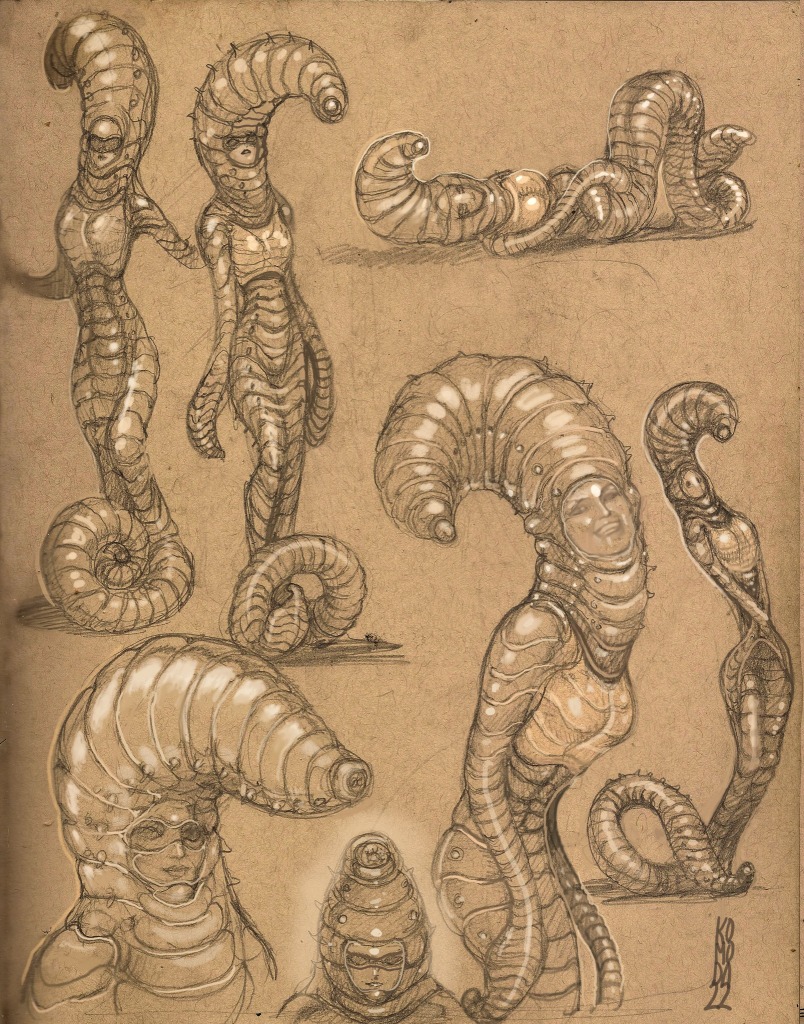
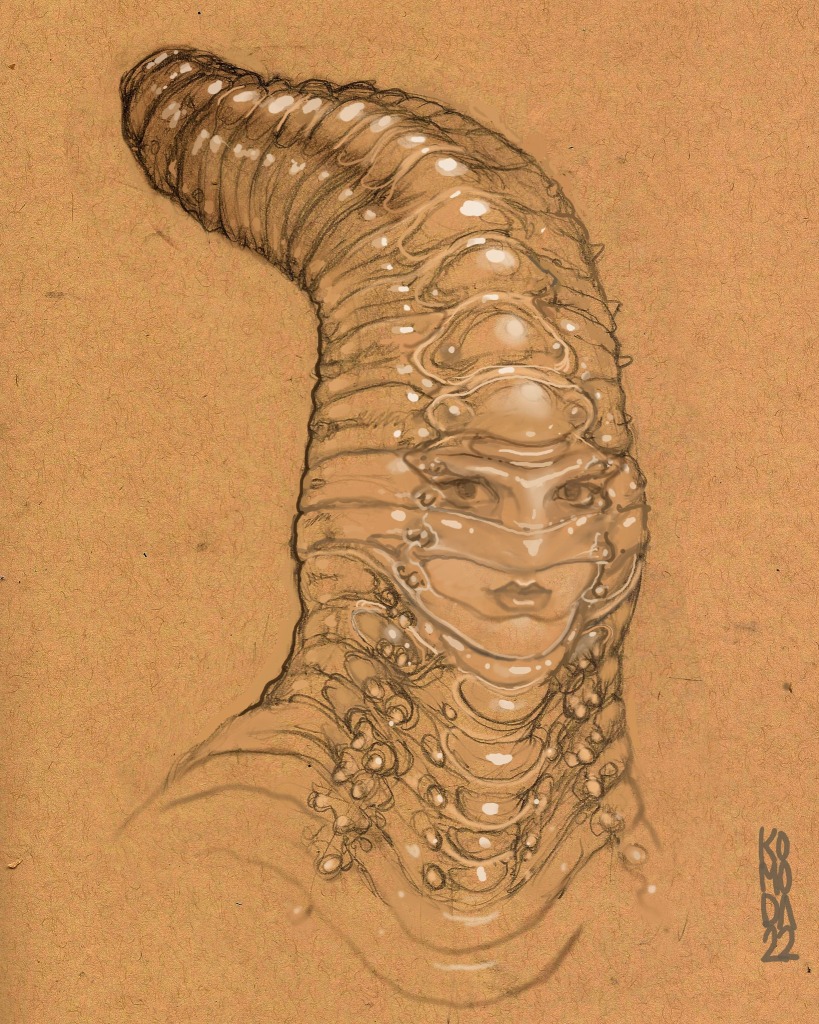
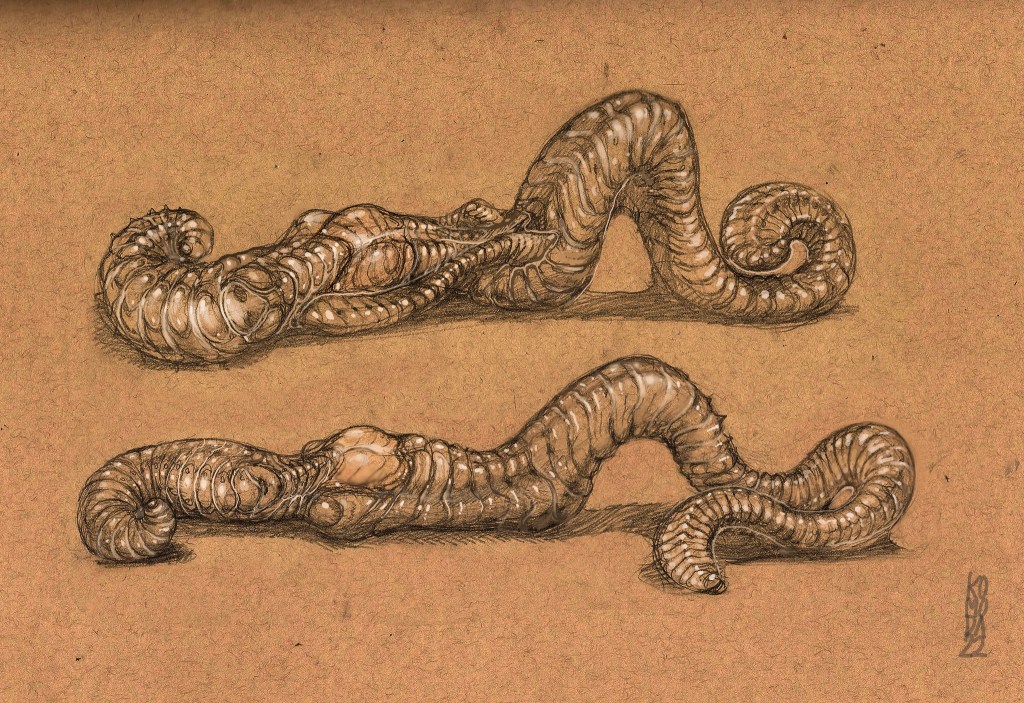
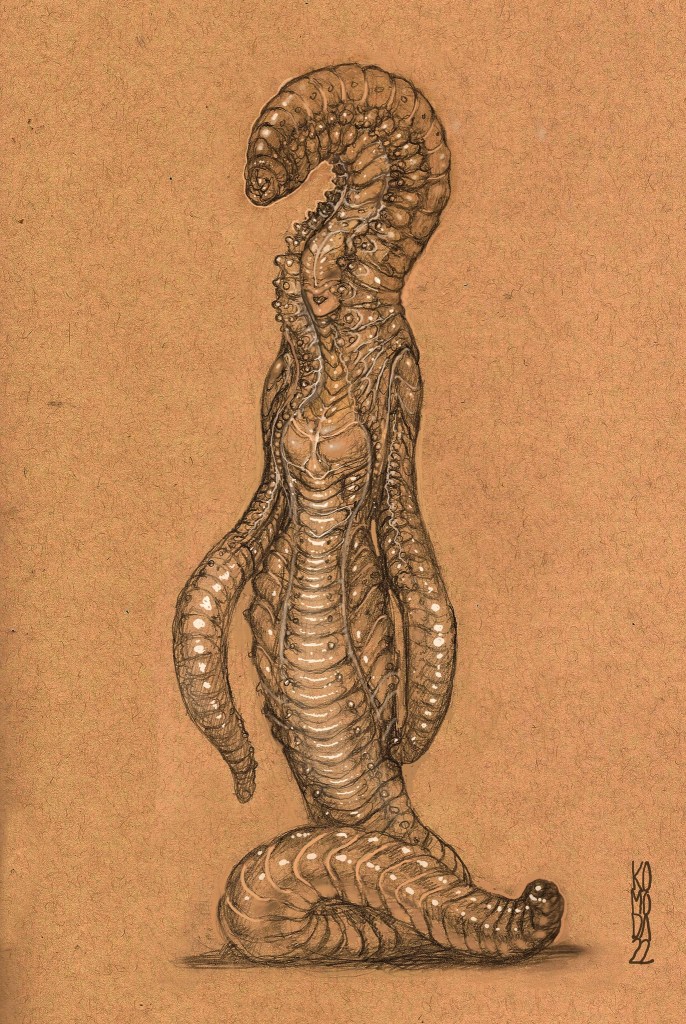
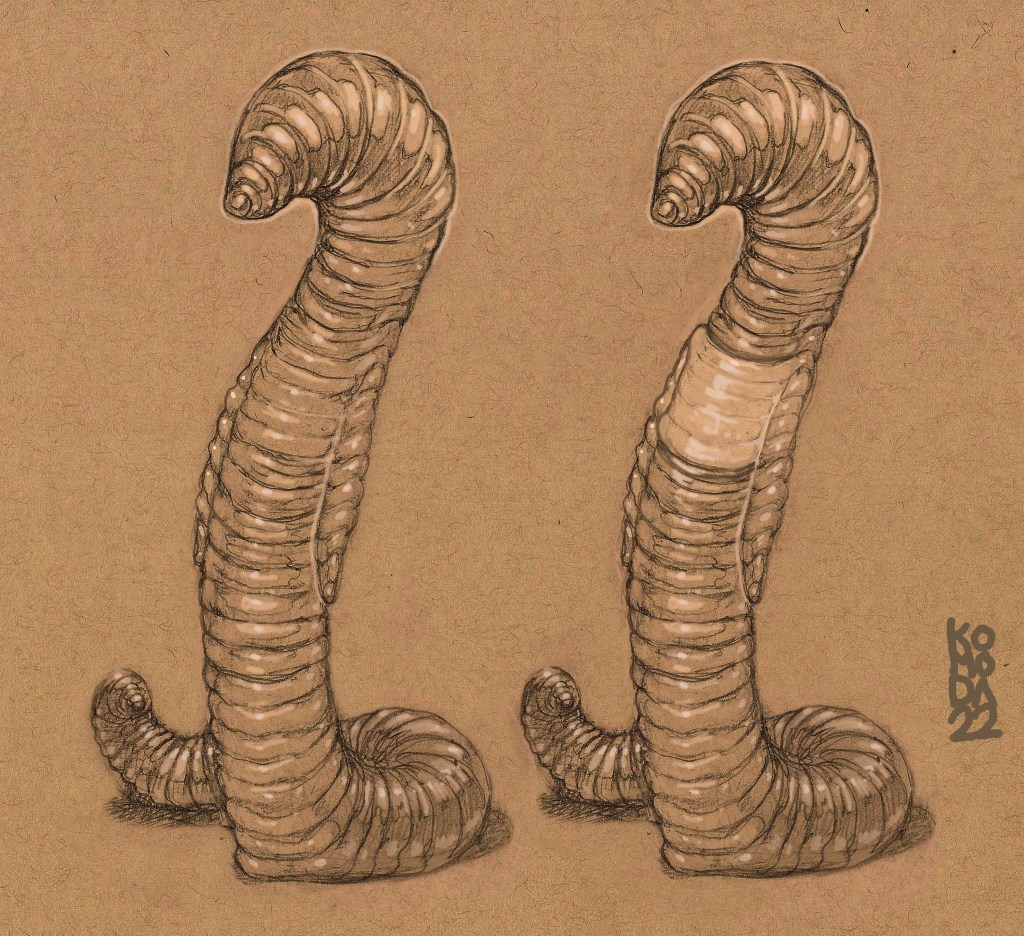
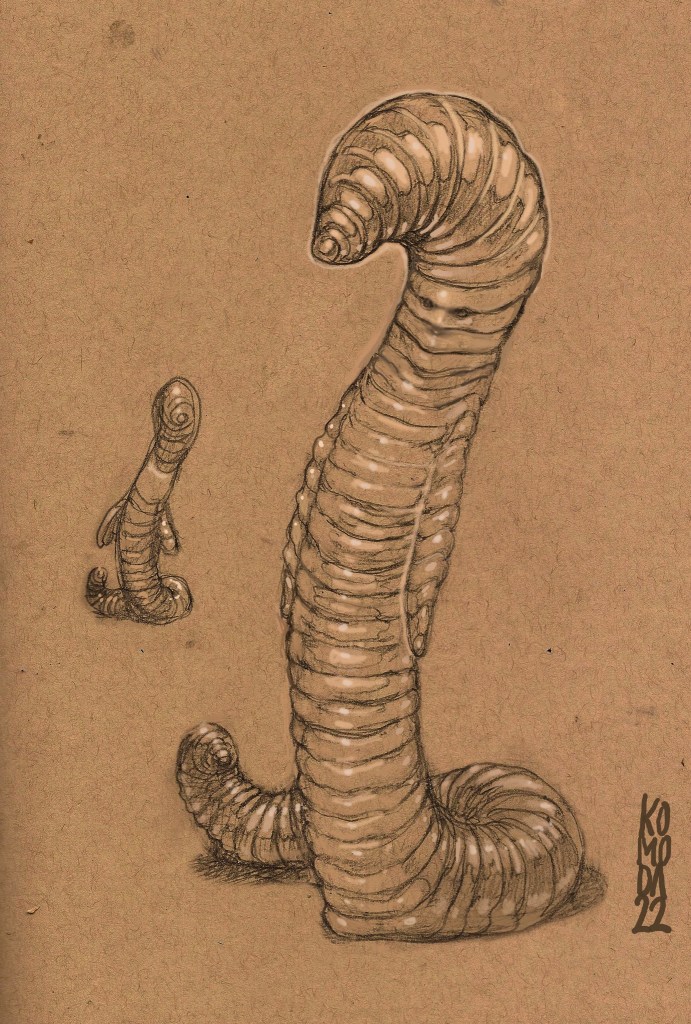
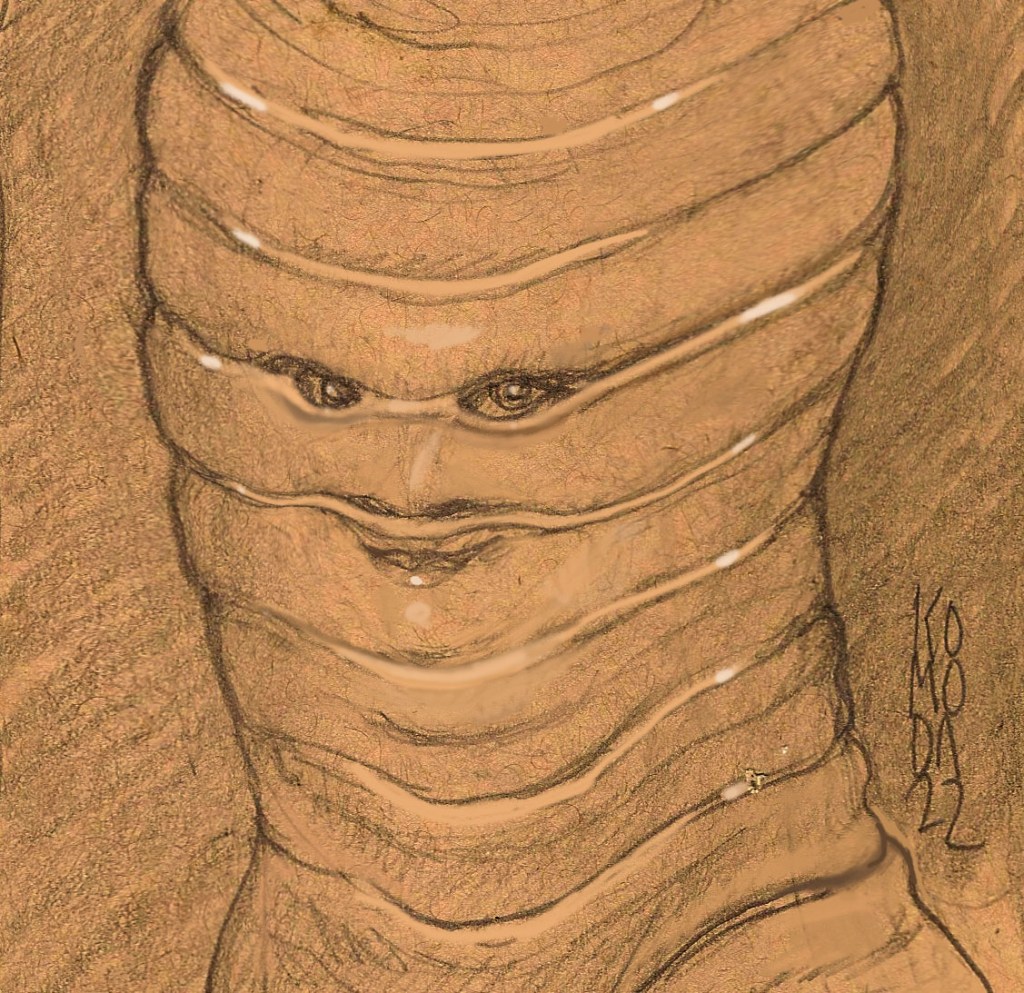
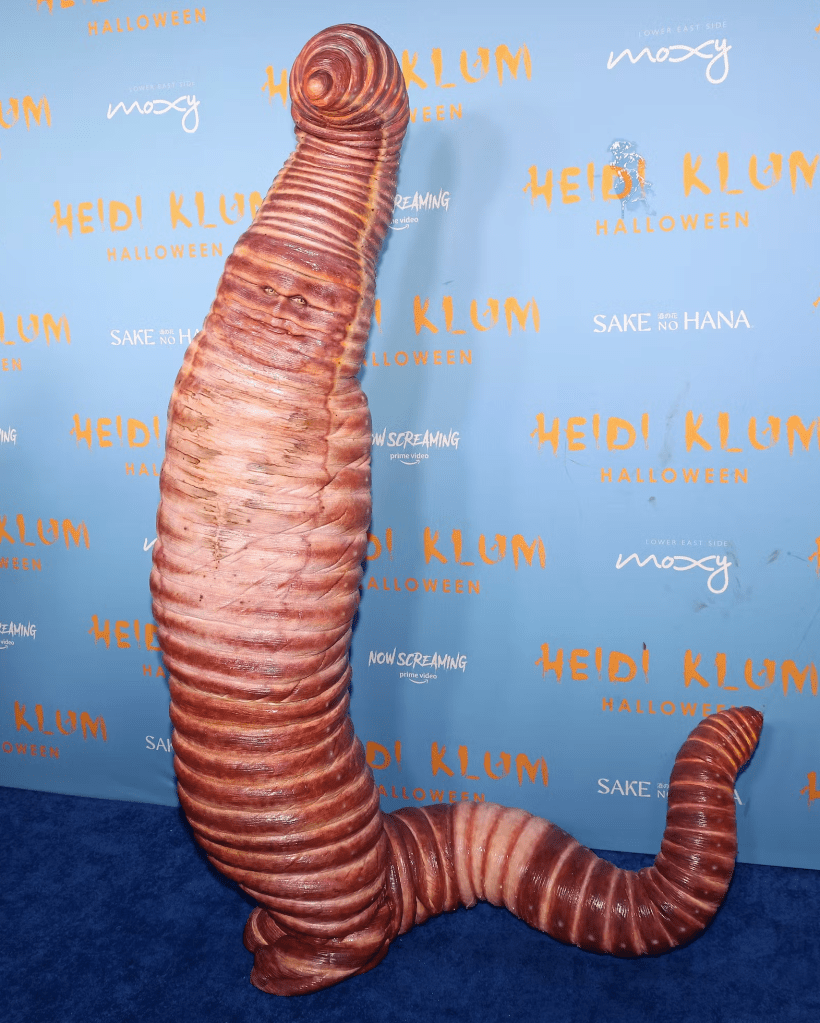
Supermodel and television personality Heidi Klum loves to throw annual star-studded Halloween parties and she really likes to dress for the occasion! In 2011, for instance, she was a hairy ape and in 2014 she dressed as the werewolf from Michael Jackson’s THRILLER video. In 2022 Paul was hired by Mike Marino of Prosthetic Renaissance to design a wild, eye-popping worm costume for Heidi. Here are just some of Paul’s concept drawings for the wonderful worm suit…
These were the very first drawings Paul did of the Heidi Klum worm suit, just trying to nail down a directionIn this design version more of Heidi’s face was exposed (it would be a little while before the decision to go ‘Full Worm’ was decided upon!)Paul drew these from screenshots from a video he was sent of Heidi Klum demonstrating how she wanted to perform in the worm suitThis design variation was about as far out into alien glamor that the worm suit design was taken. (Paul had just been to the Alexander McQueen exhibit at LACMA and felt inspired to push the look into a kind of biomorphic couture which also took more inspiration from sea worms)Drawings of the final Heidi Klum worm suit design, neither of which have a face yet. The right design still retains the clitellum (the smooth band which earthworms use for reproductive purposes)This was the final approved design (more or less): Paul was still undecided whether the suit would have flipper-like arms or notPaul’s final drawing, which was a basic idea for how the face prosthetic would look……and here’s a close-up of Heidi’s face in the actual prosthetic!Here’s the gobsmacking costume, built by Prosthetic Renaissance Inc., seen on the night of the Halloween event!
Some miscellaneous work…
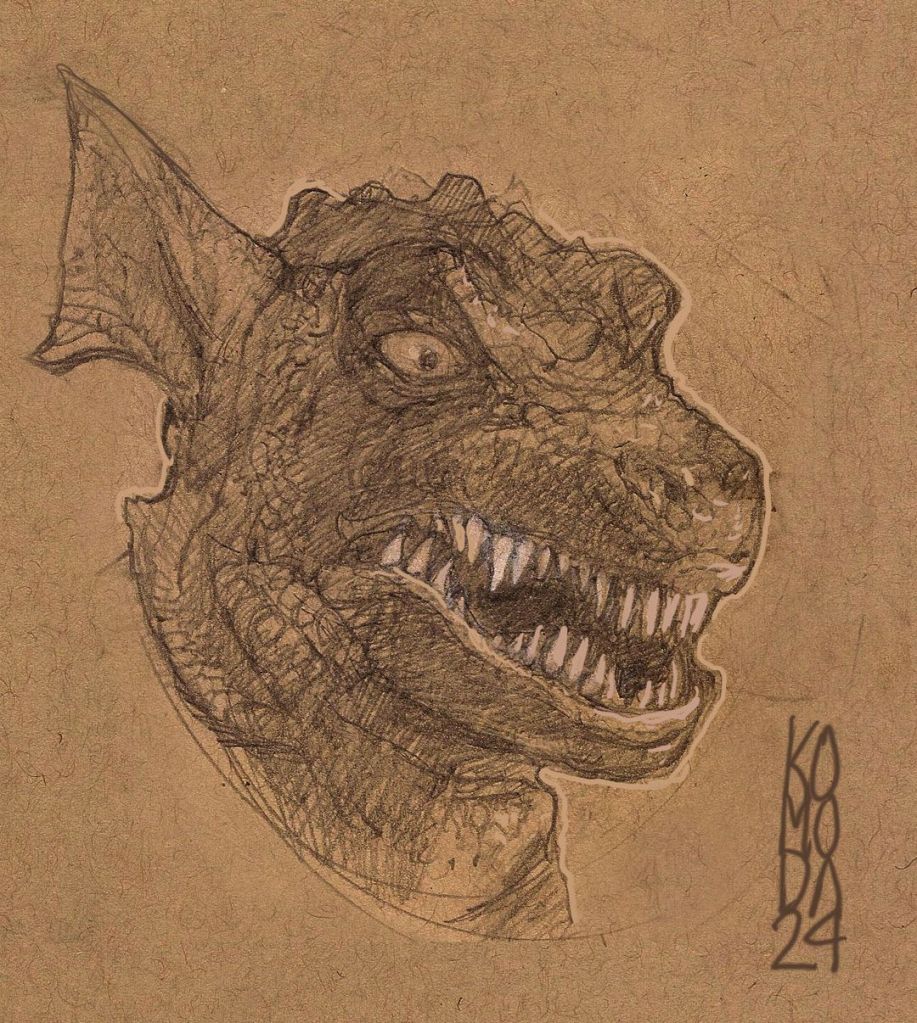
A commission Paul did in 2019, showing Ernest Borgnine melting in THE DEVIL’S RAINA cool GORGO-tastic sketchbook drawing Paul did, highlighting the creature’s wavy rows of teethA Yithian drawing from 2017Godzilla drawing done by Paul at the start of 2020Verokron from episode 1 of Ultraman Ace (on 11 x 8 1/2 multimedia paper )
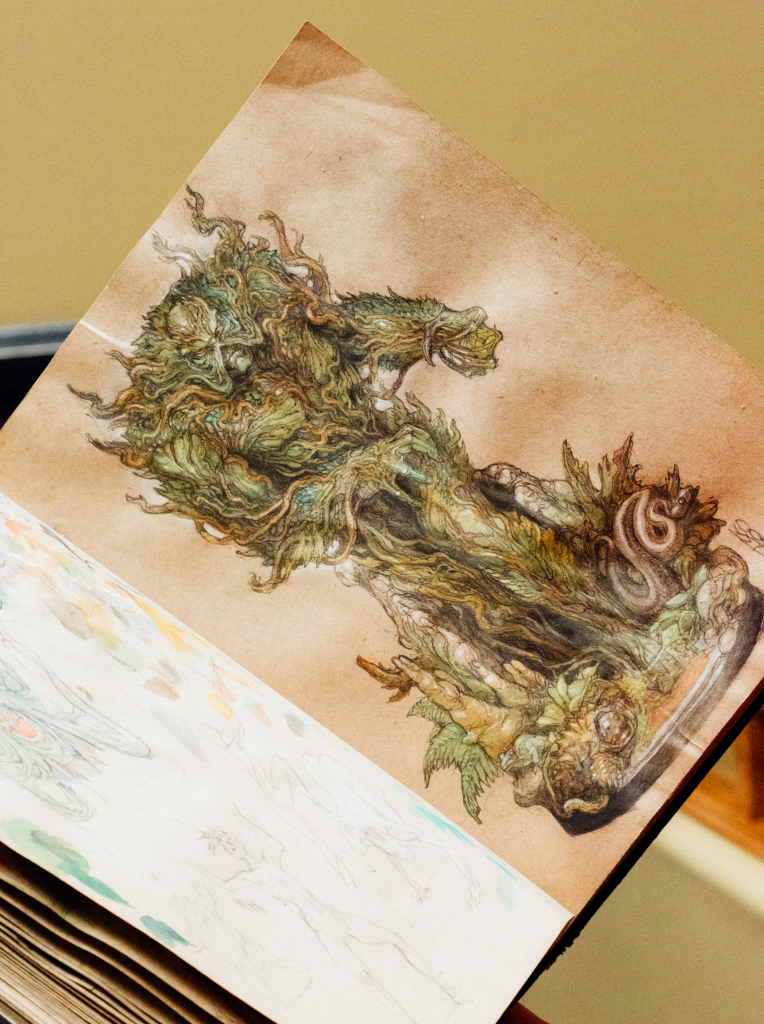
Here’s a pic of Paul sculpting a Swamp Thing maquette…
…and here’s a sketch of Swamp Thing Paul did before he began sculpting the maquette…
Niiiiiiiiiice
The 1/1 scale/proportion drawing for the Sideshow Swamp Thing…
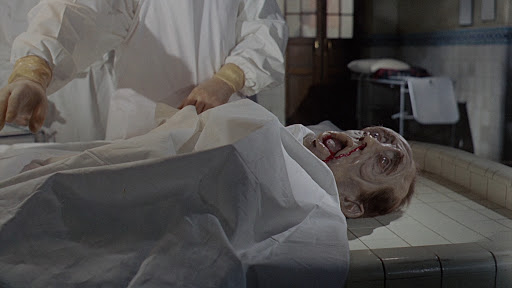
Professor Heitz (Michael Goodliffe) travels to Vandorf to prove that his bohemian artist son, who has committed suicide, is being used as a scapegoat to cover up the fact there is an ancient evil prowling the area, turning people to stone. Unfortunately, the professor himself falls victim to this creature but, before he becomes a stone corpse, he manages to send a message to his other son, Paul (Richard Pasco), asking him to look into this mystery.
Professor Heitz’s son Bruno commits suicide
A petrified victim
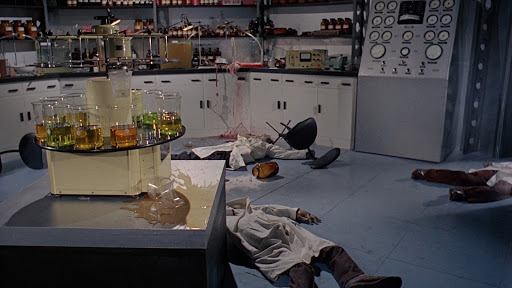
The local police (led by Patrick Troughton), along with Dr Namaroff (Peter Cushing) of the Vandorf Medical Institution, try to obstruct Paul as he attempts to solve the mystery. Paul has a narrow escape when he catches sight of the prowling gorgon’s reflection, which physically ages him and makes him ill, but he is aided by his tutor Professor Meister (Christopher Lee), who also travels to Vandorf to help out his pupil. Matters become more complicated when Paul falls in love with Namaroff’s beautiful assistant, Carla (Barbara Shelley)…
Dr Namaroff and Inspector Kanof want to keep the truth behind the deaths covered up
Some of my favourite Hammer movies are their standalone films like THE REPTILE, PLAGUE OF THE ZOMBIES and THE GORGON. The latter is a production that I will go back to enjoy again and again because it is such a wonderful, tragic concoction.
US poster
The film has an interesting plot structure, introducing a succession of characters, who arrive at the town of Vandorf looking for answers: first Professor Heitz, then Paul and then Professor Meister. This could have given it a repetitive feel, but it doesn’t, and the story moves along nicely, with Dr Namaroff acting as a constant obstruction to the enquiries made by the various visitors.
Professor Meister is very feisty!
Peter Cushing is very good in this: as Namaroff he remains impeccably well-mannered throughout, as he covers up the facts behind the deaths, never admitting to outsiders that each victim has become a corpse-statue. His love for Carla adds extra depth to the character, as he becomes jealous of Paul’s burgeoning relationship with Carla, whilst also wrestling with the knowledge of just who is transforming into the gorgon.
Peter Cushing plays a very interesting, conflicted character
The identity of the possessed person isn’t too hard to fathom, but this doesn’t harm the film because Carla’s predicament adds to the tragic nature of the story. With Paul and Namaroff trying to do what’s best for Carla (even if Namaroff’s solution ultimately involves killing her), the stage is set for a final clash between two men besotted with the same woman.
Doomed lovers
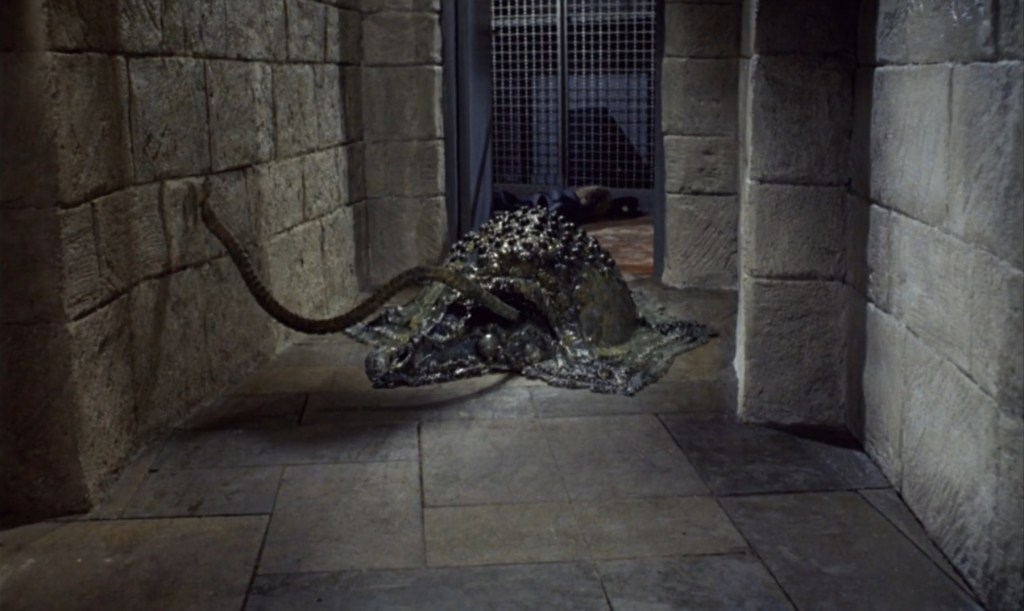
James Bernard’s score has its usual bombastic elements, as heard in many Hammer productions, but it also features haunting female vocals that add immeasurably to the atmosphere. The tattered Borski Castle interior set, by Bernard Robinson, also adds to the mood of the film, as does the ultimately sad resolution to the story.
Borski Castle
The whole cast, including Richard Pasco and Barbara Shelley, inhabit their doomed roles well, with Christopher Lee providing somewhat lighter relief as the brusque, no-nonsense, says-it-as-it-is Professor Meister.
Memorable moments include Professor Heitz struggling to write a letter as he slowly turns to stone, Paul’s encounter with the gorgon that results in him suffering badly from glimpsing her reflection in a pool, and the finale in Borski Castle.
Professor Heitz begins to turn to stone…
…and painfully writes his last letter
The depiction of Megaera the Gorgon in the film is, admittedly, a distinctly low tech affair, but Terence Fisher’s direction compensates for this by keeping the snake-haired woman in shadows, in the background, behind pillars and glimpsed in reflections. As portrayed by Prudence Hyman, the gorgon is still a memorable Hammer creation, lurking menacingly in her green robes, awaiting her next victim.
The gorgon lurks behind pillars……she’s seen in reflections…
…she stands behind cobwebs…
…and she roams the castle
Don’t look at her!
With its tragic ending, sombre fatalism and fine acting from the whole cast, THE GORGON is a top-notch Hammer production.
Megaera meets her match when Christopher Lee picks up a sword
The gorgon approaches…
…for the fine, apt, fatalistic ending
UK poster
Belgian poster
German poster
Italian poster
The shot just screams ‘Hammer’!
Christopher Lee creeps up behind the gorgon, sword in hand…
A gigantic, frozen Tyrannosaurus Rex is discovered in the arctic. The creature is shipped over to Metropolis, where it is housed in a massive, refrigerated building attached to the city museum. After an accident wrecks the generator, the ice melts and the huge dino awakens, breaks free, runs amok, but is eventually stopped by Superman.
The fun begins…
This nine minute Fleischer Studios cartoon was the fourth (of seventeen) Technicolor shorts based on DC’s Superman – and it’s my favourite.
The dino is shipped to Metropolis in a refrigerated tanker
THE LOST WORLD (1925) had ended with a brontosaurus stomping through the streets of London and the finale of KING KONG (1933) had the titular beast creating havoc in New York, but these creatures were not too exaggerated size-wise, whereas the Tyrannosaurus in THE ARCTIC GIANT is a truly Kaiju-scale beast, hinting at the kind of monster action that would appear on cinema screens from the 1950s onwards.
Will this monster thaw out?
Of course he will!
Look into my eyes
The mega Tyrannosaurus in this short makes the most of his brief rampage: he wrecks the museum, stomps on police cars, totals an elevated train track, smashes through a dam, knocks aside firefighter boats, pulls down a suspension bridge and threatens a baseball stadium.
The museum is wrecked…
…and police cars get squashed…
…and the elevated train track is stomped on…
…and the critter pushes through the dam…
…causing a flood…
…and this bridge must be torn apart too, because it’s in the way!
Superman follows after the super-sized critter, quickly filling the hole in the dam with a boulder and temporarily fixing the bridge.
Lois Lane, as usual, stubbornly wants to get in on the action and is almost eaten by the monster at the end, before Superman flies into the dino’s mouth, prises its jaws open and carries Lois to safety.
Superman to the rescue!
With story elements that would later feature in THE BEAST FROM 20,000 FATHOMS (1953), GODZILLA (1954) and many other creature features that involve colossal monsters, this is a very enjoyable short.
The arctic giant is eventually displayed to the public… but did this work out for KING KONG or GORGO?!
Popeye and Olive Oyl are stranded on a raft in the ocean when Popeye spots a galleon called the ‘Sea Witch’. They happily climb onboard but it soon transpires that the ship’s crew are still hanging around… as ghosts.
This was the 231st and final theatrical Popeye cartoon
Popeye and Olive
SPOOKY SWABS was the final Paramount Pictures theatrical Popeye cartoon to be released and, whilst nowhere near as good as the much earlier Popeye cartoons, it is quite a fun affair with such gags as Popeye speedily spinning his pipe in his mouth so that he can use it as an outboard motor, water draining out of Olive Oyl’s eyes so that we can see her pupils again, and Popeye grabbing a sawfish so that he can use it to cut through the ship’s anchor rope.
Happy ghosts
It would’ve been cooler if the ghosts had been drawn to resemble pirates, rather than your standard white sheet type ghosts, but this does allow for a final sight gag where Popeye knocks all the ghosts flat and Olive Oyl stitches them together to make a brand new sail for the galleon.
A ghostly new sail!
If this jar of Ye King’s Spinach has been hanging around since 1678 it can’t taste too good…
The ghosts should really have looked like this one featured on the cover of a Popeye the Sailor comic
This Hindi language period-set horror film was directed by Rahi Anil Barve, with Anand Gandhi serving as the additional creative director and Adesh Prasad co-directing. It starts by telling the legend of the Goddess of Plenty and her favourite offspring Hastar. The reason that nobody has heard of Hastar, it is revealed, is due to the fact he was stricken from history.
The film won awards for Best Film and Best Visual Effects at the Screamfest International Film Festival
Hastar, it turns out, physically exists in our world, trapped in a subterranean ‘womb room’ beneath a derelict mansion. The protagonist figures out a way to get a steady supply of gold from this deity, but there may be consequences…
A place where it always seems to rain…
This is a great-looking, well-told Indian horror tale with lots of cool ideas and visuals…
For instance, there’s a possessed, undead grandmother who has spikes jammed through her face to stop her opening her jaw wide enough to eat anyone – and many years later she is rediscovered with a tree growing out of her rotting-yet-living body!
The undead grandmother doesn’t like spikes jammed through her face!The still-alive grandmother with a tree growing through her!
The idea that an organic chamber beneath the mansion’s old well is actually the womb of the mother goddess is an intriguing concept, as is the crown-wearing, red-skinned Hastar, who is eternally hungry for flour!
Hastar always has the munchies
The way Vinayak, the lead character, gets hold of Hastar’s gold is nicely done: he knows that Hastar is continually ravenous, desiring flour, so Vinayak climbs down a long rope and uses dolls made from dough to lure Hastar into the centre of the goddess’s womb. Then, while Hastar is distracted by the dough-doll, Vinayak snatches at Hastar’s loincloth containing the gold, causing coins to spill from it. Vinayak regularly repeats this procedure to maintain a constant flow of stolen coins to make his fortune.
However, when more than one dough-doll is used at the same time, the situation becomes much more dangerous…
The red, pulpy-skinned Hastar on the move…
The cinematography is a joy, the mood is well maintained, with the film coming across as a dark cautionary horror tale.
The film is great to look at
TUMBBAD is a marvellous reminder to always be on the lookout for horror and fantasy stories from all around the world. When you do, you will increase your chances of discovering terrific treasures like this movie.
A victim trapped within the fleshy wall of the womb-room
Whatever you do, don’t feed the deity more than one dough-doll…
Also known as DINOWOLF, the story concerns a genetically modified (aren’t they always?) creature, that is half human and half extinct dire wolf, escaping from a lab and going on a bloody rampage in a small rural community.
Directed by Fred Olen Ray (DEEP SPACE, WIZARDS OF THE DEMON SWORD, ARMED RESPONSE), this low budget horror flick has a story that is very typical of this kind of movie, but it is far better than it should have been thanks to the fact it eschews low grade Syfy Channel-type CGI and uses man-in-suit effects instead.
The dire wolf likes to snarl!
The wolf-creature basically resembles a werewolf with a somewhat simian physique and has a snarling expression throughout the story. The creature suit is nothing special and the monster’s attacks on victims are a little too similar to each other, but these scenes remain watchable thanks to the use of practical effects with lots and lots of blood spraying about the place!
An intestine: yummy!The beast attacks another victim
A hand gets chewed off
Gil (BUCK ROGERS IN THE 25TH CENTURY) Gerard appears in a small supporting role as a senior military officer in charge of the dire wolf project, but it is Maxwell Caulfield that stands out as the likeable, slightly OCD sheriff. I think the story should’ve given him more screen time, rather than focus on various other characters, and it certainly would’ve been a better film if Caulfield had been given more to do.
Another dire wolf attack!
This low budget film is no classic, with a quite simple creature suit that has basically one expression, but it is an enjoyable watch nonetheless.
He’s behind you…
…too late!
Can a film ever have too many monster attack scenes?
Local villagers fight and kill Count Mitterhaus (Robert Tayman): a vampire who has been preying on the village’s children. As he ‘dies’, the Count curses the village, saying that the surviving children of those who attacked him will all die.
Count Mitterhaus
Fifteen years later the village is suffering from an outbreak of a plague-like illness, resulting in the place being quarantined from the surrounding area – if anyone tries to leave they are likely to be shot. But this doesn’t prevent a travelling circus from visiting the village, where it sets up camp to entertain the locals for the next few nights.
Beneath the makeup… is more makeup
Emil (Anthony Higgins), one of the circus performers, is actually the cousin of Count Mitterhaus, and it soon becomes apparent that the circus folk are out to kill those who were cursed by the Count and intend to resurrect his still-preserved body…
UK poster
The actors playing the vampires in this Hammer production, directed by Robert Young, seem to all really overact when doing their fangs-out, neck-biting scenes and, amongst the various townsfolk, it is hard to see who actually is meant to be the film’s main protagonist.
Helga (Lalla Ward) shows her fangs
Robert Tayman, as the Count, lacks the forbidding presence of Christopher Lee and certain plot points aren’t explained: how, for instance, is the female acolyte Anna Müller able to appear in the form of the circus gypsy woman (Adrienne Corri)?
Having said all that, there’s a lot to enjoy…
Dave Prowse flexes his guns
Typical of Hammer films from this period, VAMPIRE CIRCUS mixes classic elements like a gothic castle, a Bürgermeister (played by Thorley Walters) and a bat-filled crypt with 1970s elements like nudity and some extra gore, such as the scene with the mangled corpses of the Schilt family (ripped up by a vampire panther) that Dora (Lynne Frederick) stumbles upon.
Panther attack!
One of the victims…
The circus setting is what gives this film its own distinctive feel. We get acrobats, a strongman (Dave Prowse), a dwarf who acts as the master of ceremonies, big cats, a gypsy woman and dancers.
Just because he’s smiling doesn’t mean that he’s nice…
Some of the circus acts involve Emil transforming into a black panther, acrobatic twins seemingly switching from bats to human form, and a sensuous dance routine involving a woman in tiger-stripe body paint. The transformations are conveyed by simply cutting between the actor and the panther (or bats), but the effect is fine, adding a ‘circus trick’ feel of the scenes.
Tiger lady dancer!
She knows some moves
Another interesting element is the small hall of mirrors that houses a ‘Mirror of Life’, which shows people visions of a leering Count Mitterhaus or other vampiric tableaus. At one point the vampire acrobat twins are able to pass through this mirror, taking Dora with them.
There are two entertaining villagers-against-the-vampire fights (one at the start, one at the end), a death-by-falling-giant-crucifix scene, plus a novel end to the newly-revived Count: the vampire’s neck is jammed between a crossbow’s bow and stock and then the trigger is pulled, causing the bowstring to cut off the Counts head!
The vampire brother dies from the same wound when his twin sister is skewered by the cross
The crossbow is used as a cross (before it then becomes a handy decapitation device)
Children are often victims in the movie, giving it a nastier edge compared to other Hammer films
Oh yeah: the bats are generally handled well in this movie. Whereas earlier Hammer films featured puppet bats on wires, VAMPIRE CIRCUS uses real bats effectively, only using models for shots like a bat on fire (and there’s an animated cartoon bat used for the shot of the final bat flying away at the end).
The Count is staked… for now
Despite plot shortcomings and some fuzzy vampire lore, I think this is a watchable, colourful 70s slice of eccentric, quite gory Hammer horror fun.
The tramp steamer Corita sails towards a hurricane, which could prove more dangerous than usual because Captain Lansen (Eric Porter) is smuggling barrels of the explosive Phosphor B, which can detonate if mixed with water. His ship’s passengers, unaware of this explosive danger, are a varied bunch of characters who have their own reasons for sailing in this rust-heap of a ship.
A very sweaty Michael Ripper gets mutinous
After an accident causes a leak in the room that holds the explosives, some of the crew (including Hammer regular Michael Ripper) mutiny and leave in a lifeboat. Then, when it becomes apparent that a broken generator cannot be fixed, Captain Lansen decides the passengers and the remaining crew should also sail from the ship in a lifeboat.
Tom Chantrell artwork
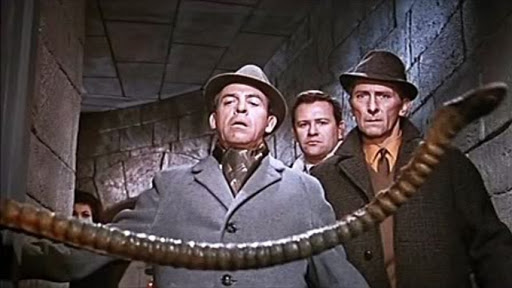
After a death-by-flare-gun incident and a fatal shark attack, Lansen’s lifeboat becomes ensnared in a mass of killer seaweed, and the boat eventually drifts back to the still-afloat Corita, which is also surrounded by the almost sentient weed. Lansen and the others climb back aboard the tramp steamer as it floats towards a mysterious, seaweed-festooned ship’s graveyard littered with vessels from different time periods, including a Spanish galleon. In this mysterious, fog-shrouded zone of the Sargasso Sea, the protagonists will encounter weird monsters, the descendants of conquistadores & the Spanish Inquisition, fur-clad barbarian-types (working for the Spanish) and a young woman called Sarah (Dana Gillespie), who traverses the weed-scape using buoyancy balloons and snowshoe-type footwear!
Ship’s graveyard
As you can see by the above synopsis, THE LOST CONTINENT is a truly oddball, pulpy Hammer production. The film, directed by Michael Carreras, begins with an incongruously apt jazzy-lounge-pop theme tune by The Peddlers, then maybe spends too much time in the earlier part of the story delving into the melodramatic lives of the dubious passengers on board the tramp steamer. However, once the mutiny happens and the weed appears, this movie becomes luridly enjoyable!
Suzanna Leigh publicity shot
‘Uncharted Seas’, the original Dennis Wheatley novel that THE LOST CONTINENT is based on, is nowhere near as enjoyably madcap as the movie adaptation: in the book the villains are descendants of slaves, whilst the movie boasts marooned conquistadors and their boy leader who, under the influence of his Spanish Inquisition mentor, feeds people who fail him to a rubbery Lovecraftian weed-monster in the hold of his stranded galleon!
The Inquisition likes very pointy hats!
Leper-faced Spanish Inquisition dude!
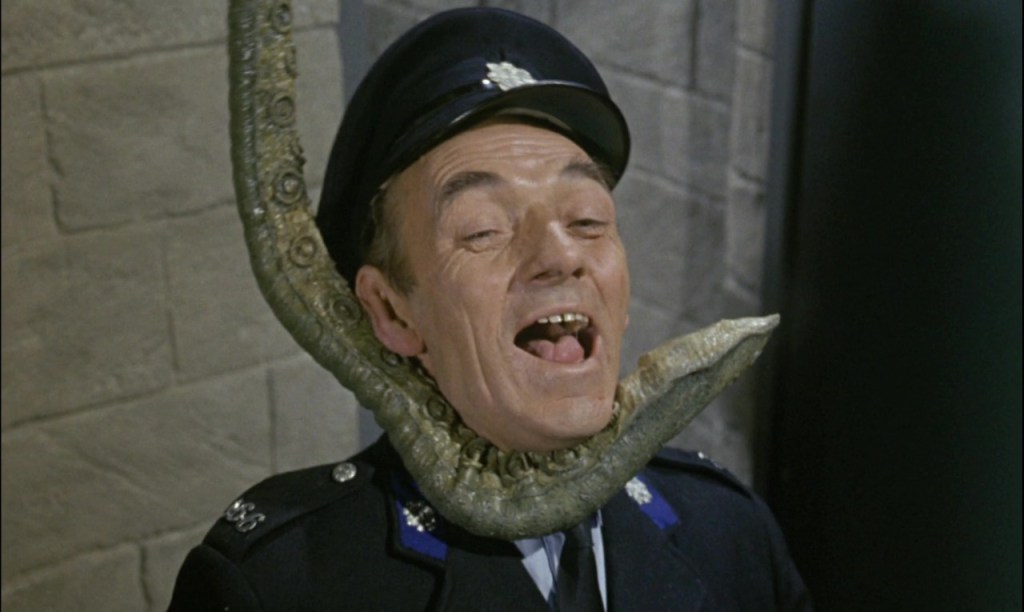
The movie is purely set-based (apart from some Canary Islands landscape stock footage taken from ONE MILLION YEARS BC used during the credits), which gives the production a heightened sense of pulpy artifice, the whole cast takes the production very seriously, with Eric Porter on fine form as the captain and, oh yes, as mentioned earlier, you also get Dana Gillespie trudging across the surface of the weeds with the help of her harness of helium balloons! Suzanna Leigh adds more Hammer glamour and gets attacked by a tentacled, cyclopean octo-thing that leaves her covered in slime. Weed-festooned madness!
Octo-beast attack!
As this blog is called Monster Zone, we’d better talk a little more about the monsters…
Watch out for the weed!
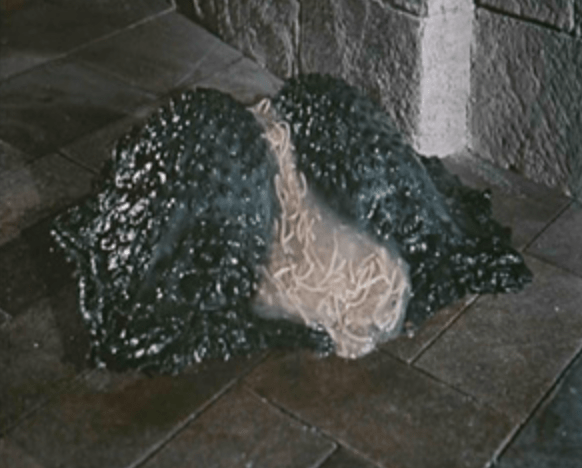
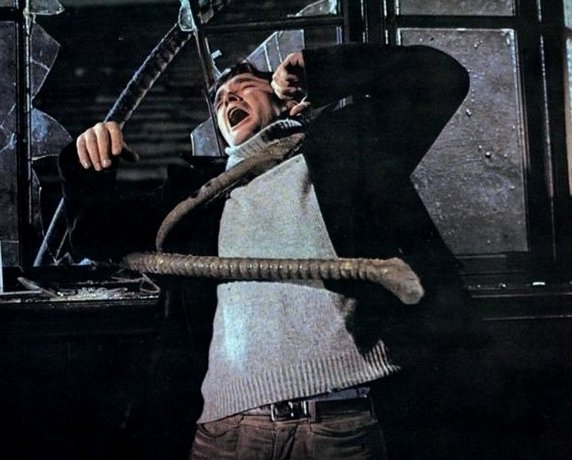
There are actually several types of weed in the film: the constricting seaweed that entraps vessels in the nicely-done, misty ship’s graveyard, there’s a more mobile weed-plant (with flowers) that gets into the ship via a porthole later in the story and, best of all, there’s the aforementioned plant-fungi thing that the Spanish Inquisition keeps in the hold of the galleon to gobble up people who displease them!
The plant-thing in the Spanish galleon
Robert Mattey’s creatures are criticised very often in reviews, and there’s no denying the glowing-eyed octo-creature is a bit iffy, though it does nicely exude green ooze from its severed foam tentacles.
Behind the scenes shot of the cyclopean octopus creature
The fight between a giant scorpion and a giant hermit crab on a small, rocky isle is pretty cool. These arthropod beasts are brought to life via full-scale mechanical models that I think look okay: I like the scorpion’s rapidly moving legs when it zips towards the crab to battle it. Though the full-scale hermit crab monster is less than mobile as a whole, it’s facial movements are really impressive: when you get a close-up of its rapidly chattering, beaky face I think it looks pretty good.
Giant hermit crab vs giant scorpion!
Close-up of the hermit crab’s face
Though I admit the film would definitely have benefitted from stop-motion critters (as, say, featured in Hammer’s ONE MILLION YEARS BC), this fog-enshrouded production is a sweaty, colourful, bizarre, pulp adventure treat.
Tentacles everywhere!
Various posters and promotional art
Tom Chantrell pre-production artwork
Possibly rough artwork design for a proposed Hammer promotional flyer by Tom Chantrell
August 1968 issue of ‘ABC Film Review’
Dana Gillespie and the giant scorpion pose for a publicity photo
Another Dana Gillespie promotional shot
If you’ve not already seen this movie, please search it out, I’m sure you’ll have a fun time viewing it.
Three astronauts are exposed to a blast of cosmic radiation during a space mission, which kills two of them. Colonel Steve West (Alex Rebar) survives but, back on Earth in a hospital, his flesh begins to melt. West loses his mind and escapes the hospital after killing a nurse, going on a killing spree, consuming flesh to inhibit his melting, slightly radioactive flesh.
Maybe he shouldn’t look under the bandages…
Scientist Dr. Ted Nelson (Burr DeBenning), a friend of West, starts searching for the melting man, helped first by General Perry and then by Sheriff Blake, following the trail of bodies and finally confronting West at a power station.
French poster
With a plot similar to FIRST MAN INTO SPACE (1959), this film hardly boasts the best dialogue or acting you’ll ever see, but it IS a schlocky sci-fi horror pic that makes up for its so-so storyline with some fine, gooey, gory practical FX by Rick Baker.
Severed ear in a bush!
Severed arm on the floor!
I first saw this film in the cinema as a teenager (in a double bill with THE SAVAGE BEES) and I loved all the gore, such as the severed fisherman’s head popping open in slow motion at the bottom of a waterfall. I enjoyed the film so much that I went back with my cousin to watch it again in the theatre that week – and, I guess, I have retained a soft spot for this pic ever since.
Savage Bees/Incredible Melting Man double bill UK quad poster
A fisherman’s head floats toward a waterfall…
It is definitely Rick Baker’s work that makes THE INCREDIBLE MELTING MAN worth viewing. I own Arrow Video’s high Definition Blu-ray release and it is great to watch Baker’s slimy creation shamble about the countryside in such a hi-def print.
Arrow Video Blu-ray
In one of the extras on the Blu-ray, Rick Baker remembers quoting quite a high price to do the effects because he wasn’t sure he should be doing this film (it was originally titled THE GHOUL FROM OUTER SPACE) after working on bigger budgeted films like KING KONG (1976) – but his quote was accepted so he made the film. Result!
His flesh keeps on liquifying!
If you are tolerant of a meandering storyline (probably made worse due to post-production reshoots), you will find a bunch of scenes to enjoy, such as the moment one of the melting man’s severed, radioactive ears is found hanging in a bush and the final scene, where the titular tragic character liquifies into a messy, bloody puddle on the floor that gets swept into a garbage can by an oblivious janitor!
At one point the creature is captured, at least for a while…
An expedition heads into the Amazon jungle after the discovery of a skeletal fossil hand that seems to be an example of a missing link between sea and land creatures…
The webbed claw!
The expedition team, aboard the steamer Rita, speculate that the rest of the fossil skeleton could be located downriver, so they sail along a tributary that leads them to a lagoon…
…the Black Lagoon!
Once they are anchored in this mysterious stretch of water the team go diving and finally realise there is a living, breathing prehistoric, amphibious, humanoid Creature lurking nearby. And now the fun really starts!
The Creature comin’ at ya!
Director Jack Arnold’s creature feature has lots of poking-at-the-lens moments that reflect the fact the film was shot in 3D (I once saw a 3D print of the film at a screening at my college and there were lots of shots of spearguns and claws looming at the screen!)
The gill-man’s claw reaches into a tent… in 3D!
The story is pretty straightforward: scientists go hunting for missing link fossils in the Black Lagoon, the Creature attacks, they capture it, the gill-man escapes and tries to prevent them from leaving by blocking their escape with branches, the heroine gets abducted by the Creature, the rest of the team go to the rescue, etc. The very linear plot is fine, though, because it provides the foundation for a production that gels nicely and is endlessly enjoyable.
Julia Adams screams!
To begin with, the film is great to look at: the underwater photography is really well done, the gorgeous Julia Adams is, well, gorgeous, and the gill-man is a brilliant monster suit design.
Gill-man alert!
The way the Creature ‘gulps’ at the air when it is on land is impressive: it looks like a gasping fish, which is such a cool touch for a movie from this period. The ‘underwater ballet’ sequence, where the Creature shadows Julia Adams as she swims in the lagoon, is rightly considered a standout moment and is unlike pretty much anything else seen in similar 50s creature features.
The superb underwater swimming scene
The score is very bombastic which, added to the 3D-inspired photography, makes the film quite an in-your-face experience. Richard Carlson is a dependable leading man and Richard Denning, as Dr. Mark Williams, is a more interesting character, who vacillates between giving up the search early on when nothing is discovered to becoming overly obsessed with capturing or killing the Creature.
The Creature in motion
The Creature is one of my all-time favourite screen monsters and it was played by Ben Chapman on land and by Ricou Browning for the underwater shots. It really is an amazing man-in-suit creation.
Ben Chapman
Ricou Browning
There’s been a lot of recent interest shown in the origin of the design of the gill-man, with much being made of the fact that Milicent Patrick designed the approved Creature look, but her role was then downplayed by lead makeup artist Bud Westmore. This is a shame, though it’s great that Milicent is receiving her due now, thanks to the book ‘The Lady From the Black Lagoon’.
Milicent Patrick
The gill-man went on to appear in two sequels, REVENGE OF THE CREATURE (1955) and THE CREATURE WALKS AMONG US (1956), its influence has extended to the likes of Guillermo del Toro’s Oscar-winning homage THE SHAPE OF WATER (2017) and it really deserves its place in the line-up of classic Universal monsters.
Classic Universal monster line-up!
Pressbook cover
Webbed claw in lobby!
The Creature looms…
Swedish poster
French 1962 re-release poster
Belgian poster
Italian poster
Devoted to every kind of movie and TV monster, from King Kong to Godzilla, from the Blob to Alien. Plus monsters from other media too, including books and comics.